

What Is Vendor Management Process A Strategic Guide
Discover what is vendor management process and how to build a system that strengthens supplier relationships, reduces risk, and drives business growth.

Tired of nonsense pricing of DocuSign?
Start taking digital signatures with BoloSign and save money.
The vendor management process is the strategic playbook your business uses to handle suppliers, from the first handshake all the way to a potential offboarding. It’s a systematic way of handling everything involved: selecting vendors, negotiating contracts, keeping costs in check, managing risks, and making sure they deliver on their promises.
Think of it less like paperwork and more like building and managing a high-performance team of external partners to help you win.
Building Your External Dream Team
At its core, vendor management is a strategic function that directly impacts your bottom line, operational efficiency, and even your brand's reputation. It’s not just about administration.
Imagine you're the general manager of a professional sports team. You don't just sign any player who shows up. You scout talent, negotiate contracts that fit the team's budget, and constantly monitor performance to build a championship roster.
That's exactly how you should think about your vendors. They are an extension of your team. Whether it’s a logistics partner in the UAE ensuring your products arrive on time, a healthcare tech provider in the US handling sensitive patient data, or a staffing agency in Canada supplying critical talent—their performance is your performance. A strong process ensures every single partner is a valuable player. To get the full picture, it's helpful to see how this fits into the broader world of procurement, like in Mastering the Government Procurement Business Process.
Why A Formal Process Matters
Without a structured approach, vendor relationships can easily become chaotic. You're left dealing with inconsistent performance, missed deadlines, and risks you never saw coming. A formal process brings order and predictability, unlocking several key benefits:
- Cost Control: It gives you a framework for negotiating better terms and spotting opportunities for savings. No more surprise invoices or unnecessary spending.
- Risk Mitigation: By formalizing your due diligence and compliance checks, you can identify and manage legal, financial, and cybersecurity risks before they blow up.
- Improved Performance: When expectations are clear and you have regular performance reviews, vendors are held accountable for meeting their contractual obligations.
- Stronger Partnerships: A transparent and professional process builds trust. It’s how you turn transactional, arms-length relationships into strategic, long-term partnerships.
A well-defined vendor management process is the blueprint for creating a resilient, efficient, and high-performing supply chain. It turns potential liabilities into strategic assets that drive business growth.
This guide will break down the entire vendor management lifecycle, from the first sourcing call to the final offboarding. We'll explore how modern tools like BoloSign can automate and secure critical steps, especially around contract management and onboarding.
With BoloSign's AI-powered automation, businesses can create, send, and sign vendor agreements, NDAs, and compliance forms in an instant. Its affordable, fixed-price model for unlimited documents and team members makes enterprise-grade efficiency accessible to everyone—from professional services firms in Australia to educational institutions in New Zealand.
Navigating The 6 Stages Of Vendor Management
A solid vendor management process isn't just a checklist; it's a strategic journey. Think of it as a roadmap that guides every supplier relationship from the first handshake to the final invoice. When you get each phase right, you build consistency, slash risks, and turn your supply chain into a genuine competitive advantage.
And this journey is more critical than ever. The global vendor management software market was valued at around USD 5.7 billion in 2024 and is expected to hit USD 17.15 billion by 2030. That explosive growth tells a clear story: businesses are waking up to the urgent need to manage suppliers, stay compliant, and keep risks in check.
Let's walk through the six stages that form the backbone of any successful vendor management lifecycle.
Stage 1: Vendor Sourcing And Selection
This is the scouting phase. It all starts when you identify a business need—then the hunt begins for vendors who can fill it. The goal here is to cast a wide net to find potential partners, then methodically narrow down your options.
You'll create a shortlist based on initial criteria like industry reputation, core capabilities, and early cost estimates. Remember, this isn't about finding the cheapest option. It’s about finding the right fit for your specific needs.
Stage 2: Due Diligence And Qualification
Once you have a shortlist, it's time to dig deeper. This due diligence phase is where you manage risk head-on. You’ll rigorously evaluate each potential vendor’s financial stability, security posture, and compliance track record.
Key activities in this stage include:
- Financial Health Checks: Looking at their financial statements to make sure they're stable enough to be a reliable partner for the long haul.
- Security Audits: Assessing their cybersecurity protocols, especially if they’ll be handling sensitive data. This is non-negotiable in sectors like healthcare that must follow HIPAA.
- Reference Checks: Actually talking to their current or past clients to get an honest take on their performance and reliability.
- Compliance Verification: Making sure they meet all relevant industry and regional regulations, like GDPR or eIDAS.
This step is designed to weed out vendors that pose an unacceptable risk, protecting your business from legal, financial, or reputational damage down the road.
Stage 3: Contracting And Negotiation
This is where the relationship gets real—defined on paper and solidified legally. After picking the best-fit vendor, you move into negotiations to nail down terms, pricing, Service Level Agreements (SLAs), and deliverables. The goal is a win-win contract that's clear, fair, and comprehensive.
But this stage is often a huge bottleneck. Manual reviews and endless back-and-forth emails can stretch timelines from days to weeks, slowing everything down.
With BoloSign’s AI contract review, your legal and procurement teams can instantly analyze vendor contracts, flagging risky clauses, identifying missing protections, and suggesting alternative language. This AI-powered automation dramatically cuts down review time while strengthening your negotiating position.
Once everyone agrees on the terms, it's time to sign. Instead of the old-school print, scan, and mail routine, a digital signing solution gets it done in minutes. With BoloSign, you can securely send the final agreement for eSignature, creating a legally binding record that complies with the ESIGN Act and other global standards.
The diagram below shows how a well-structured process helps businesses nail key goals like controlling costs, minimizing risk, and forging strong partnerships.
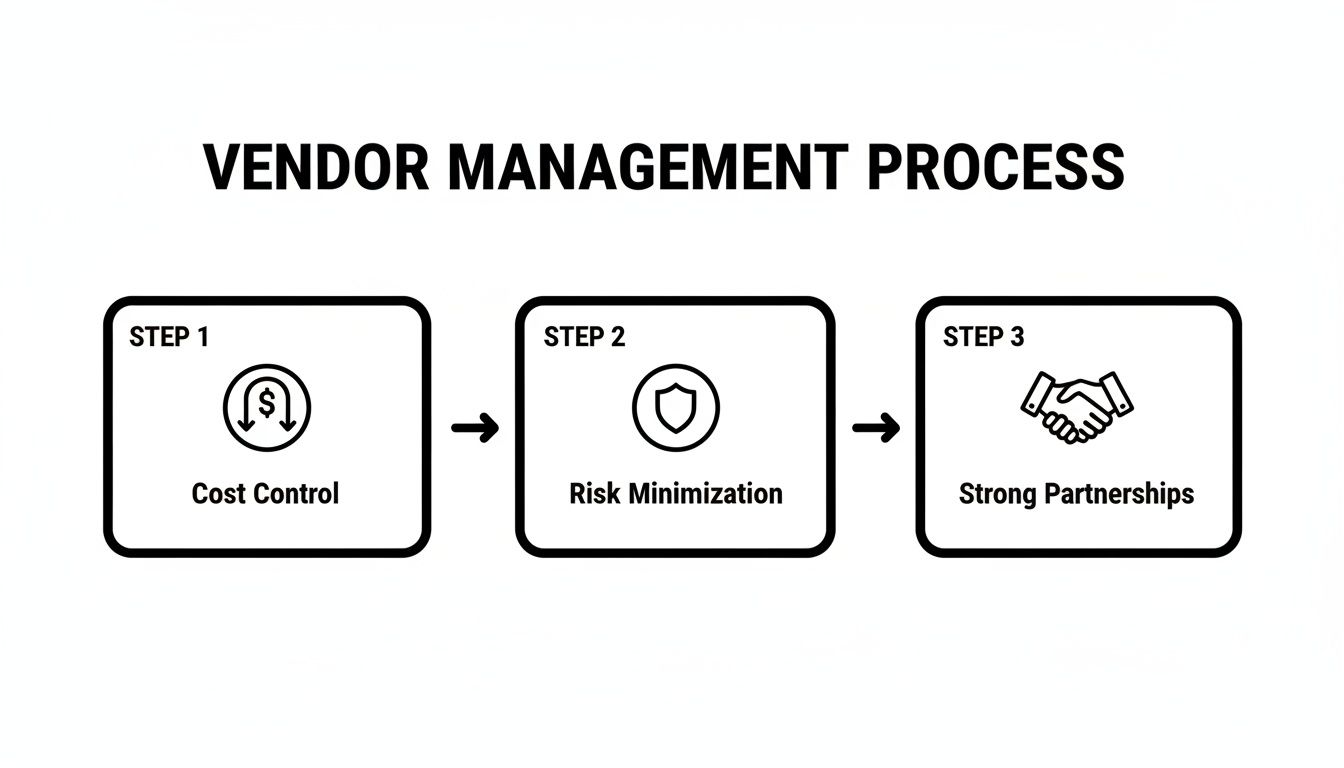
This visual reinforces that every step in the process is there for a reason—to strategically strengthen the business’s operational and financial health.
Stage 4: Vendor Onboarding
With a signed contract in hand, the vendor is officially a partner. Now comes onboarding, which is all about integrating them smoothly into your operations. A messy, disorganized onboarding can create confusion, cause delays, and get the relationship off to a rocky start.
A great onboarding process gives the vendor everything they need to start delivering value right away. This means collecting all their essential paperwork and granting them access to the necessary systems.
For example, a professional services firm can use BoloSign to create a standardized onboarding packet. A template can bundle NDAs, compliance forms, and bank detail requests into a single, easy-to-manage package. The new vendor can sign PDFs online instantly, and all the documents are automatically filed away in a secure, central location. For a deeper dive, check out our guide on vendor onboarding best practices.
Stage 5: Performance Management And Monitoring
The work doesn’t stop once the vendor is onboarded. This stage is all about continuously monitoring their performance against the KPIs and SLAs you defined in the contract. You have to make sure they're consistently meeting expectations.
Regular performance reviews, data analysis, and open communication are crucial. For a logistics company, that might mean tracking on-time delivery rates. For a staffing agency, it could be measuring the quality of candidates. This proactive approach helps you spot and fix small issues before they blow up into major problems.
Stage 6: Renewal Or Offboarding
As a contract nears its end, you’ll face a big decision: renew the agreement or part ways. This decision should be driven by data, based on all the performance monitoring you did in the previous stage.
If the partnership was a success, you'll enter renewal negotiations. If not, a formal offboarding process is essential. This ensures a smooth transition, the secure return of any company assets or data, and the final payment of all invoices. A proper offboarding protects your organization from lingering risks and keeps things professional, even when a contract ends.
Key Roles And Responsibilities In Vendor Management
A successful vendor management process isn't the job of one person or even one department; it's a team sport. When different business functions work in concert, the process transforms from a series of disjointed tasks into a smooth, strategic operation. When roles are clear and communication is open, you eliminate bottlenecks and create a system where everyone is working toward the same goals.
This cross-functional approach ensures every angle is covered—from legal risk and financial impact to day-to-day operational needs. Think of it like a well-oiled machine where each part knows its function and works in sync with the others.
The Core Players On The Field
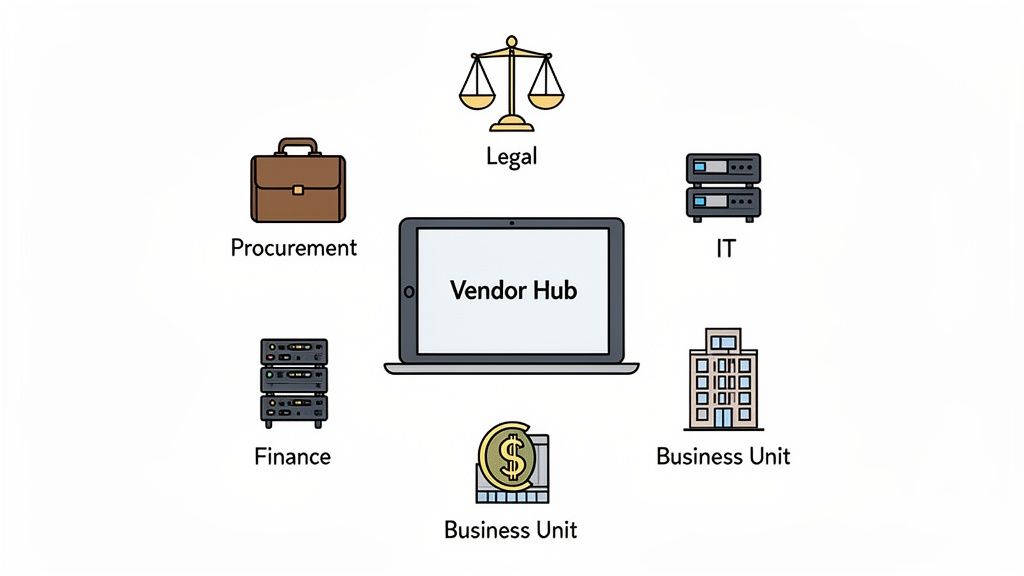
Several key departments form the backbone of any strong vendor management team. Each brings a unique expertise and set of responsibilities to the table, making the entire process comprehensive and secure.
- Procurement Team: Often leading the charge, procurement is responsible for sourcing vendors, negotiating pricing, and managing contracts. They’re the primary point of contact focused on securing the best possible value.
- Legal Department: As the guardians of compliance, the legal team drafts, reviews, and approves all vendor contracts. They make sure agreements are legally sound, protect the company from liability, and comply with regulations like GDPR and HIPAA.
- Finance Department: This team holds the purse strings. They manage the budget, process vendor payments, and track financial performance to ensure partnerships remain viable and vendors are paid on time.
- IT and Security Teams: In our connected world, these teams are critical. They are responsible for assessing a vendor's cybersecurity posture, evaluating data security protocols, and managing system access to protect sensitive information.
- Business Unit Owners: These are the people on the ground—the department or team that will actually use the vendor's product or service. Their input is vital for defining requirements and evaluating how a vendor performs against real-world needs.
Unifying The Team With A Single Source Of Truth
The biggest challenge for this cross-functional team is almost always communication and visibility. Information gets siloed. Legal has one version of a contract, procurement has another, and the business unit owner is working off an old email chain. This creates confusion, delays, and unnecessary risk.
This is where a unified platform becomes a game-changer.
BoloSign acts as the central hub—the single source of truth—where every stakeholder can collaborate in real-time. It breaks down departmental walls and creates a transparent, efficient workflow that connects everyone involved in the vendor management process.
Picture this in a real estate agency: The legal team pre-approves contract templates directly within BoloSign. The operations manager then grabs one of these templates to negotiate with a new marketing vendor, confident they are operating within safe legal boundaries.
Once the agreement is finalized, it's sent for an eSignature and is instantly accessible to the finance team. They can then trigger the initial payment without ever having to chase down a paper copy. This seamless integration of a contract automation platform turns siloed departments into a cohesive vendor management engine, ensuring everyone is on the same page from start to finish.
This kind of connected workflow is made affordable with BoloSign’s fixed-price model, which offers unlimited documents and team members. This allows organizations to apply best practices across their entire vendor ecosystem—not just a select few—making it up to 90% more affordable than alternatives like DocuSign or PandaDoc.
Measuring Success With The Right KPIs
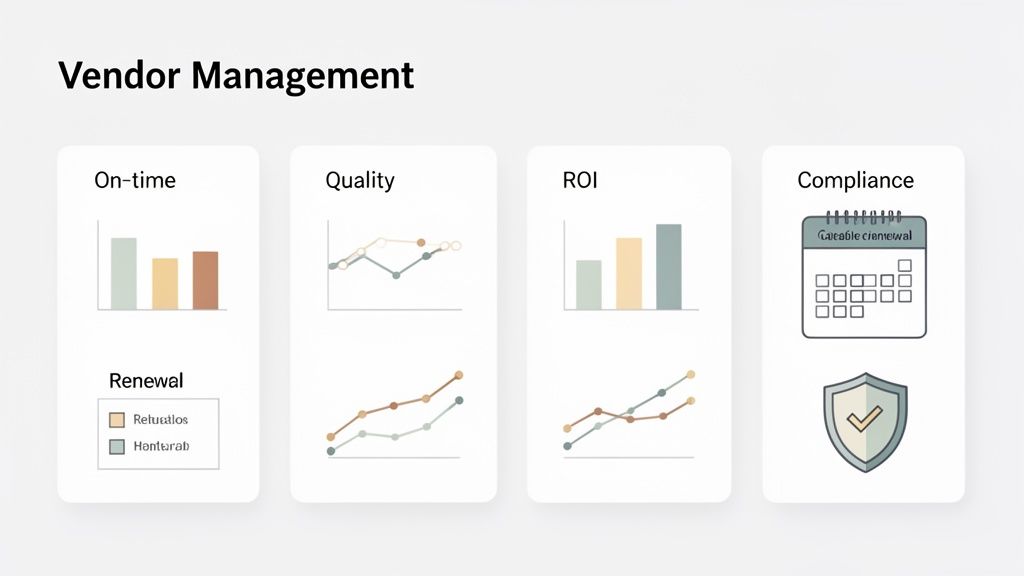
How do you know if your vendor management process is actually working? Sure, cost savings are a big part of it, but that number doesn't tell the whole story. A truly solid program depends on a balanced set of Key Performance Indicators (KPIs) that track everything from quality and efficiency to risk and financial return.
When you start tracking the right metrics, you shift from reactive fire-fighting to proactive, data-driven management. Instead of just putting out fires as they pop up, you can spot trends and fix potential issues long before they ever hit your bottom line.
Performance and Quality Metrics
These KPIs get right to the point: are your vendors delivering on their promises? Think of them as the frontline indicators of whether a partner is meeting your day-to-day operational needs.
- On-Time Delivery Rate: For a logistics company in Australia, this is everything. It measures the percentage of goods or services delivered by the agreed-upon deadline.
- Quality and Defect Rate: A healthcare provider in the US can't afford mistakes; supplied medical equipment must be flawless. This KPI tracks the percentage of products or services that meet your quality standards.
- Service Level Agreement (SLA) Adherence: This measures a vendor's ability to hit the specific performance targets in your contract, like system uptime or customer support response times.
Financial and ROI Metrics
Financial KPIs help you see the direct monetary value your vendors bring to the table. They make sure you're not just getting a service, but a service that makes good business sense. Key metrics include Total Cost of Ownership (TCO), which looks beyond the sticker price to include maintenance and support costs, and Return on Investment (ROI), which calculates the overall profitability of the relationship.
Risk and Compliance Metrics
Perhaps the most critical KPIs are the ones that keep an eye on risk. A vendor who performs well but exposes you to compliance violations is a massive liability waiting to happen.
Monitoring risk isn't a one-time check during onboarding; it's a continuous process. Effective vendor risk management involves ongoing oversight to protect against legal, reputational, and financial damage throughout the contract lifecycle.
A few crucial risk KPIs to watch are:
- Compliance Adherence: This tracks whether a vendor consistently meets regulatory requirements like HIPAA, GDPR, or eIDAS.
- Contractual Obligation Tracking: Are they actually doing everything they agreed to in the contract? This is where manual tracking falls apart.
This is exactly where BoloSign’s contract intelligence becomes essential. The platform automatically pulls and tracks critical dates and obligations directly from your signed agreements. You can set up automated alerts for key renewal dates, compliance milestones, and performance reviews. This lets your team manage by exception—focusing only on what needs attention—all while building a perfect audit trail for every single vendor.
See how our AI contract review can automatically identify these obligations right from the start.
Essential Vendor Management KPIs By Category
To build a comprehensive view, it's helpful to organize your KPIs by the business function they support. This ensures you're not just tracking one area, like cost, while ignoring equally important factors like risk or performance.
| Category | Example KPI | What It Measures |
|---|---|---|
| Operational Performance | On-Time Delivery Rate | The percentage of deliveries that arrive on or before the promised date. |
| Quality & Service | Defect Rate | The percentage of products or services that fail to meet quality standards. |
| Financial Health | Total Cost of Ownership (TCO) | The full cost of the vendor relationship, including hidden operational expenses. |
| Risk & Compliance | Compliance Adherence Score | A score indicating how well a vendor meets key regulatory requirements (e.g., HIPAA, GDPR). |
| Relationship Health | Vendor Satisfaction Score | Feedback from internal stakeholders on their experience working with the vendor. |
This balanced approach gives you a complete, 360-degree picture of your vendor ecosystem.
By combining performance, financial, and risk metrics, you get a full picture of your vendor landscape, empowering you to make smarter, faster decisions that protect and grow your business.
Overcoming Common Vendor Management Challenges
Even a perfectly designed vendor management process hits bumps in the road. You’ll run into everything from disorganized paperwork to sudden supply chain disruptions, and each one can introduce risk and drag down efficiency. But with the right approach, you can turn these common roadblocks into opportunities to build a stronger system.
The trick is to shift from being reactive—putting out fires as they pop up—to being proactive. That means anticipating where things might go wrong and building a resilient framework to handle the unexpected. Let's dig into some of the most frequent headaches and how to solve them.
The Black Hole Of Contract Management
One of the biggest hurdles we see is the simple lack of visibility into vendor contracts. Agreements get lost in email threads, saved on scattered local drives, or completely forgotten until an auto-renewal notice blindsides the finance team. This chaos means missed deadlines, accidental non-compliance, and no real way to track if a vendor is even meeting their obligations.
This problem gets exponentially worse in fields like professional services or education, where a single organization might be juggling dozens or even hundreds of vendor agreements at once. Trying to track each one manually isn't just inefficient—it's a recipe for disaster.
A disorganized contract portfolio is a hidden liability. It obscures critical obligations, renewal dates, and compliance requirements, exposing your organization to unnecessary financial and legal risks.
BoloSign solves this by creating a secure, central home for all your vendor contracts. Every single agreement, from the first draft to the final eSignature, lives in one easy-to-access place. Better yet, its AI-powered automation turns those static documents into active assets, automatically flagging key dates and obligations so nothing ever falls through the cracks again.
Inconsistent And Slow Vendor Onboarding
Another classic pain point is a messy, manual onboarding process. When every department has its own "way" of bringing on new suppliers, the experience is chaotic for everyone. Vendors get asked for the same information three times, critical compliance forms get missed, and the whole process takes far longer than it should.
This inconsistency creates serious compliance gaps. Imagine a US-based healthcare provider forgetting to get a signed Business Associate Agreement (BAA) from a new tech vendor. That one slip-up could lead to massive HIPAA violations. A standardized workflow isn’t a nice-to-have; it’s a must-have.
BoloSign cuts through the chaos with reusable templates. You can build standardized onboarding packets that bundle every necessary form—NDAs, compliance questionnaires, banking details—into a single package. A new logistics partner in Canada can get the packet, fill out the forms, and sign PDFs online in a matter of minutes, not days.
This ensures every vendor goes through the exact same compliant process, giving you a consistent and auditable record from day one. To learn more about building a solid system, check out our guide on creating a vendor risk management framework.
The High Cost Of Effective Management
For a long time, powerful vendor management tools were so expensive that most businesses could only afford to use them for their top-tier, strategic suppliers. The other 80-90% of vendors were managed with a patchwork of spreadsheets and emails, leaving the company exposed to a huge amount of "long-tail" risk.
This is where affordability becomes a game-changer. BoloSign’s fixed-price model breaks down that cost barrier, offering unlimited documents, templates, and team members for up to 90% less than platforms like DocuSign or PandaDoc. It lets you deploy an enterprise-grade digital signing solution across your entire vendor ecosystem, ensuring every partnership is managed with the same rigor.
As global supply chains get more tangled, the need for these kinds of solutions is only growing. The vendor risk management market is expected to jump from USD 10,671.1 million in 2024 to USD 24,953.3 million by 2030, with the Asia-Pacific region leading the way. You can dig into more insights on this trend over at mordorintelligence.com. This shift shows that comprehensive vendor oversight is quickly becoming standard practice for smart businesses everywhere.
Modernize Your Vendor Workflow With BoloSign
We’ve walked through what it takes to build a solid vendor management process, but now it’s time to make it real. Your vendor workflow doesn’t have to be a tangled mess of spreadsheets, email chains, and manual reminders. With the right tools, you can turn the most painful stages into a smooth, secure, and clear operation.
BoloSign is built to fix the document-heavy parts of the vendor lifecycle. From the moment you draft a contract to the day you onboard a new partner, our platform brings much-needed speed and intelligence to the table. For a solid foundation, think about using a good workflow documentation template to map out these improvements.
Unify Your Process With AI and Automation
Imagine a world where contract reviews that used to take weeks are finished in minutes. That’s what our AI-powered automation does. It helps your legal and procurement teams instantly scan agreements, flag potential risks, and check for compliance with standards like HIPAA and GDPR.
Once everyone’s on the same page, our legally binding eSignature solution gets contracts executed in a single click. This is how you build a resilient supply chain—by giving your team tools that actually work.
- Create and Send Instantly: Use pre-built templates for NDAs, compliance forms, and service agreements to create standardized vendor packets in seconds.
- Sign From Anywhere: Whether your vendors are in the US, Canada, Australia, or the UAE, they can sign PDFs online from any device, closing deals faster.
- Centralize and Secure: Every signed document is automatically stored in one secure, searchable place. See why this matters in our guide to contract repository management.
Enterprise-Grade Power Without The Enterprise Price Tag
We believe a strong vendor process shouldn't be a luxury. BoloSign offers one fixed price for unlimited documents, templates, and team members, making our platform up to 90% more affordable than alternatives like DocuSign or PandaDoc. You get enterprise-level contract intelligence and compliance without the restrictive per-user or per-document fees that kill your budget.
Ready to see how simple and affordable a modern vendor workflow can be? Start your 7-day free trial and experience BoloSign for yourself.
Got Questions? We've Got Answers
Here are a few quick answers to the common questions we hear about building a solid vendor management process.
What Is The Most Critical Stage In The Vendor Management Process?
Every step matters, but if we had to pick one, it’s the contracting and onboarding stage. This is where the rubber meets the road—where you legally define the relationship, set performance benchmarks, and lock down compliance needs. A weak contract or a messy onboarding is a problem that won’t show up until months later, when it’s much harder to fix.
Using a tool like BoloSign to nail this stage ensures every partnership starts on solid ground. With AI contract review, you can catch risky clauses before you sign, and our secure eSignature platform makes the whole process fast and legally sound. A strong start here prevents a world of headaches down the line.
How Can Small Businesses Implement A Vendor Management Process?
You don't need a massive budget to get started. Small businesses can make a huge impact just by standardizing their workflows. Begin by creating simple templates for the essentials: vendor applications, NDAs, and basic service agreements. The trick is to lean on affordable tools that can scale with you as you grow.
A platform like BoloSign is perfect for this. We offer unlimited documents, templates, and team members for one flat price, which makes a professional, automated process accessible. It’s how small businesses can manage vendors like an enterprise without the steep per-document or per-user fees you’d see from providers like DocuSign or PandaDoc.
How Does Vendor Management Software Help With Compliance?
Think of vendor management software as your single source of truth. It creates a centralized, auditable hub for every supplier interaction and document. The system ensures every vendor completes the necessary compliance paperwork (for rules like GDPR or HIPAA) right from the start, during onboarding. It also keeps an eye on key contract dates and gives you one secure place to find all your signed agreements.
Compliance is baked into the core of a platform like BoloSign. It’s built to adhere to major global standards like the ESIGN Act and eIDAS, so you know your digital signatures are secure and legally binding. This creates a clear, defensible audit trail for every vendor you work with, making compliance simpler and less risky.
Ready to build a vendor management process that's simple, secure, and won't break the bank? BoloSign gives you the AI-powered tools to handle contracts and compliance with total confidence. Start your 7-day free trial today to experience it firsthand.

Paresh Deshmukh
Co-Founder, BoloForms
3 Feb, 2026
Take a Look at Our Featured Articles
These articles will guide you on how to simplify office work, boost your efficiency, and concentrate on expanding your business.