

What is a Service Contract: A Practical Guide for Your Business
Discover what is a service contract and how it streamlines creation, signing, and management for your business.

Tired of nonsense pricing of DocuSign?
Start taking digital signatures with BoloSign and save money.
Ever hired a freelancer, onboarded a new vendor, or engaged a consultant? At its core, a service contract is the official handshake between a service provider and a client. Think of it as the blueprint for your professional relationship—it clearly lays out what work will be done, for how much, and by when.
This formal agreement is all about preventing misunderstandings. It defines the scope, sets clear expectations, and protects both parties before anyone invests time or money. It's a foundational document for industries ranging from staffing and healthcare to real estate and professional services.
Understanding the Core Purpose of a Service Contract

A service contract’s main job is to turn a verbal agreement into a legally sound business arrangement. It’s a binding document where a provider commits to performing specific services for a client over a set period.
The scale of these agreements is massive. The global contract logistics market, for instance, was recently valued at USD 324.6 billion in a single year and is only expected to grow. This shows just how vital these documents are across every industry, from logistics and healthcare to professional services and real estate. They establish the rules of engagement, making sure everyone is on the same page before the work begins.
Key Elements of a Standard Service Contract
A well-drafted contract serves several critical functions that build a strong foundation for any professional relationship. These components are crucial for minimizing risk and ensuring smooth operations.
Here's a quick breakdown of what goes into a typical service contract:
| Component | What It Defines | Why It Matters |
|---|---|---|
| Scope of Work | The exact services to be delivered, including specific tasks and deliverables. | Prevents "scope creep," where tasks expand beyond the original plan and budget. |
| Payment Terms | How and when the provider will be compensated—fixed fee, hourly rate, or milestone-based. | Ensures clear financial expectations and avoids disputes over invoices. |
| Timeline & Deadlines | The start date, end date, and key milestones for the project or service period. | Keeps both parties aligned on timing and helps measure progress. |
| Termination Clause | The conditions under which either party can legally end the contract. | Provides a clear, fair exit strategy if the relationship doesn't work out. |
| Confidentiality | How sensitive information shared between the parties will be protected. | Safeguards proprietary business information and builds trust. |
| Liability & Indemnity | Who is responsible if something goes wrong, and to what extent. | Limits financial and legal risk for both the provider and the client. |
Ultimately, this document is more than just a formality. It’s a proactive tool for managing relationships and heading off potential conflicts before they start. To learn more about what makes a contract legally sound, check out our guide on the core elements of a contract.
With modern tools like BoloSign, you can create, send, and get a secure eSignature on these agreements in minutes, removing friction from your most important business relationships.
The Essential Clauses Every Service Contract Needs
A strong service contract is really built on a handful of clear, non-negotiable clauses that protect both you and your client. Don't think of them as dense legal jargon; they're the ground rules for your professional relationship. Getting them right from the start is the best way to prevent disputes, manage expectations, and keep a project on track.
The absolute most critical piece is the Scope of Work. This is where you meticulously detail every service to be provided—specific tasks, deliverables, and milestones. For a real estate agency, this means defining if "property management" includes tenant screening, rent collection, and maintenance coordination. Vagueness here is the number one cause of disputes and surprise costs.
Next up, you need crystal-clear Payment Terms. This clause should spell out the cost, payment schedule (like an upfront deposit, monthly retainer, or milestone-based payments), and how you accept payment. It removes all the guesswork around compensation, ensuring you get paid on time for the work you do.
Protecting Your Business and Information
Beyond the core deliverables, a service contract has to safeguard your business interests. These protective clauses ensure your operations stay secure and your intellectual property is respected.
- Confidentiality: This legally binds both parties to protect any sensitive information shared during the project. For a healthcare consultant handling patient data, this is an absolute must-have for HIPAA compliance.
- Intellectual Property (IP) Rights: This clause defines who owns the final work product. A professional services firm, for instance, must clarify if the client owns the final report outright or is simply licensing its use.
- Termination Clause: This outlines the specific conditions under which either party can end the agreement. It provides a clear, fair exit strategy if the relationship isn't working out, preventing messy legal fights down the road.
Your AI-Powered Safety Net
Drafting contracts with perfect clauses can feel overwhelming, and one little mistake can create a big risk. This is exactly where BoloSign's AI contract review becomes an invaluable tool. Before a document ever goes out for a digital signing solution, our AI scans it to flag ambiguous language or point out missing critical clauses.
For example, if your termination clause is one-sided or your IP rights are poorly defined, BoloSign alerts you instantly. This automated safety net helps you reduce risk and negotiate from a position of strength, ensuring your agreements are solid before they're signed.
Additionally, clauses like the limitation of liability are crucial for managing potential financial risks. You can get a much deeper explanation of the limitation of liability clause in our detailed guide. Using BoloSign’s AI-powered automation ensures these essential protections are never overlooked, giving you peace of mind with every contract you create, send, and sign.
Common Types of Service Contracts Across Industries
Service contracts aren't a one-size-fits-all solution. They're designed to adapt to specific business relationships and projects, and picking the right one is crucial for setting clear expectations from day one.
Think of it like choosing the right tool for a job—you wouldn't use a sledgehammer to hang a picture frame. A simple, one-off project needs a very different contract than a complex, long-term partnership. The structure you choose lays the foundation for the entire engagement.
These agreements are the engines of countless industries, creating massive, measurable markets. For instance, the market for vehicle service contracts alone was valued at around USD 34.52 billion in a recent year. In the life sciences sector, the global contract research organization (CRO) services market hit an estimated USD 77.0 billion, proving how heavily specialized industries depend on outsourced, contract-based services. You can dig deeper into the full research about these market trends to see the scale.
To help you navigate this, let's break down the most common types you'll encounter.
Master Service Agreements and Statements of Work
For ongoing business relationships, the combination of a Master Service Agreement (MSA) and a Statement of Work (SOW) is incredibly popular—and for good reason. It’s efficient.
- Master Service Agreement (MSA): This is the "umbrella" agreement. It sets out all the general terms and conditions that will govern the long-term relationship, like confidentiality, payment terms, and liability. You negotiate this hefty document just once.
- Statement of Work (SOW): This is a much shorter, project-specific document that lives under the MSA. Each new project gets its own SOW, detailing the exact scope, deliverables, timeline, and cost.
Imagine a large logistics company hiring a staffing agency. They'll sign one comprehensive MSA to cover the legal basics. Then, for each new driver or warehouse worker placement, they simply issue a new SOW. This avoids renegotiating the core legal terms every single time, making the process faster for everyone. It's a common and effective approach when contracting with suppliers for recurring needs.
Service-Level Agreements and Maintenance Contracts
Other contracts are all about performance and ongoing support. A Service-Level Agreement (SLA) is a contract that defines the specific level of service a client can expect to receive. It’s all about metrics.
A logistics provider might use an SLA to guarantee 99.5% on-time delivery. A cloud software company could use one to promise 99.9% server uptime. These agreements aren't just promises; they often include penalties for failing to meet the targets, which gives them real teeth and holds vendors accountable.
The table below offers a quick comparison to help you distinguish between these key contract types at a glance.
Service Contract Types at a Glance
| Contract Type | Primary Purpose | Common Industries |
|---|---|---|
| MSA | Establishes the foundational legal terms for a long-term relationship. | IT Services, Consulting, Staffing, Marketing |
| SOW | Defines the scope, timeline, and deliverables for a specific project under an MSA. | Any industry using project-based work. |
| SLA | Sets measurable performance standards and penalties for a service. | Tech (SaaS, Hosting), Logistics, Telecom |
| Maintenance Agreement | Outlines terms for ongoing support, repairs, and updates for a product or system. | Software, Manufacturing, IT Hardware |
This table simplifies the core function of each agreement, helping you see which one best fits the nature of the services being provided.
No matter the type, every solid service contract is built on a few essential clauses that define the core of the deal.
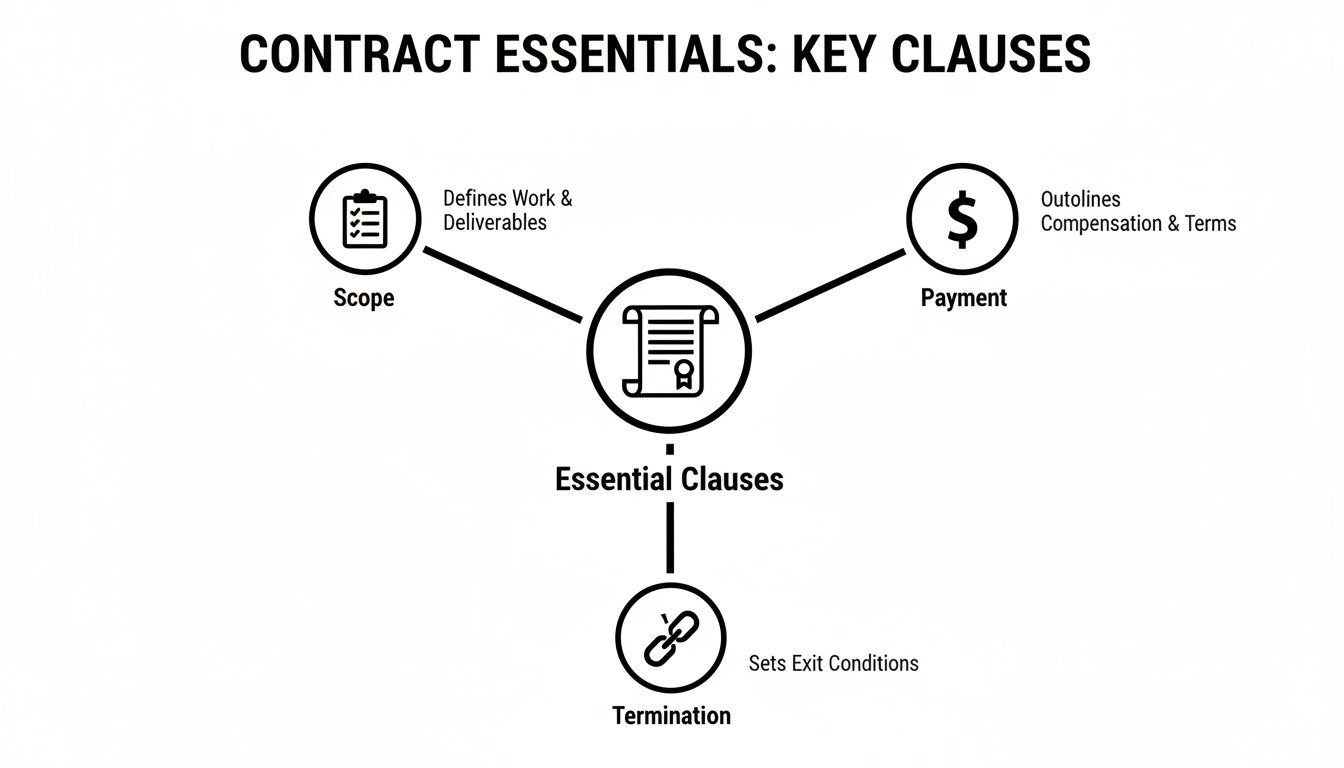
As the diagram shows, getting the scope, payment terms, and termination conditions right is fundamental to creating a reliable and fair agreement for both parties.
With BoloSign, you can create unlimited templates for your MSAs, SOWs, and SLAs, ensuring every contract is consistent and compliant. Whether you're in real estate or healthcare, you get all this at one fixed price, making it up to 90% more affordable than per-document platforms like DocuSign or PandaDoc.
Modernizing Your Agreements with AI and Automation
Let’s be honest: manual contract processes are a drag on growth. We’ve all been there—the slow drafting, the endless email chains for approval, and the constant fear of a missed deadline. Chasing signatures and manually tracking where a document is in the pipeline burns valuable time that should be spent serving clients.
The modern answer is to embrace contract automation. This isn't just about moving faster; it's about transforming a frustrating administrative task into a real strategic advantage.
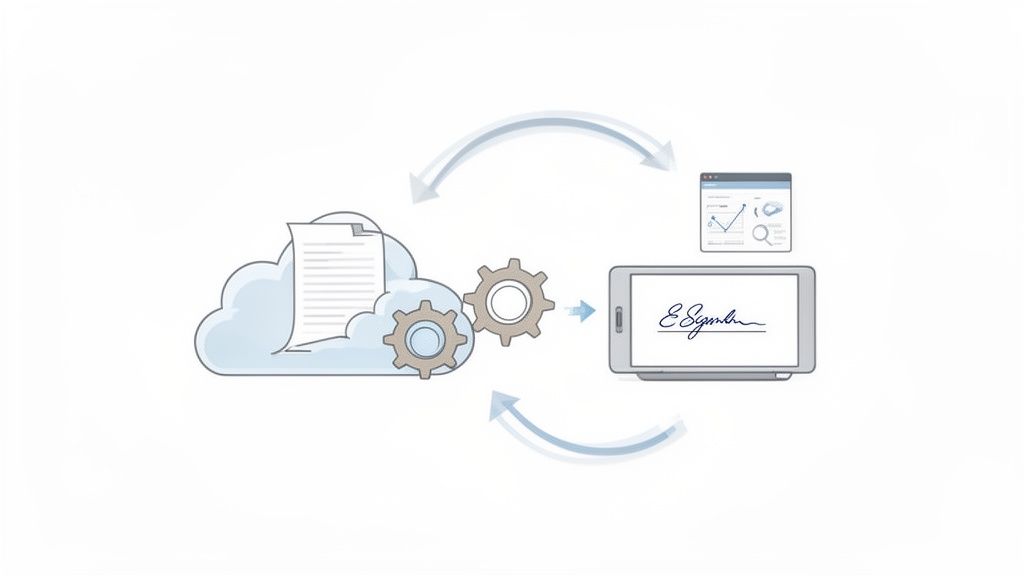
This shift is driven by secure, legally-binding technology. Before you can fully modernize your service agreements, it’s worth taking a moment to understand what an e-signature is and how it provides both speed and security.
How BoloSign Streamlines Your Workflow
Imagine turning your most-used service agreement into a reusable template that’s ready to send for an eSignature in seconds. That’s not a far-off goal; with BoloSign, it’s your daily reality. Our platform is built from the ground up to eliminate friction at every stage of the contract lifecycle.
- Create Instantly: Build a library of unlimited templates for your go-to agreements, like MSAs or SOWs. When a new deal comes up, you can generate the contract in just a few clicks.
- Send Securely: Get the contract out to every stakeholder at the same time for signing. You can sign PDFs online without touching a printer, scanner, or envelope.
- Track Everything: A central dashboard gives you a live view of every contract's status. See who has opened it, who has signed, and automatically nudge anyone who’s holding up the process.
This is about reclaiming countless hours. For a staffing agency, that means placing candidates faster. For a healthcare provider, it means onboarding new service partners with full compliance and far less paperwork.
The Power of AI in Contract Management
Beyond just automating the workflow, BoloSign brings AI-powered contract intelligence into the mix. Think of it as an intelligent layer that helps you draft stronger agreements and spot risks before a contract ever goes out the door.
Our AI contract review scans documents for missing clauses, vague language, or terms that don’t match your company’s standards. It’s like having a digital safety net, making sure every service contract is solid and protects your interests.
This AI-driven analysis helps you create, review, and negotiate with much more confidence. By combining powerful automation with smart insights, BoloSign delivers a complete digital signing solution designed for how modern business actually works. It's a smarter way to manage the agreements that fuel your revenue.
The best way to see the difference is to try it. You can explore just how simple and affordable modern contract management can be with a 7-day free trial of BoloSign and experience BoloSign firsthand.
Making Sure Your Service Contracts Are Secure and Compliant
When you're dealing with digital agreements, security and legal validity aren’t just nice-to-haves—they're the whole point. Sending a service contract is about more than speed; it's about creating a rock-solid, legally defensible record that protects your business. A casual email exchange or an unsecured signature process can leave you wide open to disputes and compliance headaches down the road.
This becomes especially true for companies operating across borders or in regulated industries like healthcare and finance. You absolutely have to know that your digital signing solution meets established legal standards.

Staying on the Right Side of Key Compliance Standards
Getting a handle on the rules that govern electronic agreements is the first step to protecting your organization. While the legalese can feel a bit dense, all these regulations share a common goal: making sure an electronic contract is just as valid as a paper one.
Here are the major players you need to be aware of:
- ESIGN Act (U.S.): The Electronic Signatures in Global and National Commerce Act is the landmark U.S. law that gives electronic signatures the same legal weight as their handwritten counterparts. It’s the foundation for digital contracts nationwide.
- eIDAS (EU): This regulation creates a consistent legal framework for electronic identification and trust services across the entire European Union. It's what makes cross-border business in the EU simpler and more secure.
- HIPAA (U.S. Healthcare): The Health Insurance Portability and Accountability Act imposes strict rules for protecting sensitive patient health information. If you're a service provider in the healthcare world, this is non-negotiable.
- GDPR (EU): For any service contract that involves handling the personal data of EU citizens, sticking to robust privacy frameworks like GDPR compliance is absolutely essential for maintaining trust and avoiding massive fines.
Using a platform that was built from the ground up with these standards in mind isn't just a good idea—it's a critical part of your risk management strategy.
Think about the sustainable energy sector, where long-term contracts are the norm. New energy service company (ESCO) projects recently saw investments totaling USD 15.7 billion globally, with the U.S. alone accounting for about USD 10.66 billion. These are complex, multi-year deals that bundle investment with performance guarantees, underscoring just how vital secure and compliant contract frameworks are. You can find more details on this growing market at unepccc.org.
At BoloSign, we built our platform on a foundation of security that adheres to these international eSignature laws. For every single document you send, we generate a legally binding audit trail that tracks every action—from the moment it's opened to the exact time and location it was signed. This gives you the peace of mind that your signed service contracts are not just convenient, but truly robust and defensible.
Making Service Contracts Work for You with BoloSign
Understanding the theory behind a service contract is one thing. Putting it into practice efficiently is what actually moves your business forward. It’s time to stop chasing paperwork and start focusing on what you do best: delivering value.
A smart, modern process turns administrative headaches into a real competitive edge. This is exactly where BoloSign comes in. We built our platform to make creating, sending, and managing your service agreements simple and secure.
Streamline Everything from Start to Finish
Imagine a workflow where your most-used agreements are ready to go in seconds. BoloSign lets you create unlimited templates for all your contract types, from complex MSAs to specific SOWs. When a new deal is on the table, you can generate and send a professional, compliant document for a secure eSignature instantly.
This kind of automation gives your team real power to:
- Create and Send Instantly: Use pre-approved templates to generate PDFs and forms in just a few clicks.
- Accelerate Review Cycles: Our AI contract review helps spot missing clauses and vague language, cutting down risk before a contract ever leaves your hands.
- Track in Real-Time: Get a clear view of your contract's status, see who has signed, and send automated reminders without lifting a finger.
This isn’t just about convenience; it’s about reclaiming your time and closing deals faster.
A streamlined contract process gives your organization a clear competitive advantage. By removing friction, you empower your sales, legal, and procurement teams to operate with greater speed and confidence, directly impacting your bottom line.
Unlock Unbeatable Value and Security
We believe powerful contract automation should be accessible to everyone. That’s why BoloSign offers unlimited documents, templates, and team members for one fixed price. This simple, transparent model makes us up to 90% more affordable than platforms with per-envelope pricing like DocuSign or PandaDoc.
You get enterprise-grade security and compliance with ESIGN, eIDAS, and HIPAA standards, all without the unpredictable costs. The final step is to see this efficiency for yourself.
Discover how simple and powerful your contract management can be. Experience firsthand how BoloSign helps you create, send, and sign PDFs, templates, and forms instantly. Start your 7-day free trial today.
Frequently Asked Questions About Service Contracts
Got a few more questions? You're not alone. Here are quick, straightforward answers to some of the most common things business owners ask about service contracts.
What’s the Real Difference Between a Service Contract and an Employment Contract?
Think of it this way: a service contract is for a specific gig with a clear finish line. You're hiring an independent contractor or another business (B2B) to deliver a defined service, not bringing them into the company family. It's transactional and project-based.
An employment contract, on the other hand, creates a formal employer-employee relationship. It’s about an ongoing role, salary, benefits, and being part of the team. This distinction is absolutely critical for taxes, liability, and legal compliance.
Are Electronic Signatures on Service Contracts Actually Legally Binding?
Yes, without a doubt. In most of the world, including the US, Canada, Australia, New Zealand, and the UAE, laws like the ESIGN Act and eIDAS regulation give electronic signatures the same legal weight as a wet-ink signature on paper.
A compliant digital signing solution like BoloSign gives you more than just a signature; it creates a secure, timestamped audit trail for every document. This makes your digital contracts not just enforceable but easily defensible.
How Can I Create a Service Contract Without Calling a Lawyer?
While a lawyer is your best bet for high-stakes, complex deals, you don’t need to call one for every single agreement. Modern platforms put professional-grade tools right in your hands. With BoloSign, for instance, you can start with pre-vetted, customizable templates to generate solid agreements in minutes.
Better yet, BoloSign’s AI contract review feature acts as an intelligent second pair of eyes. It scans your document for potential risks or missing clauses, giving you an extra layer of confidence before you send it out to sign PDFs online.
Can a Service Contract Be Changed After It’s Signed?
Absolutely, but it has to be a team decision. Any changes require the formal, written agreement of everyone involved. This is usually handled with a document called an "amendment" or "addendum."
This new document clearly spells out what’s changing and must be signed by all parties. An eSignature platform makes this a breeze—you can send the amendment for signing in a few clicks, ensuring all changes are properly recorded and legally sound.
You now have the essentials of service contracts down, from the must-have clauses to the smartest ways to manage them. It's time to put that knowledge to work and swap slow, manual paperwork for speed and intelligence. With BoloSign, you can create, send, and manage all your agreements with AI-powered automation, all for a single fixed price.
Ready to see how effortless contract management can be? Start your 7-day free trial today.

Paresh Deshmukh
Co-Founder, BoloForms
24 Dec, 2025
Take a Look at Our Featured Articles
These articles will guide you on how to simplify office work, boost your efficiency, and concentrate on expanding your business.