

Types of API Every Developer Should Know in 2026
Explore the main types of API used in 2026, from REST and GraphQL to webhooks and SDKs, with practical examples for contract and eSignature workflows.


Tired of nonsense pricing of DocuSign?
Start taking digital signatures with BoloSign and save money.
You're staring at a stack of integrations again. A hiring manager wants candidate data in the ATS, a recruiter wants status updates on their phone, and legal wants every signed PDF stored with an audit trail that won't fall apart in a review. The confusing part isn't that APIs exist, it's that different types of API solve different parts of that workflow, and using the wrong one creates extra work fast.
The good news is that the API domain is more understandable than it first looks. REST, GraphQL, SOAP, gRPC, WebSocket, webhooks, SDKs, and audience-based API categories all have a clear job when you connect them to real contract and eSignature workflows. Once you see where each one fits, the choices stop feeling abstract and start looking like practical engineering trade-offs.
A Day in the Life of Eight Different APIs
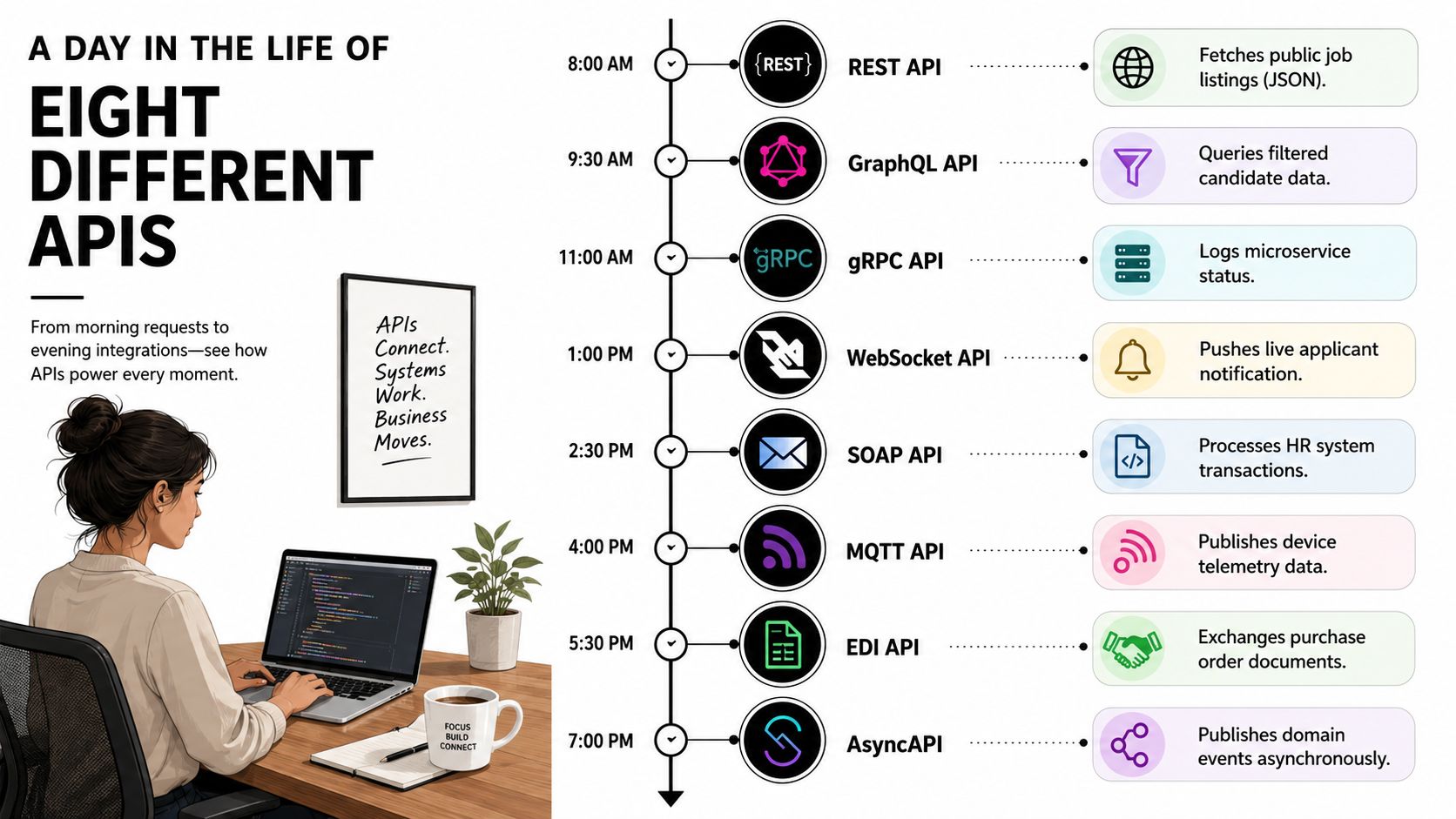
Maya, an ops engineer at a mid-size staffing firm, opens her laptop and sees the same thing she sees every morning, a pile of systems that need to agree with each other before coffee gets cold. A public REST call pulls a candidate profile from the recruiting platform, then a GraphQL query trims that profile down for the mobile recruiter view so the app doesn't drag in fields nobody needs. By the time the dashboard loads, the office already feels less chaotic.
The legacy bridge and the live layer
The older systems still matter. A SOAP bridge sends payroll data into a legacy finance system that won't speak anything else, while an internal gRPC service scores candidates in the background for skills matching and routing. Then a WebSocket stream pushes interview-room updates to recruiters as soon as someone joins, leaves, or gets bumped into the next round.
Practical rule: if the workflow needs a human to see it now, use a live channel. If the workflow can wait for completion, use a callback.
Later in the day, a webhook fires the moment an offer letter changes status, and that event kicks off downstream updates without Maya polling the system every few seconds. An embedded signing flow, delivered through an SDK call inside the ATS, lets the recruiter send a document for signature without leaving the app. A partner integration then syncs the signed agreement into the CRM so sales, legal, and operations all see the same record.
The pattern is simple once you zoom out. APIs are not just pipes, they're different ways of moving work through a business, from public lookup to private scoring to final signature. That's why the same hiring flow can include almost every major API style before the morning standup ends.
The Eight Types of API You Actually Need to Know
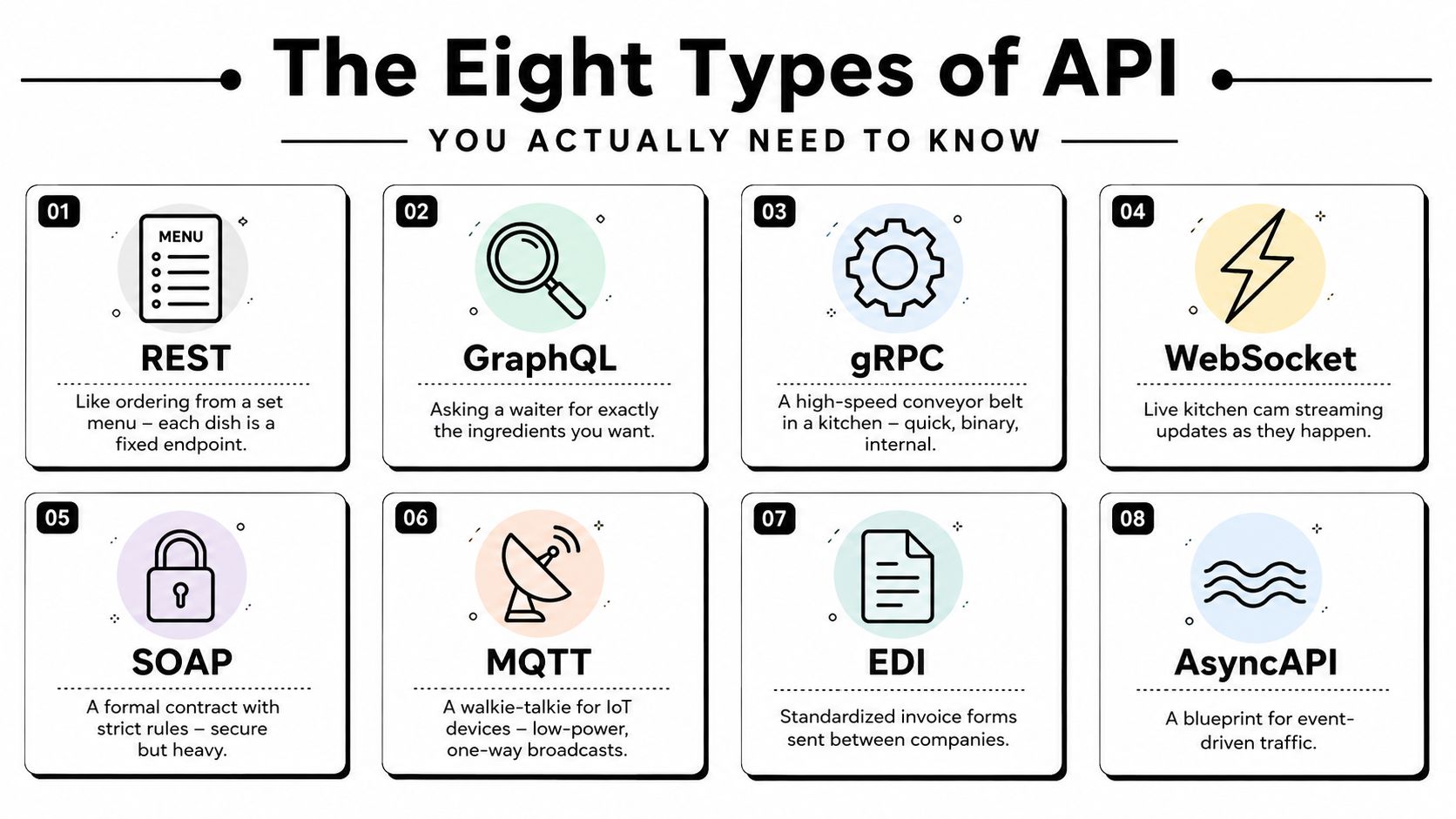
The easiest way to learn types of API is to stop treating them like a vocabulary list and start treating them like tools in a workshop. A builder doesn't ask whether a wrench is better than a screwdriver in general, they ask which one fits the bolt in front of them. APIs work the same way.
The core styles in plain English
REST is the menu at a restaurant. You ask for a resource over HTTP, the server returns a representation, and you can cache, inspect, and reuse it easily. It works well for sign PDFs online, pulling document status, and exposing public contract resources because it's simple and broadly supported, and the JRC describes REST as a stateless style that maps HTTP verbs to resource operations with strong tooling and observability support (JRC API landscape standards).
GraphQL is the made-to-order dish. The client asks for exactly the fields it needs, which helps mobile dashboards and complex contract views avoid over-fetching. For legal or sales portals where one screen needs document status, approver info, and signer metadata in one pass, that precision matters.
SOAP is the notarized contract. It's heavier, but the structure is strict, and that matters where compliance and legacy systems dominate. In banking, healthcare, and government workflows, SOAP can still be the right choice because the contract itself is part of the system design, not an afterthought.
RPC and gRPC are the direct phone call. They're built for asking a service to do something fast, especially inside microservices where latency matters more than human readability. That makes them useful for internal tasks like envelope generation, document stamping, or signature validation.
WebSocket is the walkie-talkie. The connection stays open, so both sides can talk in real time. It shines in signing rooms, live dashboards, and collaboration sessions where presence and status changes matter immediately.
Webhooks are the callback request. Instead of asking “did it happen yet?” on repeat, your system gets told when an event occurs. That's why they're useful for signature completion, form submission, and CRM sync.
SDKs and embeddables are the pre-built appliance. They wrap APIs in language-native code or user interface components, so teams can drop signing into an app without rebuilding the whole flow. In product terms, that's how an HR portal, CRM, or property management app can create, send, and sign PDFs with less custom wiring.
Audience-based categories still matter
Public APIs are the front office, partner APIs are the shared meeting room, and internal APIs are the back office. That audience decision affects authentication, rate limits, tooling, and support just as much as transport does. The category matters because a signing workflow for a reseller, a clinic, and an internal legal team rarely needs the same exposure model.
If you want a broader technical reference point, Scrapeway's notes on web scraping APIs are useful because they show how transport choice and access model shape the way builders think about API design. That same thinking applies when you're deciding whether a contract workflow should be public, partner-only, or kept inside the company boundary.
Comparing the API Types Side by Side
A good comparison table should help you choose, not rank winners. For contract and eSignature systems, the question is where each API type reduces friction, and where it adds ceremony. REST usually wins for public CRUD-style resources, GraphQL can win for mobile-first contract dashboards, gRPC fits high-throughput internal services, and WebSocket is hard to beat when a signing room needs live presence.
| API Type | Transport | Payload Shape | Best For | Contract Workflow Example |
|---|---|---|---|---|
| REST | HTTP or HTTPS | JSON or XML | Public document endpoints, simple CRUD, broad tooling | Fetching a signed PDF, sending a template, or pulling document status |
| GraphQL | HTTP or HTTPS | JSON | Dashboards with mixed data needs | A legal portal that needs signer status, approval state, and document metadata in one request |
| gRPC | HTTP/2 | Binary protocol buffers | Internal microservices, low-latency calls | High-volume envelope validation or internal document processing |
| WebSocket | WebSocket over TCP | Text, JSON, or binary | Real-time collaboration | Live signing-room presence and instant status updates |
| SOAP | HTTP, SMTP, or TCP | XML | Regulated enterprise systems | Legacy insurer or government systems that need strict contracts |
| Webhooks | HTTP callback | Usually JSON | Event notification | Triggering CRM updates the moment a document is signed |
| SDK | Language-native wrapper over underlying API | Depends on the wrapped API | Developer adoption, embedded UX | Rendering an in-app signing flow inside an HRIS or CRM |
| Public, partner, internal APIs | Usually depends on the underlying style | Depends on the underlying style | Exposure and governance decisions | Sharing signing capabilities with customers, partners, or internal teams |
The trade-off shows up in the debugging experience too. REST is easy to inspect with standard HTTP tools, while GraphQL needs query discipline, and gRPC asks for better internal observability because the payload isn't as readable on the wire. WebSocket is great when the room has to stay live, but it's not the first choice when you just need a document record in storage.
For contract automation, mixing styles is normal. A document may start with a REST send request, trigger a webhook on completion, sync through a partner API into the CRM, and surface in a dashboard through GraphQL. The stack is healthier when each layer does one job well.
Security and Compliance Across API Types
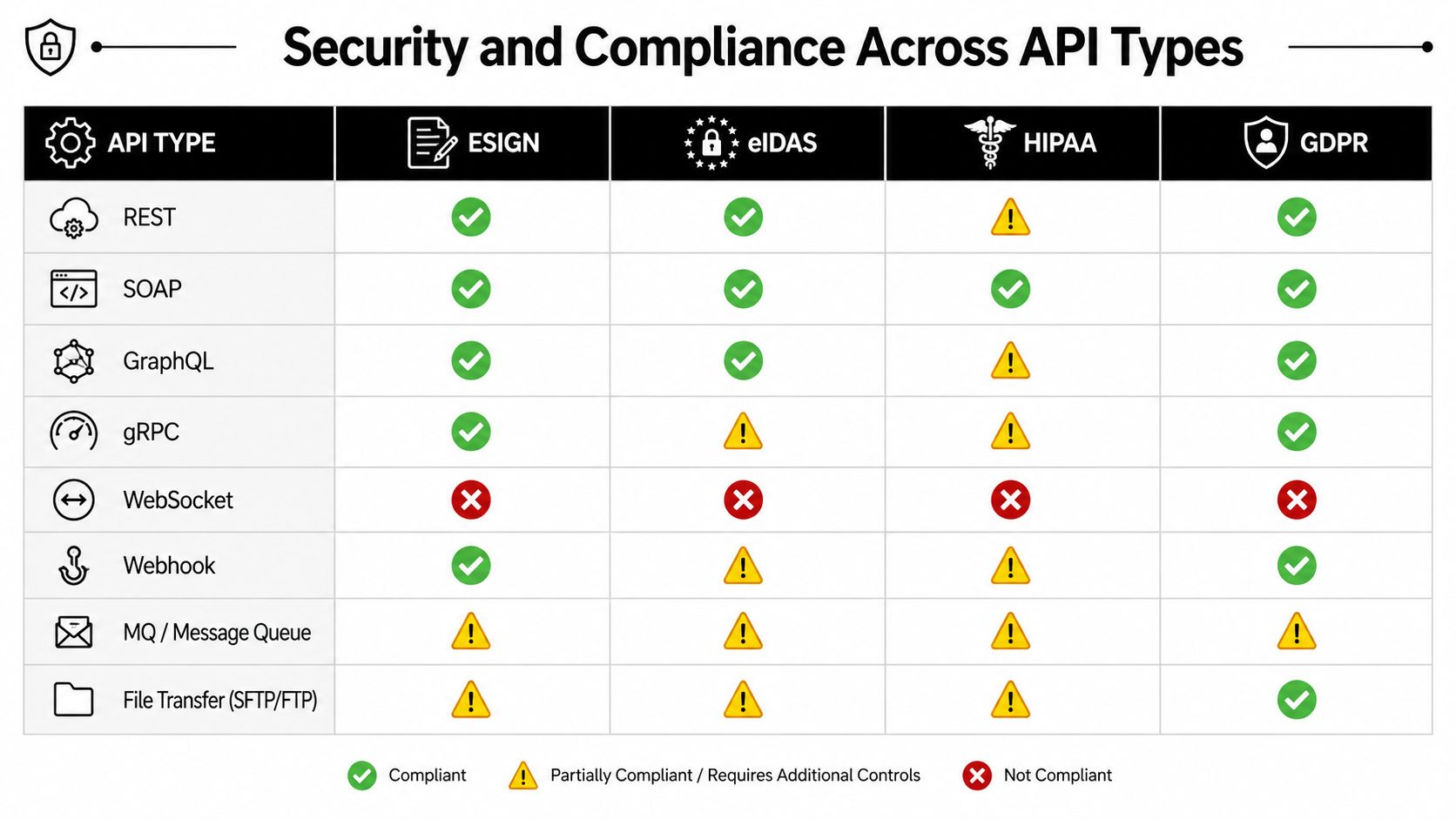
Security can't be bolted on after the API choice is done. For eSignature workflows, the legal rules matter first, then the transport and auth model has to support them cleanly. Under the U.S. E-Sign Act, electronic records and signatures are generally valid for transactions in interstate or foreign commerce, the law took effect on October 1, 2000, and consumers need to affirmatively consent before electronic records can satisfy writing requirements (U.S. E-Sign Act overview).
Matching compliance rules to transport mechanics
The EU side is equally concrete. The eIDAS framework defines an electronic signature as data in electronic form attached to or logically associated with other electronic data, and it says an electronic signature can't be denied legal effect solely because it's electronic, while qualified electronic signatures carry equivalent legal effect to handwritten signatures across EU member states (eIDAS overview). In healthcare, HIPAA doesn't ban e-signatures outright, but the underlying content still has to comply with applicable law and protected health information needs safeguards against unauthorized access or disclosure (HIPAA e-signature guidance).
That's why the transport controls matter so much. REST and GraphQL commonly rely on OAuth 2.0 plus JWT bearer flows, while gRPC often pairs well with mTLS for service-to-service trust. SOAP still has a strong place in regulated pipelines because WS-Security supports message signing and encryption, and webhook receivers need HMAC signatures, replay protection, IP allow-lists, and idempotency keys so an old event doesn't look new.
Compliance doesn't come from the API label. It comes from the controls around identity, transport, and auditability.
GraphQL also needs guardrails. Query depth limits and persisted queries help reduce abuse and make the API easier to reason about in environments where access control and data minimization matter. For live signing sessions, WSS gives you encrypted WebSocket traffic, which is a better baseline than open, unauthenticated channels when signer presence and document state are exposed in real time.
For deeper governance thinking, BoloSign's guide on GDPR and SOC 2 considerations for global e-sign rollouts is a useful companion because it ties compliance to rollout design rather than just feature lists.
If you're looking at automation abuse and bot-driven traffic patterns, Scrapfly's walkthrough on bypassing DataDome is relevant as a reminder that exposed endpoints need layered protections, not just a friendly API key.
Real Integration Patterns for Contract Workflows
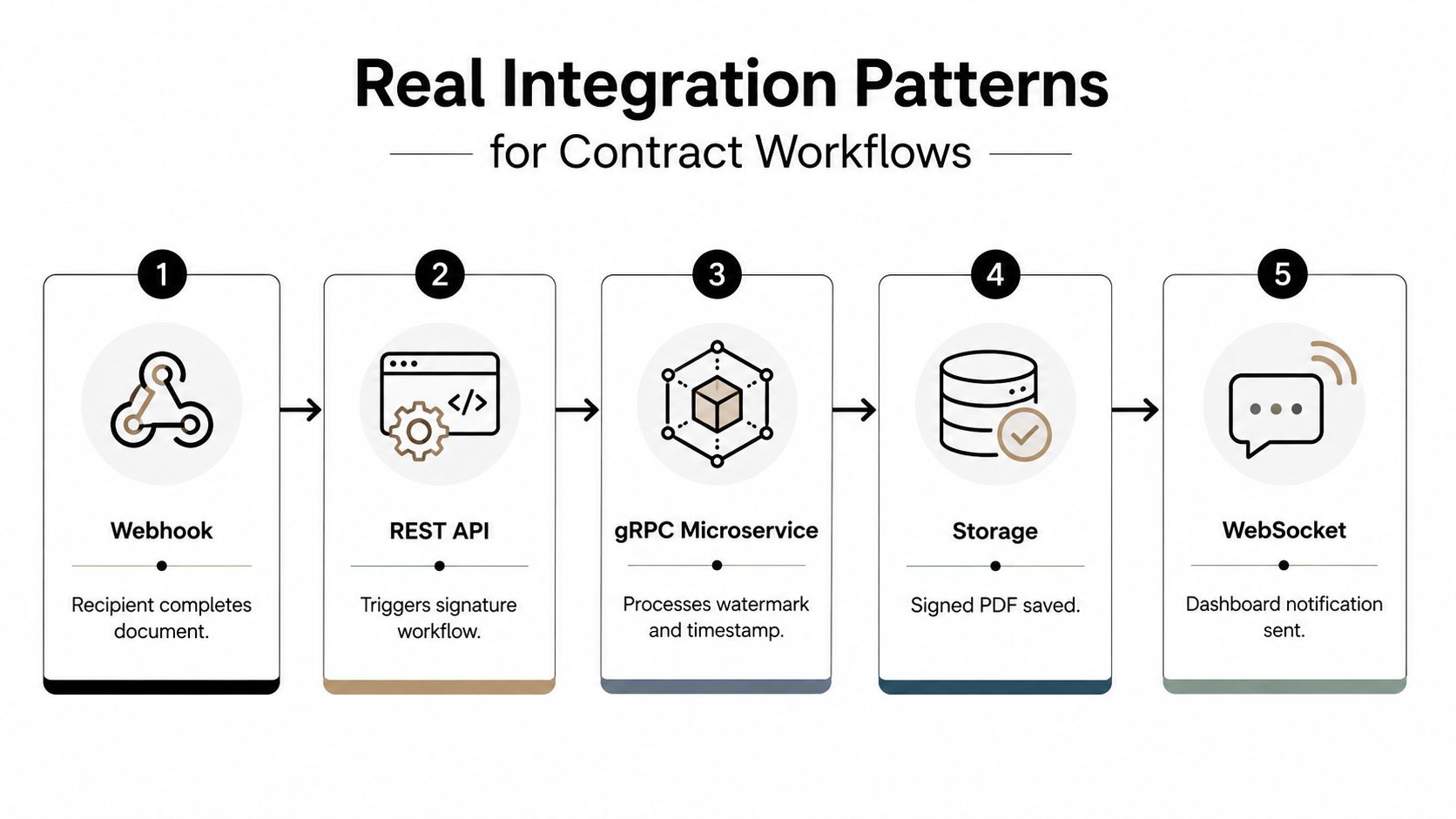
A contract workflow usually isn't one API, it's a chain. One system detects an event, another formats the payload, another signs or stores the document, and another tells the rest of the business what changed. The teams that move fastest don't force every step through the same protocol, they choose the right one for each responsibility.
How the stack splits by job
A staffing agency might bulk-send onboarding packets through a REST endpoint, then listen for webhooks when a contractor finishes signature so the recruiter can update the ATS immediately. A clinic might use scoped tokens to send consent forms, then rely on completion events to route the signed record into the patient file. In both cases, the API choice is shaped by who needs the data and when they need it, not by protocol fashion.
A real estate brokerage often needs something different. Agents want in-person signing with live status, so a WebSocket-backed session keeps the signing room synchronized while the deal is still active. A logistics firm might send a bill of lading through a programmatic REST call, then pull counter-signed documents back on a schedule so the ERP stays aligned with what got executed.
BoloSign fits naturally in stacks like this because it exposes a Document Signing API, embeddable signing components, and integrations that let teams send PDFs, templates, and forms from the tools they already use. Its workflows are built for contract automation where approval steps, signature capture, and system sync all need to happen without bouncing users between apps.
For product teams that want to embed the signer directly in their own app, BoloSign's embedded signing API guide is the most direct starting point for understanding how in-app execution works. That same pattern works well in HRIS portals, CRMs, and procurement systems where the user should never leave the record they're already working in.
The useful mental model is simple. REST sends and fetches, webhooks announce completion, SDKs reduce integration effort, and live channels handle collaboration. Once those roles are clear, the workflow stops feeling like a maze.
How to Pick the Right API Type for Your Stack
The fastest way to choose is to look at four things, the workload shape, the latency budget, the compliance posture, and the audience. If the work is ordinary resource CRUD, REST is usually the cleanest start. If the business cares more about machine-to-machine triggering, webhooks or event-driven APIs become more useful than repeated polling.
A quick decision filter
Workload shape tells you whether the job is a resource lookup, a collaborative session, or an event stream. Latency budget tells you whether humans are waiting, or whether microservices need a response before the next step can run. Compliance posture tells you whether the API must support ESIGN, eIDAS, HIPAA, or GDPR requirements without awkward compensating controls. Audience tells you whether this is public, partner-only, or strictly internal.
That's why a public REST surface is often the first layer, not the last. It's easy to expose, easy to document, and easy to support for customers and partners who need to sign PDFs online without learning a new protocol. From there, webhooks handle status changes, SDKs improve adoption, and embeds keep the signing experience inside the product people already use.
Builder's shortcut: start with the simplest API that can safely move the document, then add real-time or internal optimizations only where they earn their keep.
The decision becomes easier if you think in workflow terms. A CRM-facing contract dashboard wants GraphQL. A microservice validating envelopes at scale wants gRPC. A partner insurer might still need SOAP. A SaaS product that wants in-app execution and white-label behavior will usually lean on an embedded component or SDK, then connect it back to the rest of the stack with REST and webhooks.
For teams comparing vendors, BoloSign's best e-signature API for SaaS apps is a practical reference point because it frames the decision around application fit, not just feature checklists. In real deployments, that's the difference between a signing flow that gets adopted and one that gets ignored.
Common Misconceptions About API Types
One common mistake is assuming REST is automatically modern. REST only feels modern when the resource model is clean, versioning is disciplined, and the API is easy to observe. A sloppy REST design can be harder to maintain than a stricter alternative.
Another myth is that webhooks are just REST requests in disguise. They're not. A webhook is a push callback triggered by an event, and it needs its own signing, retry, and idempotency rules because the receiver didn't ask for the call in the moment it arrived.
SOAP also gets written off too quickly. It's still useful in contract-heavy, regulated environments because WSDL, WS-Security, and formal message structure solve problems that a looser approach doesn't always cover well. Public APIs aren't risky either, they become risky when OAuth scopes, gateway policies, rate limits, and logging are weak.
A useful way to think about public APIs is as a trust problem, not an exposure problem. A well-governed public signing API can be safer than a poorly managed internal one, especially when approvals, audit logs, and data access policies are explicit. In contract workflows, that difference can decide whether a rollout passes review or gets delayed.
Putting It All Together and Next Steps
The cleanest contract stacks usually combine several API types on purpose. REST handles resource CRUD, webhooks notify the rest of the system when signature events happen, GraphQL cleans up dashboard reads, gRPC helps internal services move quickly, and embeds keep the signing experience inside the product itself. That mix shortens the gap between send and signature because each step uses the path that fits best.
That matters operationally. Faster send-and-sign loops reduce manual chasing, make audit trails easier to follow, and keep approval handoffs from stalling in someone's inbox. For teams handling staffing, healthcare, real estate, logistics, education, or professional services, the practical win is simple, less rework and fewer places for the process to break.
BoloSign brings those pieces together with contract automation, AI-assisted review, and eSignature workflows that let teams create, send, and sign PDFs, templates, and forms without stitching together a dozen disconnected tools. If you want to see how the API, embedded signing, and workflow pieces behave in practice, the easiest move is to test them in your own environment and compare the result against your current stack.
Try BoloSign with a 7-day free trial and see how its API, embedded signing, and contract automation tools fit your workflow. Visit BoloSign to explore how you can create, send, and sign documents with less friction, while keeping compliance and auditability front and center.

Paresh Deshmukh
Co-Founder, BoloForms
31 Aug, 2026
Take a Look at Our Featured Articles
These articles will guide you on how to simplify office work, boost your efficiency, and concentrate on expanding your business.