

Risks in Contract Management: Costs, Compliance and Fixes
Learn the biggest risks in contract management across the lifecycle, from value leakage and vendor breaches to HIPAA gaps and AI data rights, with fixes.

Tired of nonsense pricing of DocuSign?
Start taking digital signatures with BoloSign and save money.
Your staffing agency's payroll-vendor agreement has renewed automatically. Finance notices the higher invoice, operations assumed procurement was watching the deadline, and procurement thought the contract owner had left. The signed PDF is somewhere in a shared drive, but nobody can quickly establish whether the increase was allowed.
That's where risks in contract management become expensive: not necessarily in a badly drafted clause, but in an agreement nobody actively manages. Better negotiation helps, yet it won't recover an expired notice period, claim an overlooked credit, or stop a supplier using data in ways your team never understood.
Contract Risks at a Glance Across the Lifecycle
A facilities lease can sit in a shared folder for three years with a valid signature and still create a loss nobody budgeted. The notice window for a rent step-up or an insurance certificate expires, and the team that negotiated the deal has moved on. Signature closed the negotiation. It did not assign anyone to watch the dates.
Contract risk is a chain of decisions and omissions, spanning drafting, negotiation, approval, signature, administration, and renewal. Construction quality matters on a bridge, and so do the inspections after traffic starts. A signed agreement works the same way: drafting errors hurt, but unmonitored renewals, legacy terms, and price changes after signature usually cost more because nobody is still looking.
Contract risk map by lifecycle stage
| Risk category | Lifecycle stage where it starts | Typical example | Control that catches it |
|---|---|---|---|
| Value leakage | Post-signature monitoring | Price increases and auto-renewals nobody tracked | Renewal calendar and invoice-to-contract checks |
| Third-party data breach | Vendor onboarding and drafting | Processor lacks an incident-notice clause | Security clause library and approval routing |
| Missed obligations | Administration | Notice deadline passes before anyone acts | Obligation tracking with automated reminders |
| Compliance gaps (HIPAA, GDPR) | Drafting | Missing business associate terms | Clause review before signature |
| Legacy exposure | Contracts signed years ago | Unknown auto-renewal or insurance requirement | Portfolio inventory and risk scoring |
| AI data-use rights | Vendor selection | Provider can retain uploaded contracts | Negotiated data-use and deletion terms |
| Supplier failure | Performance management | No contingency plan for vendor exit | Documented continuity and transition rights |
The categories overlap. A healthcare vendor's missing subcontractor terms can create both compliance and security exposure. A logistics carrier's service failure becomes a financial problem when nobody records the evidence needed to claim a contractual remedy.
Legal can interpret a lease. Facilities knows whether the premises are still needed. Procurement can negotiate carrier terms. Dispatch knows whether the carrier meets them. The department holding the PDF does not own every exposure. Rank each one by who can still act, then assign a named owner before the next notice date.
Practical rule: Treat signature as the handover into active management, not the point where responsibility ends.
Match the control to the exposure
Use the category that matches your portfolio to decide where to investigate first. For real estate, that might mean notice periods and insurance. For staffing, prioritize payroll continuity and candidate-data access.
Global operations also need jurisdiction-specific review rather than a universal privacy addendum. For teams assessing Indian data-protection readiness, DilicheckRep's Portuguese-language guide, como preparar empresas indianas para o DPDP, offers a focused starting point for that discussion.
Catch the failure while a notice, a credit, or an exit right is still available. I would score legacy auto-renewals and unmonitored price changes ahead of clause polish, then give each item an owner and a date. Drafting still matters. Administration is where the money and the liability move.
How Value Leaks After Signature
Organizations lose an average of 11% of contract value through failures including missed savings, unmanaged clauses, untracked price changes, renewal problems, unauthorized changes, and disputes, according to World Commerce & Contracting's procurement value-gap report.
The loss is cumulative. An employee accepts extra work without recording the commercial change. Accounts payable misses a discount. A business owner lets an unwanted service renew because nobody gave them the notice deadline.
The pattern is easier to recognize when the losses are separated.
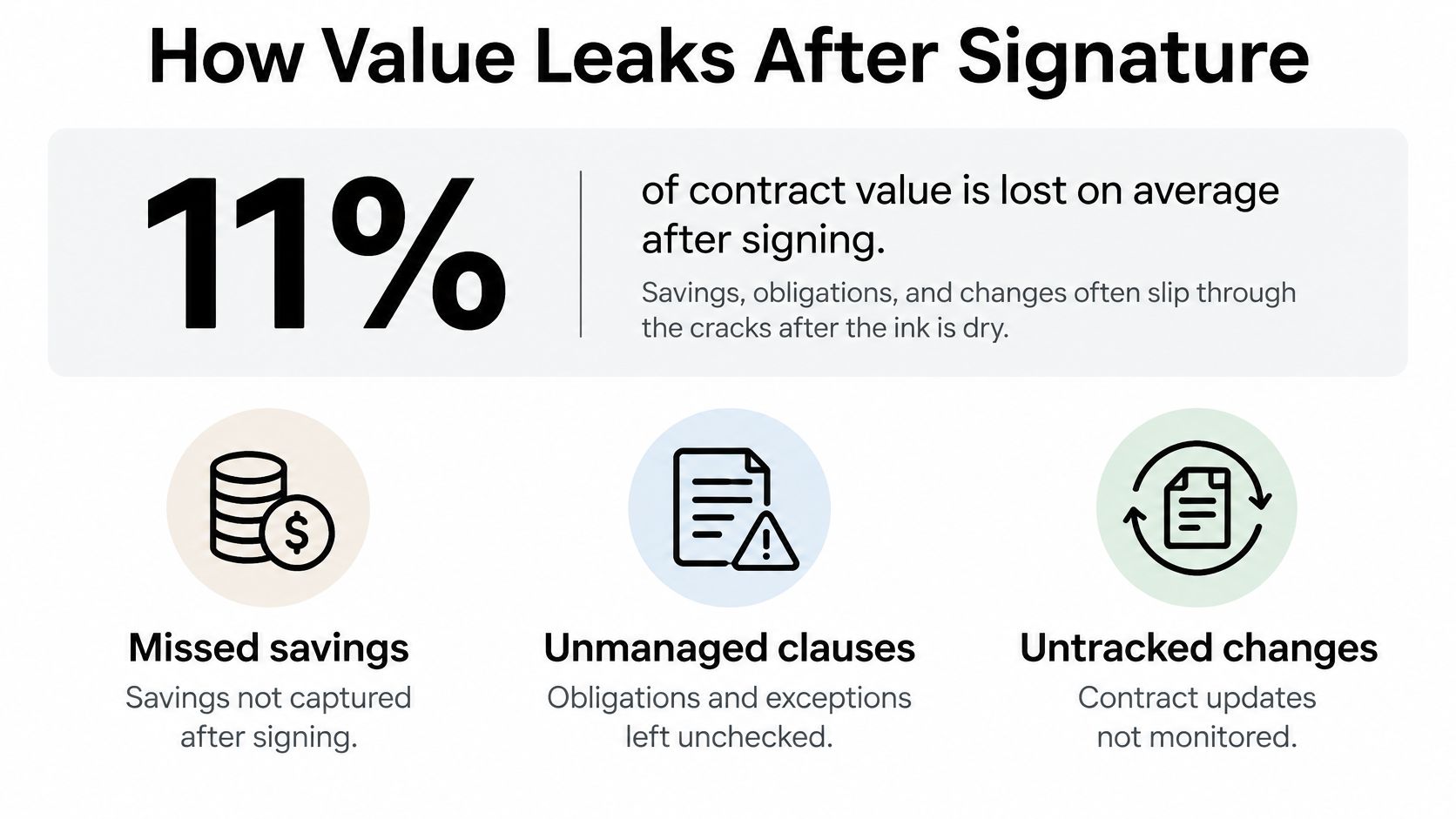
Where contract value leaks after signature
The breakdown below uses WorldCC's estimates from the report cited above. These categories describe different failure mechanisms, not a formula for forecasting every organization's losses.
| Leakage source | Share of contract value | What it looks like in practice |
|---|---|---|
| All leakage combined | 11% on average | Cumulative losses, not one catastrophic event |
| Unauthorized or unrecorded scope changes | Approximately 2–3% | Extra work approved by email and never tied to the contract |
| Missed savings from weak negotiation | Approximately 2–3% | Discounts and volume tiers nobody claimed |
| Renewal costs from poor forward planning | Approximately 2–3% | Renewal rolls over at list price because no one reviewed the date |
| Unrealized benefits, overpayments, missed obligations, damaged supplier relationships | Typically 1–2% each | Credits never requested, invoices paid above the agreed rate |
Two ordinary ways to lose money
Say a logistics manager asks a warehouse provider to add weekend handling. They agree by email, but nobody records the new scope, authorization, or rate in the contract record. Finance later receives a larger invoice without a reliable baseline for deciding what was approved.
Stopping every operational adjustment until legal reviews it would slow the business unnecessarily. A better control is a documented change route: identify the authorized approver, record the scope and price, and attach the approval to the agreement before payment.
Renewals require a different intervention. A professional services team may intend to renegotiate a software subscription, but a reminder on the expiry date is useless if the cancellation deadline has already passed. Track the last date to give notice, together with the decision date the business needs to meet internally.
WorldCC also illustrates the practical scale: for an organization with $500 million in contracted expenditure, average practices can allow as much as $15 million in preventable annual leakage. That illustration is separate from applying the headline average to the whole spend base.
This is a financial-control problem, not exclusively a legal one. Finance needs approved rates and adjustment formulas; operations needs deliverables and evidence requirements; the commercial owner needs enough time to make a renewal decision.
Start with a register containing active agreements, values, renewal and notice dates, and approved pricing. Compare it against invoices each quarter, then investigate exceptions rather than rereading every agreement indiscriminately. A practical contract obligation tracking and management workflow should connect each exception to someone authorized to resolve it.
Security Exposure Through Vendors and Subcontractors
Breaches involving third-party vendors and supply-chain compromise carried an average cost of $4.91 million, according to IBM's 2025 Cost of a Data Breach reporting. The same reporting places the global average at $4.44 million, down 9% from $4.88 million in 2024.
Your own systems don't have to be the original point of compromise for your organization to face serious consequences. A background-check provider, outsourced billing company, or technology partner may hold information your employees remain responsible for protecting.
Contracts matter because they define what that partner must do, what evidence you can demand, and how both parties respond when something goes wrong. They don't replace technical safeguards.
Find the security duties before an incident
For every vendor handling sensitive information, locate and verify these provisions:
- Data-protection requirements: Identify the information covered and the purposes for which the vendor may process it.
- Incident-notification deadlines: Establish when notice is due, who receives it, and what information follows.
- Audit rights: Specify how you can obtain evidence of compliance.
- Subcontractor restrictions: Define approval, notification, and downstream protection requirements.
- Minimum safeguards: Describe applicable controls rather than relying on broad assurances.
- Indemnities: Establish which losses the vendor accepts responsibility for.
- Insurance provisions: Check the required coverage and evidence of renewal.
The failure pattern is usually administrative as well as contractual. Different vendors accept different terms, negotiated exceptions remain in email, and nobody checks whether promised evidence arrives.
Say a staffing firm sends candidate records to a background-check provider. The contract includes confidentiality language but never establishes an incident-reporting deadline or an escalation contact. If the provider discovers unauthorized access, the staffing firm has less contractual clarity about when it should hear and what cooperation it can require.
Make the record usable during an incident
Build a searchable vendor list organized by customer, employee, health, payment, and proprietary data access. Attach the executed security terms, incident contacts, relevant certification expiry dates, and the employee responsible for reviewing evidence.
A third-party vendor risk assessment should inform that record, not remain a separate questionnaire nobody revisits. When a supplier changes its processing arrangements, the contract owner should reassess the affected permissions and safeguards.
Don't make every vendor undergo the same review. A carrier receiving delivery addresses and a payroll processor receiving employee records need different scrutiny. For healthcare arrangements, the subcontractor chain also requires a specific legal assessment, not just a stronger security questionnaire.
Compliance Gaps in Healthcare and Regulated Contracts
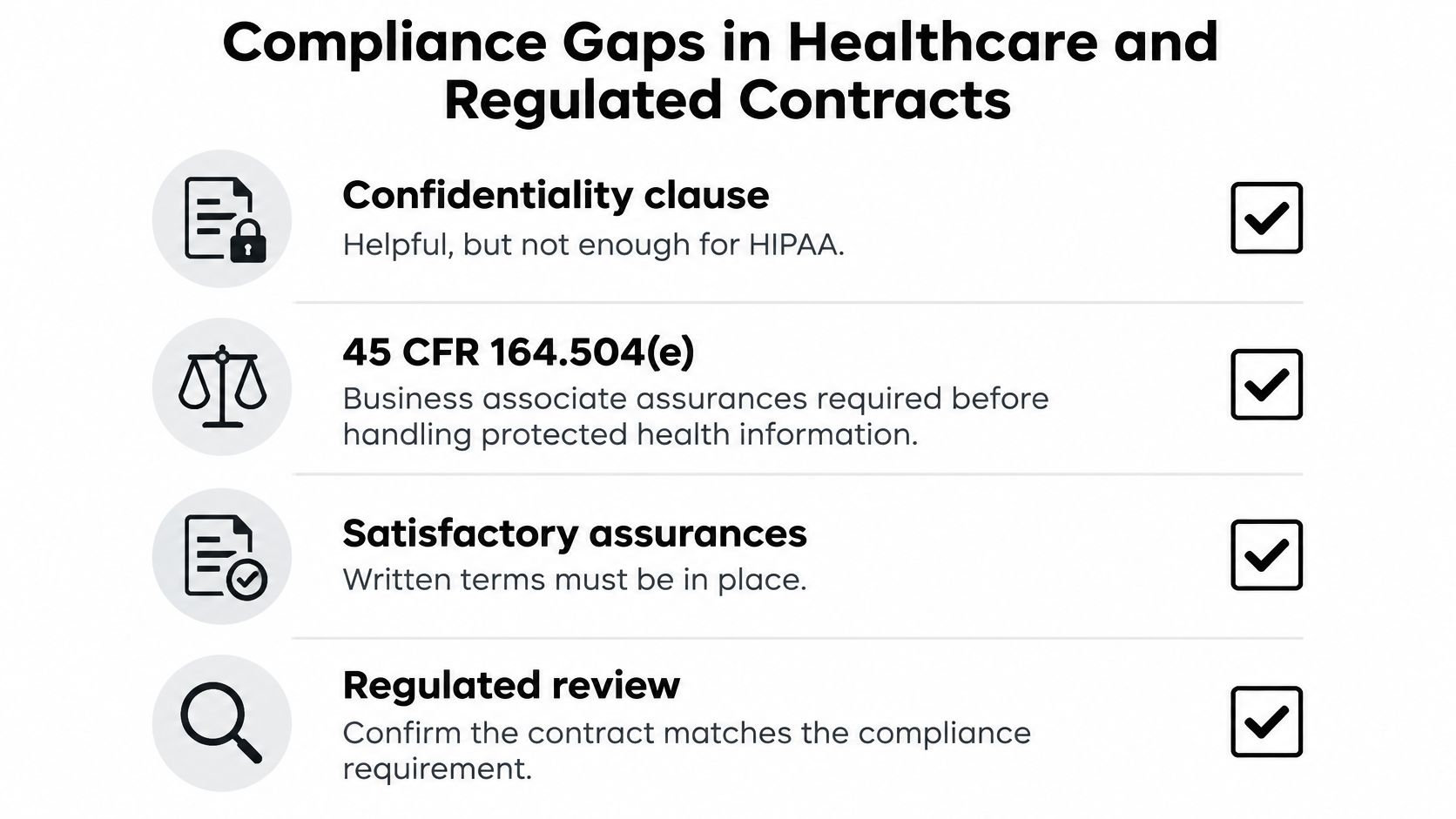
A confidentiality clause isn't enough for HIPAA. Under 45 CFR 164.504(e), a covered entity must obtain satisfactory assurances before allowing a business associate to create, receive, maintain, or transmit protected health information.
The business associate agreement must define permitted and required uses and disclosures, restrict other uses except as legally permitted, require appropriate safeguards, and require reporting of unauthorized uses or disclosures, including breaches of unsecured PHI. A general promise to protect confidential information doesn't establish all those mechanics.
Use the checklist as a prompt for substantive review, not as evidence that a document is compliant.
Follow the information through the subcontractor chain
Under 45 CFR 164.314, a business associate must ensure that subcontractors handling electronic PHI agree to applicable requirements through a compliant contract or arrangement. The provision also requires reporting of security incidents, including breaches of unsecured PHI, to the covered entity.
Say a clinic signs an appropriate agreement with its scheduling provider. The provider then uses a cloud subcontractor to maintain patient information, but the required downstream agreement is missing. The clinic's primary agreement doesn't, by itself, establish that the subcontractor has accepted the necessary protections.
An unidentified subcontractor is a warning that needs investigation, not automatic proof that no agreement exists. Request the relevant contractual evidence and resolve the uncertainty before treating the chain as verified.
A promise that a service is secure isn't a substitute for defined data uses, safeguards, reporting duties, and downstream obligations.
Check the mechanics before signature
A practical pre-signature review should address:
- Named PHI access: Record what information the provider will create, receive, maintain, or transmit.
- Permitted uses: Match the permission to the service being purchased, rather than accepting unrelated secondary uses.
- Safeguards: Identify the applicable protections and evidence the organization will review.
- Incident reporting: Confirm the contractual reporting window, recipients, and cooperation duties against applicable requirements.
- Subcontractors: Establish the processing chain and required downstream terms.
- Retention and deletion: Agree how information will be retained, returned, or destroyed, including relevant exceptions.
The HIPAA business associate agreement requirements should guide the legal review; a keyword search for confidential or secure won't do it. AI clause-review tools can flag missing language, but a qualified reviewer still needs to determine whether the terms fit the actual workflow.
GDPR in Europe and the UK, ESIGN in the US, and eIDAS in the EU raise different privacy or electronic-signature questions. Don't treat them as interchangeable certifications of a contract's suitability.
For teams operating across the US, Canada, Australia, New Zealand, and UAE, establish the governing requirements for each transaction and data flow. A valid eSignature doesn't establish lawful processing, and an approved agreement doesn't validate every system configuration. Access permissions, retention settings, vendor arrangements, and operational practices still need review.
Legacy Contracts Hiding the Biggest Exposure
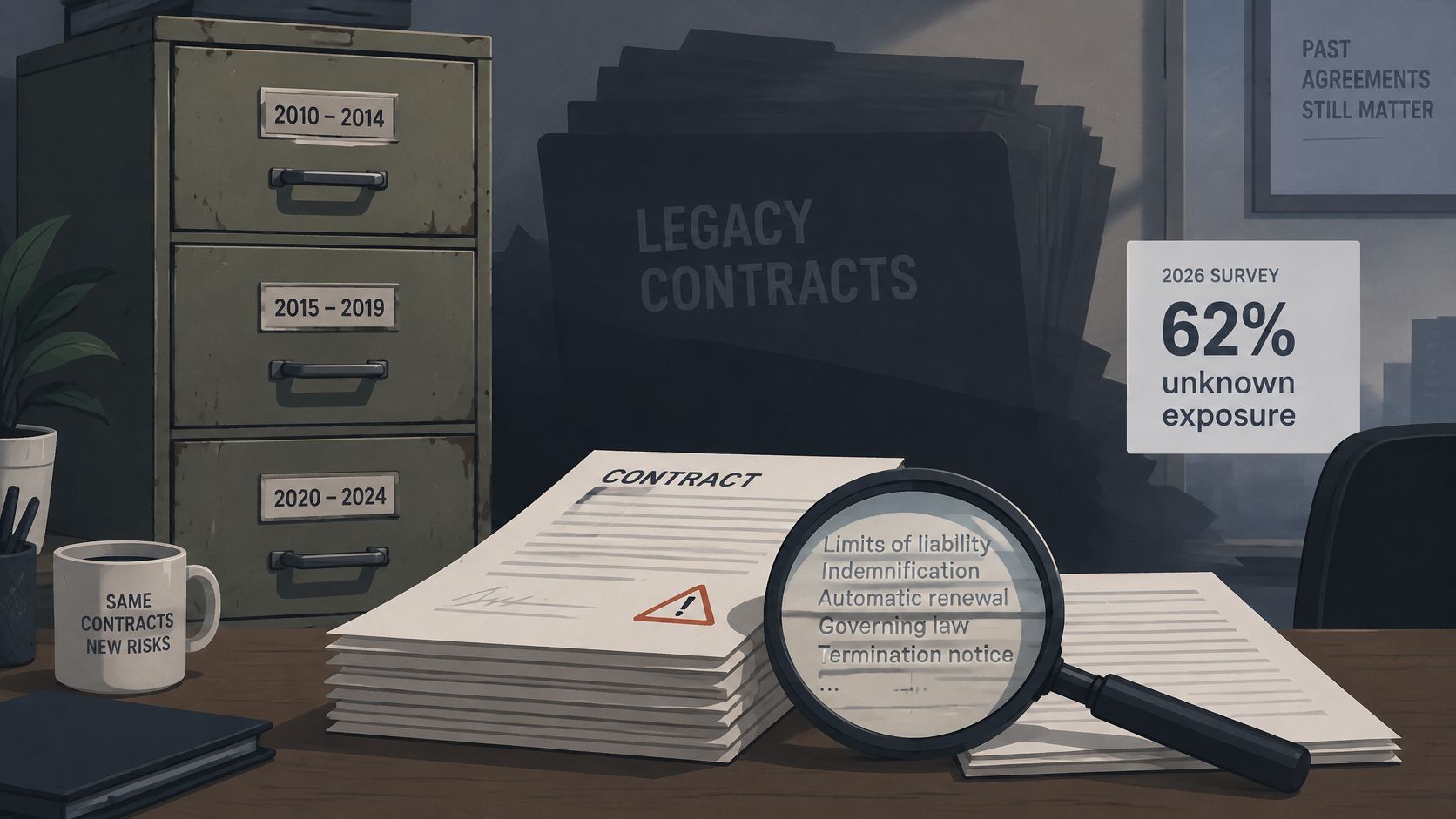
Tomorrow's negotiation may attract the most attention while yesterday's agreements contain the least understood exposure. In IntelAgree's 2026 CLM Trends survey, 62% of respondents identified unknown exposure in older agreements, while 57% cited missed obligations as a leading risk.
A legacy portfolio can resemble an attic of signed documents: everything was put somewhere, but nobody knows what's in the boxes. Improving new-contract intake won't tell you what those existing agreements require.
The first task is discovery, not renegotiating every document.
Separate an unknown obligation from a missing field
Unknown exposure means the organization hasn't established what a clause requires or permits. Incomplete metadata means the relevant document or obligation is known, but its structured record lacks information.
That difference changes the work. A missing renewal field calls for extraction and validation. An agreement nobody has reviewed for data-use permissions calls for substantive analysis. Marking both as incomplete hides which contracts need legal judgment.
Triage the portfolio without stopping business
- Inventory executed agreements across departments. Include amendments, schedules, side letters, and replacement versions. Ask finance to identify active suppliers whose agreements haven't surfaced.
- Tag the operational triggers. Extract renewal and notice dates, automatic-renewal language, price adjustments, data-processing duties, insurance requirements, and termination rights.
- Rank financial exposure and consequences separately. A low-spend healthcare vendor may deserve urgent attention because it handles patient information. High spend alone isn't a sufficient risk score.
- Assign the person who can perform the duty. Operations should own a logistics carrier's performance evidence; facilities should own lease-related actions. Legal supports interpretation and escalation.
For a staffing agency, prioritize older payroll and screening agreements where service interruption or candidate-data permissions remain unclear. For a healthcare provider, investigate whether an old vendor's actual data access has expanded beyond the arrangement originally approved.
A practical walkthrough can help colleagues discuss how they'll turn existing documents into a working review queue.
Set explicit escalation criteria. I would move agreements with an approaching notice deadline, uncapped liability, sensitive-data access without established protections, or no accountable business owner to the front.
Don't wait until the entire portfolio is perfectly tagged before acting. Confirm urgent exposures as you find them, record the decision, and keep an unresolved-items queue. The useful outcome is an actionable obligation record, not a tidy folder that still leaves employees guessing.
AI Vendor Contracts and the Data Rights You Must Negotiate
The surprise in an AI vendor agreement may not be what the tool gets wrong. It may be what the provider is allowed to do with everything your employees upload.
Stanford Law's 2025 analysis of AI vendor contracts found that 92% of sampled vendors claimed broad data-usage rights, 17% expressly committed to full regulatory compliance, and 33% offered indemnification for third-party intellectual-property claims. Those findings concern the agreements analyzed, not every AI provider.
A contract can prohibit unauthorized disclosure while expressly permitting model improvement using prompts, uploaded agreements, or derived information. Confidentiality and restricted use are different protections.
Clauses in AI vendor contracts (Stanford Law, 2025)
The comparison below summarizes the analysis cited above. Negotiation targets are proposed protections, not descriptions of what vendors already promise.
| Clause | Share of AI vendor contracts | Negotiation target |
|---|---|---|
| Broad data-usage rights | 92% | Use limited to delivering the service, with no training on your inputs unless agreed |
| Data rights beyond what the service needs | 92% (63% in broader SaaS) | Named permitted purposes and a firm deletion timeline |
| Commitment to full regulatory compliance | 17% | Express compliance obligation tied to the regulations you operate under |
| Indemnification for third-party IP claims | 33% | Indemnity addressing relevant claims involving uploaded content and outputs, with exclusions reviewed |
An indemnity needs careful allocation. Don't assume a provider will cover infringement caused by material your business had no right to upload. Focus on provider-caused exposure, permitted use of the service, exclusions, and how responsibility changes when employees modify an output.
Answer the operational questions before uploading
- Training permission: Can inputs, outputs, or derived information improve a shared model?
- Deletion: What triggers deletion, what remains in backups, and what exceptions apply?
- Subprocessor changes: Can the provider change processing partners without meaningful notice or an agreed response?
- Output responsibility: Who reviews inaccurate or biased results before anyone relies on them?
- Liability allocation: How do caps and exclusions apply to confidentiality, privacy, IP, and regulatory exposure?
Say recruiters paste candidate résumés into an AI screening tool whose terms permit indefinite retention. The team may believe it bought a convenient assessment service while accepting a broader and longer-lived use of candidate information.
The practical fix isn't telling recruiters to be careful. Define approved tools, permitted input categories, retention requirements, and the approval needed for exceptions. A school reviewing student information or a sales team uploading customer records needs the same clarity about authorized use.
AI contract review can reduce reading effort, but it doesn't transfer accountability. Require reviewers to verify extracted clauses against the executed text and assess whether suggested alternatives fit the transaction.
Standard fallback language helps negotiators respond consistently. A vendor that won't restrict training use may be acceptable for public information but unsuitable for confidential agreements. Make that distinction before employees concentrate sensitive documents in the service.
Process, People and Tech Controls That Cut Risk
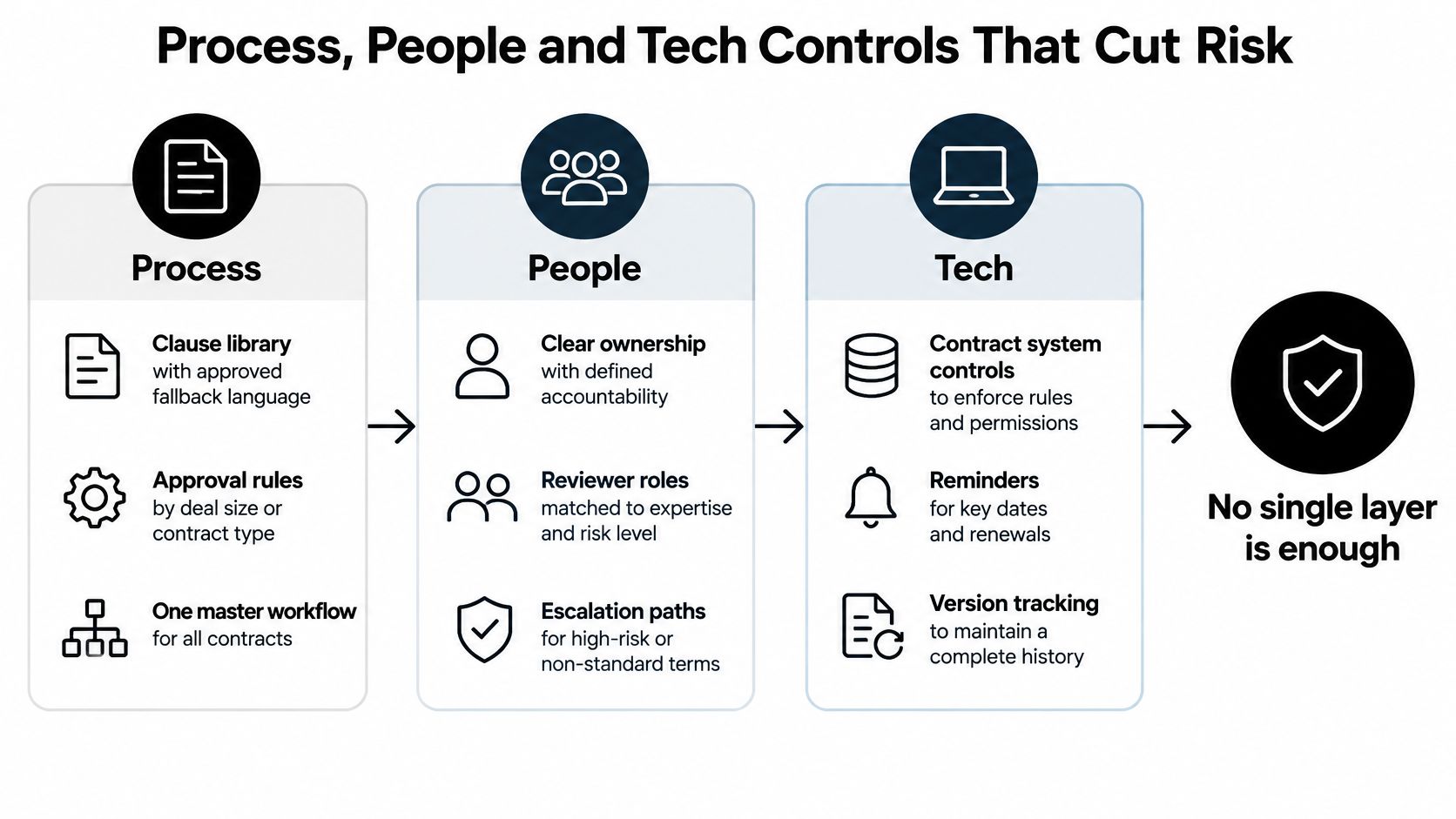
A sound contract program needs process, people, and technology together. A clause library won't make someone perform an obligation, and automated reminders won't help if nobody has authority to decide.
The layers work best when they address specific decisions rather than broad ambitions such as improving visibility.
Process and people establish the rules
Process. Maintain a clause library with approved language, acceptable fallback positions, and the circumstances requiring escalation. Set approval rules by deal size, contract type, and exposure, rather than sending every document through every department.
Use a designated master template for each agreement type. Retire obsolete versions from shared folders so employees don't start with whatever attachment they last received.
People. Name an operational owner for each continuing obligation and a backup for absences or departures. Train sales and operations to record commercial changes rather than relying on private email exchanges.
A school district, for example, can require written approval before a vendor changes how it shares student information. A professional services firm can make the engagement lead responsible for deciding whether a client relationship should continue, while finance validates the commercial consequences.
Hold a monthly finance and operations review focused on decisions: disputed charges, approaching notice deadlines, proposed adjustments, and overdue evidence. A meeting that merely reads out statuses adds work without resolving exposure.
Technology makes the rules repeatable
Technology. Evaluate concrete capabilities:
- Obligation tracking: Store the trigger, required action, owner, evidence, and escalation route.
- AI-powered automation: Flag nonstandard clauses and propose alternatives against approved positions, with human verification.
- Searchable metadata: Find agreements by supplier, data access, pricing mechanism, and business unit.
- Approval and signing records: Preserve the approved version and evidence of the authorization and execution sequence.
- CRM integration: Populate agreed deal information without repeatedly retyping names, scope, and payment details.
For execution controls, electronic signing best practices from PDFWix provide useful prompts for reviewing signer verification, document integrity, and evidence retention. Digital signing solutions should support the workflow without encouraging employees to bypass review.
A real estate agency might set a renewal alert early enough to inspect the property, confirm business needs, and negotiate, while requiring written consent for changed service scope. A logistics firm should map each carrier's service-level commitments to the dispatcher or operations manager who can obtain performance evidence.
Implementation order: Agree the approved positions, assign decision-makers, then automate their work.
Keep supplier exit arrangements in that design. Specify transition assistance, data export, alternative sourcing, and the employee responsible for testing whether the plan is workable.
Start with the clause library, then assign owners, then add tooling. Otherwise, the software will distribute unresolved decisions faster without making them safer.
Start a Contract Risk Review This Week
A facilities lease rolled into another term because nobody owned the notice window. The rent step-up was already in the executed file. That is the exposure worth reviewing this week: obligations that sit quiet after signature, including missed renewals and price changes nobody is watching.
Pick one category where uncertainty can cost money or create liability. Vendors holding personal data, a critical outsourced service, or property leases are workable first cuts. Keep the pile small enough that the people who own those agreements can finish the review and act on what they find.
Build a working record before anyone plans a company-wide change:
- List active agreements with their value, business owner, executed version, and renewal or notice date.
- Tag consequential terms, including data-processing duties, automatic renewals, pricing adjustments, and exit requirements.
- Decide where the record belongs and who will maintain it when an agreement changes.
Test the complete workflow
BoloSign combines contract automation, AI contract review, and eSignature across drafting, review, approvals, signing, and renewals. Its AI can route a contract, review it, and suggest edits. Users define who drafts, who reviews, and who signs, and BoloSign routes the contract automatically. Approval workflows keep a full audit trail.
Teams can create, send, and sign PDFs, templates, and forms in the same record, so execution stays attached to the obligations that follow. During onboarding, customers can import existing contracts, set up clickwraps and eSign templates, and start tracking status in under a week. Limited plans have monthly signing limits. Exceeding them may result in additional fees or service restrictions unless you choose a high-volume signing plan.
Run the test on one live agreement, one real approver, and one post-signature obligation, such as a renewal notice or a pricing-adjustment clause. A clear inventory is the first control.
BoloSign brings AI-assisted review, secure eSignatures, and contract tracking together so your team can follow what happens after signing as well as collect signatures. Visit BoloSign and test the workflow with your own vendor agreements, renewal decisions, and approval responsibilities.

Paresh Deshmukh
Co-Founder, BoloForms
13 Nov, 2026
Take a Look at Our Featured Articles
These articles will guide you on how to simplify office work, boost your efficiency, and concentrate on expanding your business.