

A Guide to Responding to RFP Documents and Closing Deals
Master the art of responding to RFP requests with our expert guide. Learn how to qualify, write, and submit winning proposals that close deals faster.

Tired of nonsense pricing of DocuSign?
Start taking digital signatures with BoloSign and save money.
Responding to a Request for Proposal (RFP) used to be a marathon of paperwork, late-night edits, and last-minute scrambles. Today, it’s a strategic race where speed, accuracy, and compliance determine who wins. The old, slow approach just doesn’t cut it anymore, especially when you’re competing for high-value contracts.
The Modern Playbook for Responding to RFPs
Winning businesses have stopped treating their RFP process like a chaotic cost center. Instead, they’ve turned it into a streamlined revenue driver. I’ve seen this shift happen everywhere, from staffing agencies in the US to logistics firms in the UAE. The common thread? A smart move toward automation and AI-powered tools that do the heavy lifting.
This guide breaks down the essential stages of a modern, tech-enabled RFP workflow. Mastering this isn't about writing more—it's about working smarter. It’s about using the right tools to make sure every proposal is compliant, competitive, and compelling from the moment you start.
A modern process boils the entire journey down to three core phases: Intake, Build, and Submit.
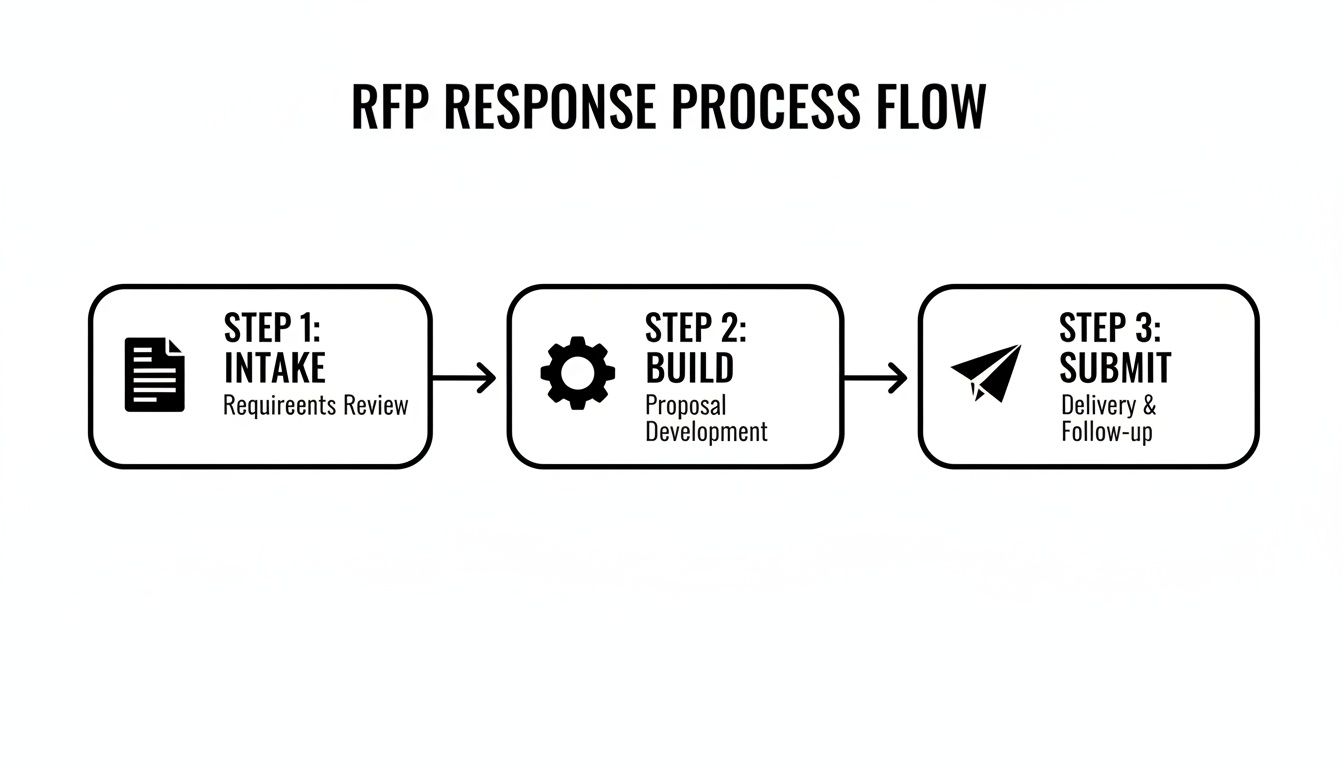
This simple flow cuts through the chaos, giving you a clear path from opportunity to submission. Each stage builds on the last, creating a cohesive and high-quality proposal that stands out.
Why Automation Is No Longer Optional
Still relying on email chains, shared drives, and spreadsheets? You’re creating bottlenecks and inviting costly errors. Disjointed workflows are a recipe for version control nightmares, missed deadlines, and inconsistent messaging that procurement teams spot from a mile away.
A disorganized RFP process doesn't just waste time; it actively undermines your credibility before the client has even read page one. Consistency and professionalism in your submission signal the quality of work they can expect from your organization.
This is where a unified platform becomes a game-changer. With tools like BoloSign, organizations can centralize the entire process. You can create, send, and securely sign all related documents—from NDAs to the final proposal—in one compliant environment. Think about the advantage for a healthcare provider in Canada needing to maintain HIPAA compliance or a real estate developer in Australia juggling multiple bids at once.
BoloSign’s platform brings together AI-powered contract automation with a secure digital signing solution. Imagine being able to:
- Instantly create proposals using pre-approved, compliant templates.
- Collaborate seamlessly with your legal, finance, and sales teams in real-time.
- Automate approval workflows to completely eliminate delays.
- Execute final documents with legally binding eSignatures compliant with ESIGN and eIDAS standards.
When you automate these steps, you don't just speed up your response time; you also strengthen compliance and slash risk. Better yet, BoloSign offers unlimited documents, templates, and team members at a single fixed price, making it up to 90% more affordable than alternatives like DocuSign or PandaDoc.
To give a clearer picture, here’s how a modern, technology-driven workflow breaks down.
Key Stages of an Optimized RFP Response Workflow
This table outlines the critical phases in today's RFP response process, showing how each step’s objective is met with the right technology.
| Stage | Core Objective | Key Enabler (Example) |
|---|---|---|
| Intake & Qualification | Quickly decide if an RFP is worth pursuing based on win probability and resource alignment. | Automated scoring matrix, integrated CRM data. |
| Team Coordination | Assemble the right experts and assign tasks with clear deadlines and dependencies. | Centralized project management dashboards. |
| Content Construction | Draft compliant and persuasive technical, commercial, and legal sections efficiently. | AI-powered content libraries, collaborative editing tools. |
| Review & Approval | Secure sign-off from all stakeholders (legal, finance, leadership) without bottlenecks. | Automated, sequential approval workflows. |
| Submission & Tracking | Deliver the final proposal securely and track its status post-submission. | eSignature platforms with built-in audit trails. |
This structured approach ensures nothing falls through the cracks, transforming a reactive scramble into a proactive, repeatable process.
Ready to transform your RFP process and start winning more bids? Start your 7-day free trial today to see how BoloSign can make a difference.
Qualifying RFPs with a Go or No-Go Framework
Let’s be honest: not every RFP that lands in your inbox is a golden ticket. The most successful teams aren’t the ones chasing every single opportunity. They’re the ones who can quickly spot a winner and politely decline the bids that are a terrible fit from the start. This discipline all comes down to a solid go/no-go framework.
Without a clear qualification process, teams waste countless hours and resources on proposals they have almost zero chance of winning. It’s a reactive approach that kills morale and pulls focus away from the deals you could be closing. A structured framework, on the other hand, transforms this gut decision into a smart, data-driven one.
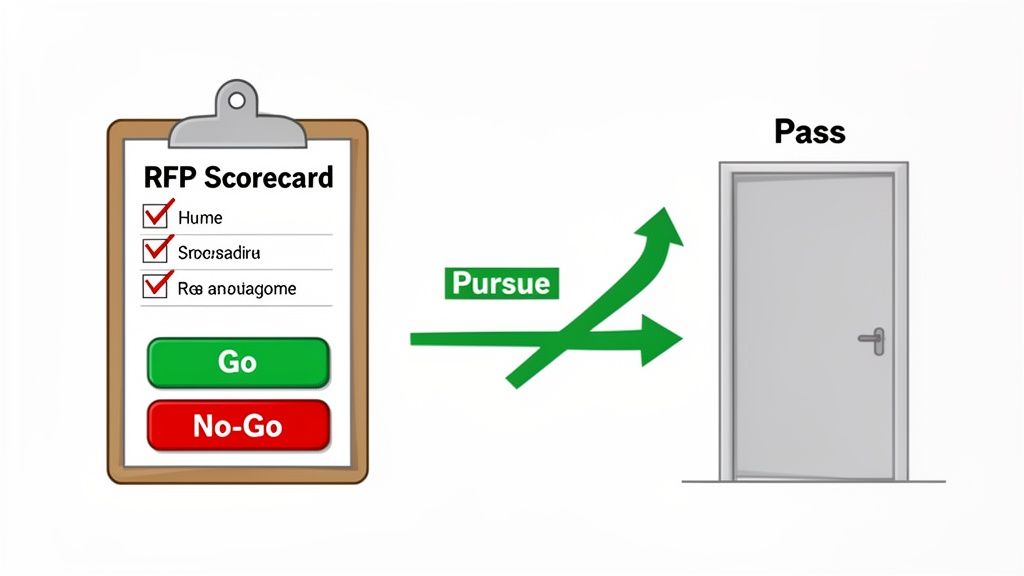
Building Your Qualification Scorecard
The heart of a good framework is a simple qualification scorecard. It forces you to look past the flashy contract value and weigh the real cost and probability of winning.
Think about it this way: a professional services firm in the UAE gets a massive RFP that looks great on paper but requires deep expertise in a niche they only dabble in. A scorecard flags this mismatch immediately, saving everyone a headache.
Your scorecard should score criteria like these:
- Strategic Fit: Does this project actually align with our long-term goals and core strengths?
- Resource Availability: Do we have the right people and the bandwidth to do this right, both for the proposal and the project itself?
- Competitive Landscape: Who are we up against? Is there an entrenched incumbent? Do we have a clear, defensible advantage?
- Relationship Strength: Do we know these people, or are we coming in completely cold? A warm relationship is a massive advantage.
- Profitability Potential: Is their budget realistic for what they're asking? A low-ball bid can end up costing you more in the long run.
By scoring every RFP against these factors, you build a consistent, repeatable process for making smart decisions. It ensures your team’s energy is always focused on opportunities where you have a genuine shot at winning.
Many of the same principles from lead scoring best practices apply here, helping you refine your process and make more informed decisions.
Using AI to Accelerate Qualification
Nobody wants to manually slog through a 100-page RFP document just to find a single deal-breaking requirement buried on page 73. This is where AI-powered tools have become a game-changer, automating the initial analysis so your team can make a call in minutes, not days.
The demand for this kind of efficiency is driving massive market growth.
The global RFP software market has exploded, jumping from USD 1.7 billion in 2023 to a projected USD 4.2 billion by 2032. That’s a compound annual growth rate of 10.5%. This isn’t just hype; it shows how businesses everywhere are scrambling to automate their proposal process to stay competitive.
Platforms with AI contract review features, like BoloSign, can instantly scan huge RFP documents to pull out key requirements, deadlines, and potential red flags. Imagine a US-based healthcare provider getting a compliance-heavy RFP. Instead of someone spending hours hunting for HIPAA or GDPR clauses, an AI can surface them in minutes.
This AI-driven pre-qualification shrinks the timeline from receipt to a go/no-go decision dramatically. It stops being a days-long debate and becomes a quick, data-backed choice. This speed ensures your team is always aimed at the most promising opportunities, maximizing both your win rate and your ROI.
Assembling Your Team and Building the Proposal
Once you’ve given the green light, the real race begins. Responding to an RFP isn’t a solo sport; it’s a full-team press that requires a cross-functional group firing on all cylinders. A messy approach here almost always leads to blown deadlines, mixed messages, and a final document that feels completely disjointed to the evaluator.
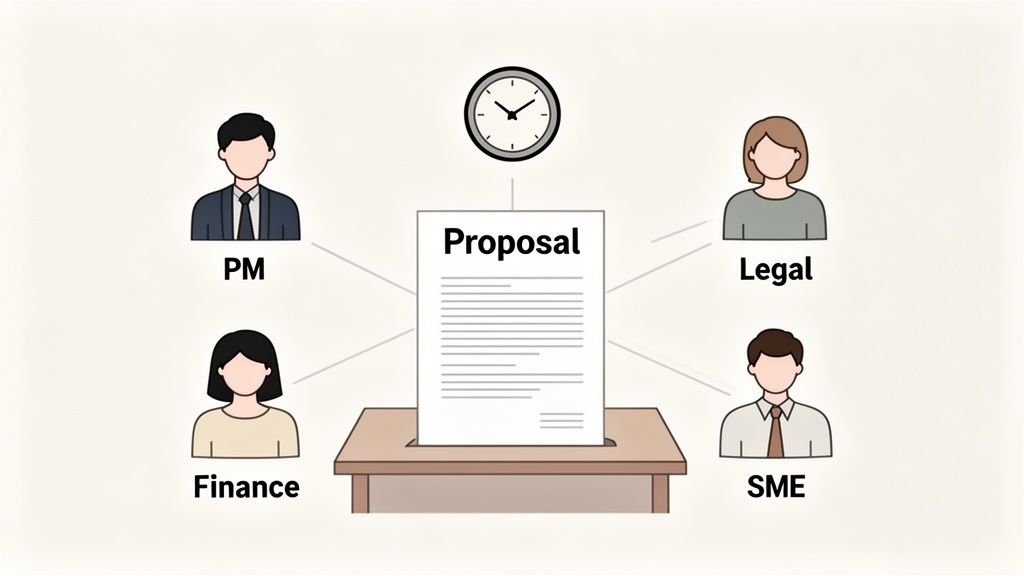
The first move? Appoint a proposal manager or response lead. This person is your quarterback—they don’t write every word, but they own the timeline, wrangle all the contributors, and make sure the final submission is cohesive and compliant. Without a clear leader, accountability gets blurry, and crucial details will inevitably fall through the cracks.
Defining Roles and Responsibilities
With a leader in place, it's time to get the rest of the team on the field. The average RFP requires input from multiple departments, so absolute clarity on who does what is non-negotiable.
Your core response team will almost always include:
- Subject Matter Experts (SMEs): These are your technical gurus from product, engineering, or operations. They provide the detailed, accurate answers that prove you can actually do the job.
- Sales and Account Management: This group owns the customer context. They understand the prospect’s unstated needs and the competitive landscape, helping you tailor the response far beyond the written requirements.
- Legal and Compliance: Absolutely essential for reviewing terms, flagging risks, and ensuring the proposal meets all contractual and regulatory standards, from GDPR in Europe to HIPAA in the US healthcare sector.
- Finance: This team is on the hook for developing a pricing strategy that is both competitive enough to win and profitable enough to be worth it.
A simple responsibility matrix—outlining who owns which section and their deadline—is a lifesaver that prevents utter chaos. This makes sure every part of the proposal is handled by the right expert.
Crafting a Compliant and Persuasive Proposal
With the team assembled, the focus shifts to actually building the document. A winning proposal is a blend of art and science—it has to be meticulously compliant while also being genuinely persuasive. Your goal is to make it incredibly easy for the evaluator to say "yes" by clearly showing you understand their problem and have the best solution.
Break the proposal down into its core components:
- Executive Summary: This is often the only part a busy executive reads. It needs to be a powerful, one-page pitch that focuses on outcomes, not just a list of features.
- Technical Section: This is where you address their requirements point-by-point. Be direct, use their exact numbering system, and provide proof for every single claim you make.
- Commercial Section: Detail your pricing with complete transparency. Confusing or murky pricing models just create suspicion.
- Legal and Contractual Information: Address their proposed terms and conditions clearly and directly.
This is where a centralized content library becomes a massive advantage. Instead of writing every response from scratch, your team can pull from a repository of pre-approved, accurate answers.
A strong content library doesn't just save time; it ensures consistency in your messaging and technical claims across every proposal you submit. It’s your single source of truth for your company's value proposition.
Accelerating Proposal Creation with BoloSign
Manually piecing these components together from scattered documents is slow and riddled with opportunities for error. This is where tools for contract automation can dramatically speed up the process. With BoloSign, you can build a library of proposal templates that serve as your starting point.
For example, a real estate firm in Australia that frequently bids on commercial property management contracts can create a master template in BoloSign. When a new RFP comes in, they can instantly generate a proposal with all the standard sections, legal clauses, and company info already in place.
The team can then use BoloSign's collaborative features to assign sections and work on the document in parallel. The AI assistant can even help draft initial responses based on past successful bids, freeing up your experts to focus on customizing the content to the client’s specific pain points. You can even explore how to add a signature to a Google Form if parts of your data collection rely on that workflow, keeping everything integrated.
This unified approach allows you to create, send, and prepare for the final eSignature all within one secure platform. It transforms proposal building from a manual copy-paste exercise into a strategic, streamlined workflow, giving you back precious time to make your response truly compelling.
Ready to stop reinventing the wheel with every RFP? Start a 7-day free trial of BoloSign and experience how templates and automation can help you build winning proposals faster.
Navigating Pricing, Redlining, and Final Approvals
The proposal is built, the technical answers are polished, and the team feels confident. But the final stretch—pricing, legal review, and approvals—is often where momentum stalls and deals fall apart. This is the make-or-break phase, demanding a delicate balance of competitive pricing, meticulous risk management, and airtight internal coordination.
Smarter response strategies are clearly paying off across the board. RFP win rates have climbed to a global average of 45%, a significant jump from 43% in the previous year and the biggest annual increase in five years. In the United States, this figure also hits 45%, while the United Kingdom edges ahead at 46%, showing how mature markets are honing their edge. A key driver for this uptick is automation, which allows organizations to focus on high-value stages like this one.
Developing a Competitive Pricing Strategy
Your pricing can't be developed in a vacuum. It needs to be competitive enough to win but profitable enough to be worthwhile. This means your finance and sales teams must collaborate closely, considering a few key angles:
- Value-Based Pricing: Instead of just covering costs, anchor your price to the tangible value and ROI your solution delivers to the client. Can you quantify that?
- Competitive Landscape: What are your competitors likely to bid? Your pricing must be positioned strategically within the market. This requires intel, not guesswork.
- Total Cost of Ownership: Look beyond the initial price. Consider long-term costs for the client and highlight areas where your solution is more efficient over the life of the contract.
Transparency is your best friend here. A clear, itemized pricing table inspires confidence, whereas a single, opaque number can create suspicion and invite unnecessary scrutiny.
The Bottleneck of Manual Redlining
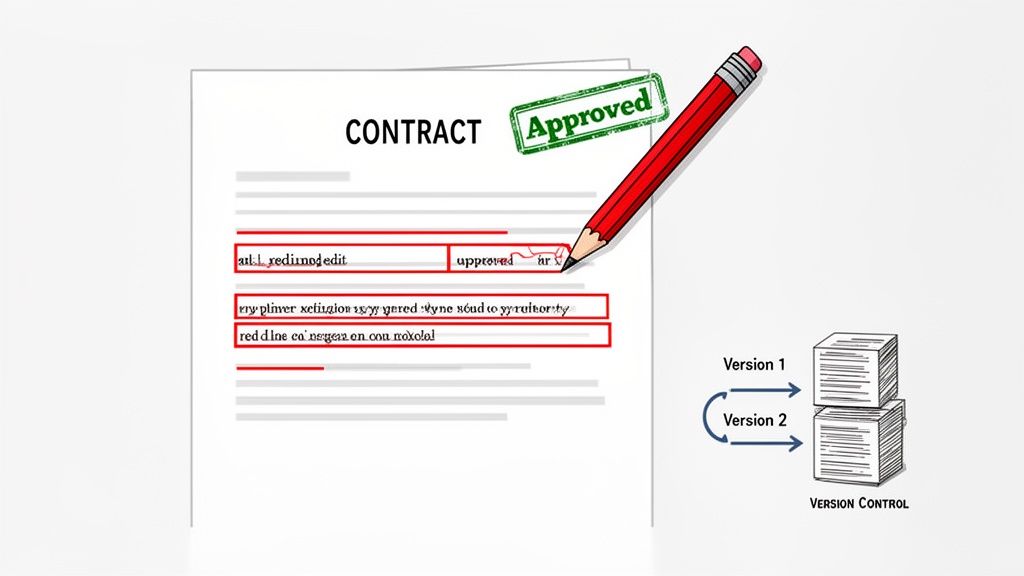
Once pricing is set, the proposal moves to the legal team for review. And this is where the wheels can come off. Traditional, email-based redlining creates massive bottlenecks. Version control becomes a nightmare as Word documents fly back and forth, each with different tracked changes and comments. It's organized chaos at best.
Imagine a logistics company in the UAE negotiating complex liability clauses in an RFP. Multiple stakeholders from legal, operations, and finance need to weigh in. With email, it’s nearly impossible to track who approved what and ensure the final version incorporates everyone’s feedback correctly. This mess not only slows the process down but also dramatically increases the risk of human error.
Manual redlining isn't just inefficient; it's a significant business risk. A single missed edit or unapproved clause can expose your organization to unacceptable liabilities down the line.
Streamlining Review with AI Contract Intelligence
This is where a modern platform transforms the entire experience. BoloSign’s AI contract review capabilities turn a chaotic process into a controlled, efficient workflow. Instead of emailing documents, your team collaborates on a single, centralized version. No more "final_v3_final_final.docx."
Our AI-powered contract intelligence can automatically:
- Flag Risky Clauses: Instantly identify non-standard or high-risk language related to liability, indemnification, or data privacy.
- Suggest Alternative Language: Propose pre-approved, compliant clauses from your legal playbook to speed up negotiations.
- Maintain a Clear Audit Trail: Track every single change, comment, and approval, creating a complete, verifiable record for compliance.
This system gives your legal team full visibility and control. For a deeper dive into modernizing this crucial step, you can review our guide on AI contract lifecycle management.
Automating Final Approvals for Speed and Compliance
The final hurdle is securing sign-off from all internal stakeholders—legal, finance, and executive leadership. Waiting for manual signatures or chasing down approvals via email is a recipe for last-minute panic, especially with a tight submission deadline looming.
Automated approval workflows eliminate this friction entirely. With a solution for contract automation like BoloSign, you can set up a sequential approval chain. Once one stakeholder approves, the document is automatically routed to the next person in line. No chasing required.
This ensures:
- No Missed Steps: The process is locked in, guaranteeing that every required stakeholder signs off.
- Full Accountability: Everyone’s approval is digitally recorded and timestamped.
- Speed to Submission: The final, approved proposal is ready for its eSignature and delivery well before the deadline.
By automating these final stages, you ensure your meticulously crafted proposal crosses the finish line with full compliance and without any of the last-minute stress.
Secure Submission and Strategic Follow-Up
Getting your RFP response over the finish line is about more than just hitting 'send'. The final steps—securely submitting the proposal and then following up strategically—are where you truly cement trust and professionalism. A sloppy delivery can undermine weeks of hard work, while a thoughtful follow-up strategy can set you apart from competitors who simply disappear after submitting.
Executing the Final Proposal with Compliant eSignatures
Before you can submit, the proposal needs to be officially signed. This isn't just a formality; it's a critical legal step, and procurement teams expect it to be handled with airtight security and compliance. Emailing scanned PDFs is an outdated and risky method that leaves your submission vulnerable and lacks a verifiable audit trail.
A modern digital signing solution is non-negotiable here. Using a platform like BoloSign ensures every document is executed in a way that’s both secure and legally sound, providing verifiable proof of who signed, when, and where. This builds immediate trust with the procurement team.
In the world of high-stakes proposals, how you sign and submit your document is a direct reflection of your company's commitment to security and professionalism. An eSignature with a clear audit trail isn't just a convenience; it's a statement of compliance.
BoloSign is built to guarantee that all signatures are legally binding and adhere to major global regulations, giving both you and your client complete peace of mind.
- ESIGN Act (United States): Ensures your eSignatures are legally valid across the U.S.
- eIDAS (European Union): Provides a consistent legal framework for electronic signatures across the EU.
- HIPAA & GDPR: For industries like healthcare in the US or professional services in the EU, BoloSign maintains the stringent data privacy and security standards required for compliance.
Whether you're a staffing agency in Canada or a logistics firm in the UAE, using BoloSign to sign PDFs online means you can confidently execute proposals, knowing the signatures are secure and backed by a detailed, court-admissible audit trail.
The Art of Strategic Follow-Up
Once your proposal is securely submitted, the waiting game begins. But being completely passive is a mistake. A strategic follow-up plan keeps you on the buyer's radar without being pushy or annoying. The key is to add value, not pressure.
A simple, professional confirmation email immediately after submission is a great first move. It confirms they received it and reiterates your enthusiasm for the opportunity. After that, your follow-up cadence should be respectful of their evaluation timeline.
A well-timed check-in a week or two later might involve sharing a relevant case study or article, which shows you’re still engaged with their industry and its challenges. This approach positions you as a helpful expert rather than just another vendor chasing a deal. You can find more details on what happens after the signature in our guide to understanding the contract signing process.
Analyzing the Outcome to Refine Your Process
Whether you win or lose, the RFP process isn’t truly over until you’ve analyzed the outcome. This final step is crucial for continuous improvement.
If you win, conduct a "win analysis" to understand what resonated most with the client. Was it your pricing, your technical solution, or your deep understanding of their pain points? Document these strengths so you can replicate them in future bids.
If you lose, don't be afraid to proactively ask for a debrief. Feedback from the evaluators is invaluable intelligence. It might reveal gaps in your proposal, issues with your pricing model, or a competitor's strength you hadn't anticipated. Use this feedback to refine your go/no-go framework and strengthen your content library for the next opportunity.
Remember, this is a global game. Market trends show that the Asia-Pacific region is set for huge growth in RFP software adoption, with an 18.2% CAGR. This market segment makes up 23% of the USD 2,624.5 million total, driven by digitalization in China and India as logistics and real estate firms automate their bidding processes. This contrasts with North America's steady leadership, where healthcare and sales enterprises use advanced tools for faster deal cycles.
By treating every submission—win or lose—as a learning experience, you turn your RFP response process into a powerful engine for growth and refinement.
Turning RFP Responses Into Revenue with Smart Automation
Winning RFP documents consistently isn’t about brute force or last-minute heroics. It's the direct result of a smart, repeatable process powered by the right technology. Real success comes from strategic automation, not just throwing more people at the problem.
From the initial go/no-go call to the final, secure eSignature, every step we've covered is a chance to build a competitive advantage. The journey from qualification to submission stops being a chaotic mess of emails and spreadsheets and becomes one integrated, efficient workflow.
From Cost Center to Revenue Driver
This is where platforms like BoloSign come in. They are designed to connect every stage of this process, bringing together everything you need—from AI-powered drafting and collaborative templates to legally binding eSignatures—all under one roof. This unified approach delivers outcomes you can actually measure.
- Slash Response Times: Teams in professional services or logistics can cut the time it takes to build and submit high-quality proposals by days, not hours.
- Boost Win Rates: A polished, compliant, and timely submission makes a powerful impression on procurement teams, directly improving your odds of winning.
- Lower Your Risk: With built-in compliance for ESIGN, eIDAS, HIPAA, and GDPR, you can confidently go after opportunities in any market without worrying about legal exposure.
This is the core of modern AI contract lifecycle management, where technology handles the repetitive, low-value work so your experts can focus on winning strategy.
The goal is to transform your RFP process from a reactive, high-stress cost center into a predictable and efficient revenue engine for your business.
What really sets BoloSign apart is the value. You get unlimited documents, templates, and team members for one fixed, predictable price. This makes enterprise-grade contract automation and eSignature capabilities up to 90% more affordable than alternatives like DocuSign or PandaDoc.
Experience the difference firsthand. Start your 7-day free trial and see how BoloSign can help you turn your next RFP response into a win.
Questions We Hear All the Time About Responding to RFPs
Even with a rock-solid process, responding to an RFP always brings up questions. Here are the ones that pop up most often, along with some straight-talking answers from our experience on the front lines.
What’s the Most Common Mistake Companies Make?
The single biggest mistake? Diving headfirst into writing without qualifying the RFP. So many teams jump straight into the response without first asking the tough question: "Can we really win this, and is it a good fit for us?" This leads to countless hours wasted on bids they had little to no chance of winning in the first place.
A close second is sending out a generic, one-size-fits-all proposal. Procurement teams can spot a copy-paste job from a mile away. It immediately signals you haven’t bothered to understand their unique challenges, and it’s a fast track to the “no” pile.
How Can AI Tools Really Help in the RFP Process?
Let's be clear: AI isn't about replacing people. It's about making your experts more strategic by automating the most tedious, time-consuming tasks.
AI tools, like the ones built right into BoloSign, can:
- Scan a massive RFP document in seconds to pull out key requirements, deadlines, and potential red flags.
- Help draft initial responses by instantly finding approved content from your knowledge library.
- Flag risky or non-standard clauses that need a second look from your legal team.
This powerful AI contract review capability speeds up the entire process, cuts down on human error, and frees your team to focus on the strategic work—like tailoring the proposal—instead of getting bogged down in administrative muck. To really maximize the revenue you get from your RFP responses, it helps to understand and use tools like the ones covered in a practical guide to Revenue Intelligence.
How Can Our Team Actually Improve Our RFP Win Rate?
Boosting your win rate boils down to two things: discipline and a smart tech stack. If you focus on these three core areas, you’ll see a real difference.
- Get More Selective. Seriously. Put a strict go/no-go process in place and only chase the RFPs where you have a clear, defensible competitive edge. Saying "no" to the wrong bids is just as important as saying "yes" to the right ones.
- Personalize Every Single Response. Show them you’ve done your homework. Your proposal should speak directly to the client's specific pain points and business goals, not just list your features.
- Build a Tech-Driven Workflow. Use a single, unified platform for collaboration, content management, and the final eSignature. This is how you guarantee every proposal goes out looking professional, fully compliant, and on time, every time.
Ready to stop wasting time on manual processes and start winning more bids? BoloSign offers a unified platform to manage the entire RFP response lifecycle with AI-powered automation and secure, compliant eSignatures.
Start your 7-day free trial to experience BoloSign firsthand.

Paresh Deshmukh
Co-Founder, BoloForms
16 Jan, 2026
Take a Look at Our Featured Articles
These articles will guide you on how to simplify office work, boost your efficiency, and concentrate on expanding your business.