

Renewing a Contract: A Step-by-Step Timeline and Checklist
Learn how renewing a contract works: set the right notice dates, run a review checklist, renegotiate terms, and automate renewals with CLM to avoid lapses.

Tired of nonsense pricing of DocuSign?
Start taking digital signatures with BoloSign and save money.
The vendor has sent a renewal PDF, finance wants to know whether the price is fair, and the operations team doesn't want any interruption. Before you send it for signature, check whether you still have time to say no. The expiry date may be weeks away while the cancellation deadline has already passed.
Renewing a contract is a commercial decision, not a filing task. A sound process gives someone responsibility for the decision, tests whether the agreement still delivers value, and preserves enough time to negotiate or leave.
Renewal Timeline and Triggers to Track
Consider this illustrative scenario: a staffing agency's placement contract with its payroll vendor rolls over on Friday. Nobody noticed that the notice window closed the month before. Payroll continues without disruption, but finance loses the opportunity to challenge the renewal price or reduce unused capacity.
That's an ownership problem, not just a missed reminder. Aberdeen Group research cited by Ironclad's contract renewal guide reported that best-in-class organizations renew 56% of their contracts annually, compared with about 25% for other organizations, equivalent to roughly 310 additional renewals per 1,000 agreements. This indicates a difference in operational capability, not proof that more renewals are always better.
Build the calendar from the notice deadline
Record the expiry date, notice window, auto-renewal trigger, price escalation formula, termination rights, and required notice method. Capture the exact clause location so legal can verify the interpretation without searching the entire PDF.
Use this working calendar, then move checkpoints earlier wherever the contractual notice period requires it.
Renewal milestones, actions and owners
| Milestone | Action | Owner |
|---|---|---|
| 180 days before expiry | Open the renewal file, pull the key clauses and name an owner | Business owner and contract manager |
| 120 days before expiry | Start collecting performance evidence and usage data | Operations and procurement |
| 90 days before expiry | Benchmark pricing and draft the negotiation position | Procurement and finance |
| 60 days before expiry | Send proposed changes to the counterparty if any are needed | Legal |
| 30 days before expiry | Complete final approvals and keep proof of notice | Approvers named in the approval workflow |
| Notice deadline | Hold the decision gate: renew, renegotiate or exit | Business owner and finance |
Treat the last row as a hard stop, not the preferred meeting date. Hold the decision gate before the notice deadline, with time left to deliver a valid notice.
The visual below shows why the review must happen before the cancellation window closes.
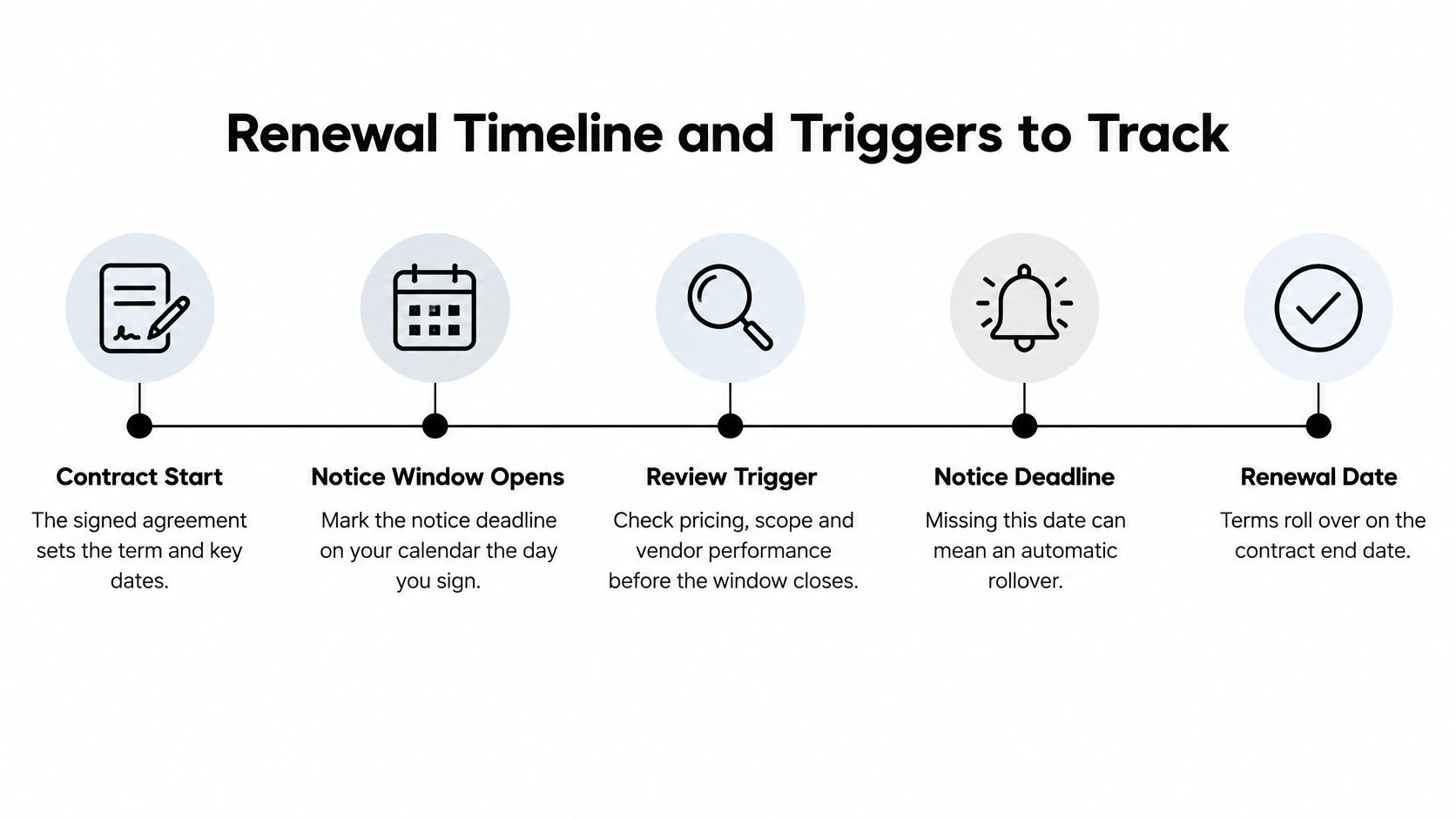
This week, build this timeline for your five most valuable contracts, starting with the nearest notice deadline.
Auto-Renewal Rules That Set Your Notice Dates
Map the jurisdiction before setting reminders. A BCLP legal overview identified at least 24 US states with automatic-renewal statutes and explains that FTC Act Section 5 addresses unfair or deceptive practices, while ROSCA requires clear disclosure and express consent for covered online consumer transactions.
The state-level differences matter. The regulatory developments described in Paul Hastings' auto-renewal update include California amendments effective July 1, 2025, requiring affirmative-consent records for at least three years or one year after termination, whichever is longer, annual reminders and advance notice of plan changes; Florida's 2025 statute requires notice 30 to 60 days before the cancellation deadline for certain consumer service contracts, while a federal appeals court vacated a 2025 federal auto-renewal rule change.
Match the rule to the agreement
Use this jurisdiction map as a screening tool, not a substitute for checking the current law and its exemptions.
Auto-renewal rules by jurisdiction and contract type
| Jurisdiction | Requirement | Applies to |
|---|---|---|
| California amendments | Retain affirmative-consent records for the applicable statutory period; send annual reminders and advance notice of plan changes | Consumer auto-renewal plans |
| Florida statute | Send notice within the statutory advance-notice window | Certain consumer service contracts |
| US federal, FTC Act and ROSCA | Avoid unfair or deceptive practices; provide clear disclosure and obtain express consent for covered online transactions | Covered consumer online transactions |
| Other US states with auto-renewal statutes | Check disclosure, consent, cancellation and reminder requirements | Contracts covered by each state's definitions and exemptions |
| Business-to-business agreements | Don't assume consumer rules apply or that commercial agreements are exempt; check the law and contractual terms | Supplier, staffing, vendor and lease renewals |
| Canada, Australia, New Zealand, UAE | Obtain local review before relying on this workflow | Consumer subscriptions, commercial services and leases under applicable local law |
Label each agreement business-to-business or consumer-facing, identify applicable jurisdictions, and separate renewal notices from material-change notices and cancellation confirmations. Keep the disclosure, consent record, notice version and delivery evidence together.
For Canadian property agreements, Royal LePage Brookside Realty's guide to BC rental termination forms and rules provides useful tenancy-specific context. Don't apply a generic vendor cancellation workflow to a residential tenancy.
Deleting an auto-renewal clause doesn't resolve every compliance issue. Review disclosure, consent, timing, records and the accessibility of cancellation together.
Review Checklist Before You Decide on Renewal
A supplier can hit every delivery obligation and still cost too much, sit underused, or fit your business poorly. Contractual compliance tells you whether the supplier kept its promises. It cannot tell you whether another term is worth buying.
New Zealand's 2025 Procurement Capability Index found that 77.3% of agencies recorded on-time delivery and 88.0% recorded delivery within budget, yet performance monitoring wasn't consistently embedded. Records exist. The gap is converting them into a documented decision taken before the notice deadline, not after it. If the evidence isn't assembled by that date, the renewal has already happened by default.
Pre-renewal scorecard: evidence, checks and red flags
| Evidence area | What to verify | Red flag |
|---|---|---|
| Service levels | SLA attainment and service credits over the last 12 months | Targets met on paper while credits are never claimed or applied |
| Usage and spend | Actual volume against committed volume and spend against baseline | Large gap between committed and used volume |
| Pricing | Current price against the escalation formula and fresh market quotes | Escalator running ahead of benchmark quotes |
| Incidents and disputes | Count and cost of defects, disputes and outages | Same issues recurring without a documented fix |
| Stakeholder view | Feedback from the teams that use the service every day | Teams working around the supplier |
| Data and compliance terms | Data protection, audit rights and subcontracting clauses | Clauses unchanged despite changes to applicable obligations |
| Exit terms | Termination rights and exit assistance | No practical way to leave without major disruption |
Turn findings into a recommendation
Ask operations to substantiate performance, finance to validate total cost, and legal or compliance to identify unacceptable exposure. Use contract obligation tracking and management to connect promised services with evidence of delivery, rather than relying on the account manager's summary.
For a logistics company, repeated delivery failures may justify changing carriers despite competitive rates. For an education provider, unused training capacity may justify reducing scope rather than replacing a reliable supplier. Both outcomes belong in the same record: what was checked, what failed, and who signed off.
Include transition and implementation costs before recommending an exit. Where continuity is sensitive, plan the transition steps, including data migration, onboarding and any overlap period, before committing to a switch. Consumer switching guides show the same sequencing in a different category: a walkthrough of how to change health insurance providers in Spain covers notice, overlap, and confirming the new service is live before the old one ends.
Record a recommendation, unresolved conditions and an accountable approver. A renewal that nobody championed, on evidence nobody produced, is a default rather than a decision.
Decision standard: A high renewal rate is a warning sign if nobody can explain which agreements failed the scorecard.
Apply the same checks to familiar suppliers and new alternatives. Renewing feels easier, and that ease is exactly how poor economics survive.
Renegotiation Tips and the Concession Matrix
Ask for fewer changes, backed by better evidence. Too little challenge leaves value untested, but reopening every clause can consume the negotiation window and threaten continuity without improving the agreement.
A peer-reviewed study of 252 French public-sector parking contracts observed renewal rates of 45% for concession contracts and 78% for service contracts, and found that renegotiation characteristics influenced retention of the incumbent. Those are sector-specific findings, not targets for your portfolio, but they reinforce the need to calibrate the negotiation.
Separate a service fix from a commercial trade
An unresolved security incident isn't something to exchange for a discount. Require a documented remedy and an accountable owner. Then negotiate commercial changes using utilization, volume forecasts, inflation indices, benchmark quotes and service-credit history.
For example, a professional services firm might seek lower committed capacity because its project pipeline has changed. A staffing agency might instead need guaranteed payroll support during peak processing periods. Those are different problems and require different concessions.
Concession matrix
| Benefit requested | Reciprocal trade | Boundary to preserve |
|---|---|---|
| Lower unit pricing | Longer commitment | Usable termination rights |
| Guaranteed peak capacity | More reliable volume forecasts | Remedies for missed capacity |
| Stronger service credits | Faster payment of undisputed invoices | Ability to dispute incorrect charges |
| Lower minimum commitment | Narrower service scope | Clear deliverables and responsibilities |
| Predictable renewal pricing | Earlier planning discussions | Adequate renewal notice |
Set a must-have position, tradable position and walk-away position before contacting the supplier. Finance should approve the economics of a longer commitment, including the cost of unused volume, rather than approving only the headline discount.
Keep termination, renewal-notice, liability, confidentiality and compliance protections outside the routine commercial concession pool. Any proposed change to those protections needs separate legal approval.
Use a controlled redline to record the actual exchange. A practical guide to how to redline a contract can help reviewers distinguish negotiated wording from unresolved comments.
Don't exchange a durable contractual protection for a temporary price concession without explicitly approving the risk.
Close every agreed change in the amendment, including revised scope and effective dates. Missed notices, undocumented side agreements and reliance on a friendly relationship instead of market testing are avoidable weaknesses, even when the incumbent is performing well.
Approvals and eSignature Steps That Close the Renewal
Approval and signature serve different purposes. Approvers authorize the commercial and legal decision; authorized signers execute the agreement. Sending a PDF for eSignature doesn't replace internal approval.
Follow a controlled signing sequence
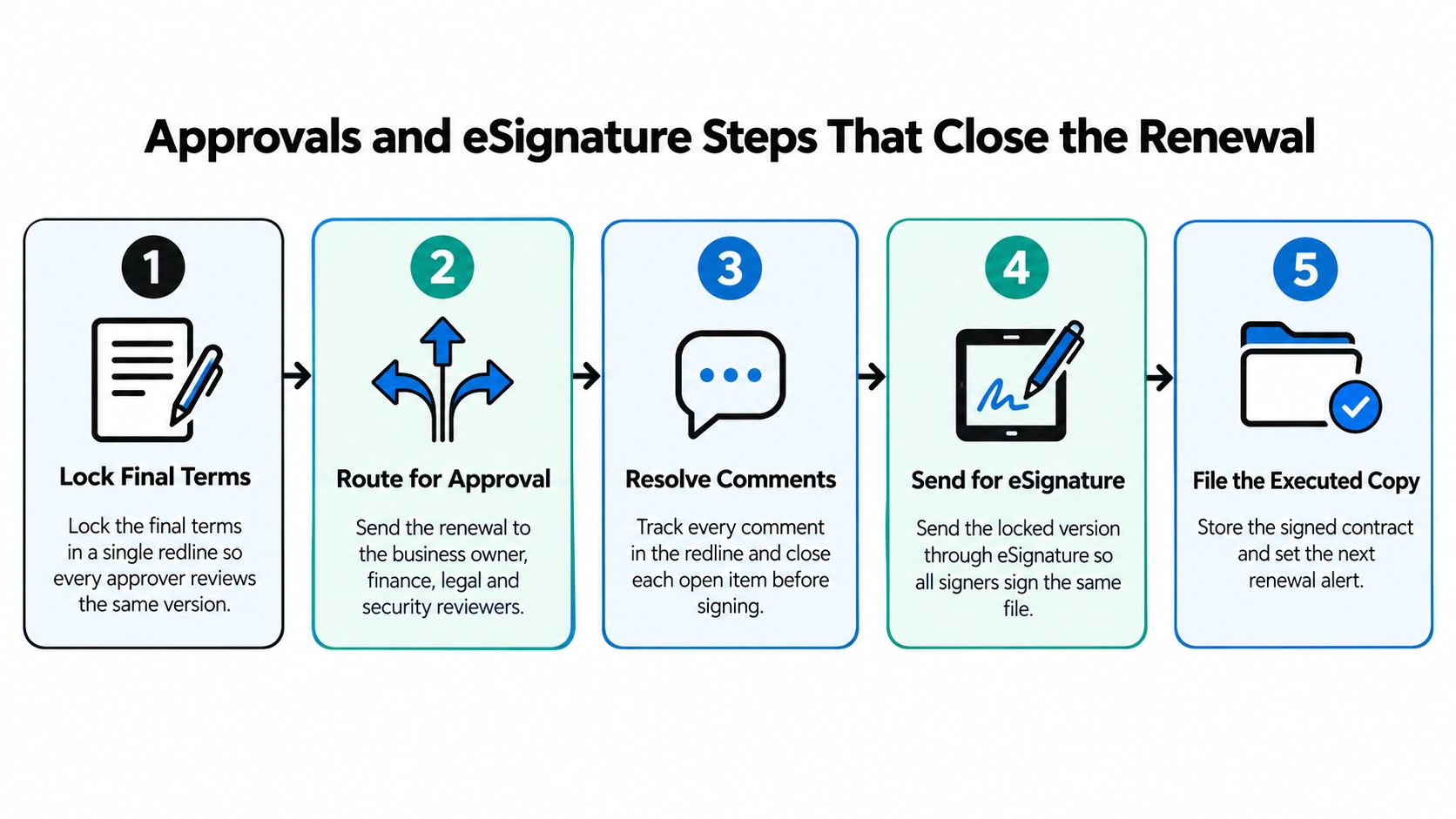
- Lock the final terms. Maintain a single redline, resolve comments and produce the clean execution version.
- Route the renewal to the business owner, finance, legal, and security or compliance in the agreed order. If the counterparty changes a material term, return it to the affected approver.
- Record each approval with the reviewer's name, date, decision and any conditions.
- Create or upload the renewal PDF, place signature and date fields for each signer, and send the locked version for eSignature.
- Track outstanding signatures and confirm that every required party has completed the document.
- Archive the executed copy with the approval record, revised terms and ongoing obligations.
Reusable templates help teams create, send and sign PDFs and forms instantly without rebuilding routine renewal amendments. A staffing agency can renew placement terms, a real estate firm can extend a lease, and a logistics company can execute revised carrier terms while keeping transaction-specific fields separate from approved wording.
The flow below summarizes the handoffs.
Preserve evidence without overstating compliance
Under the US ESIGN framework, electronic form alone isn't grounds to deny a signature or record legal effect. Separately, the EU eIDAS regulation protects electronic signatures from rejection solely because they're electronic and gives qualified electronic signatures the equivalent legal effect of handwritten signatures. Attribution, consent, retention and transaction-specific requirements still matter.
For clinics renewing provider agreements, the HIPAA Security Rule requires appropriate safeguards for electronic protected health information, including transmission security. The HIPAA Privacy Rule also requires appropriate access controls and minimum-necessary uses and disclosures where applicable.
GDPR obligations likewise require review when personal-data processing falls within its scope. Audit trails and central storage help evidence a controlled process, but they don't make every configuration compliant.
When teams sign PDFs online as part of signing a contract, restrict access to the fields and records each participant needs. Keep unnecessary patient or employee information out of renewal packets.
Automating Renewals With CLM Alerts and a This-Week Start
A renewal rarely fails loudly. It fails unnoticed, in a spreadsheet nobody opened. An ACC survey cited in PRGX's procurement best-practices guide found that organizations overlook expirations or renewals daily in 1% of cases, weekly in 20%, monthly in 56%, and annually in 23%. Most misses sit on the monthly cycle, which means the agreement someone planned to check "later" is usually the one that lapses.
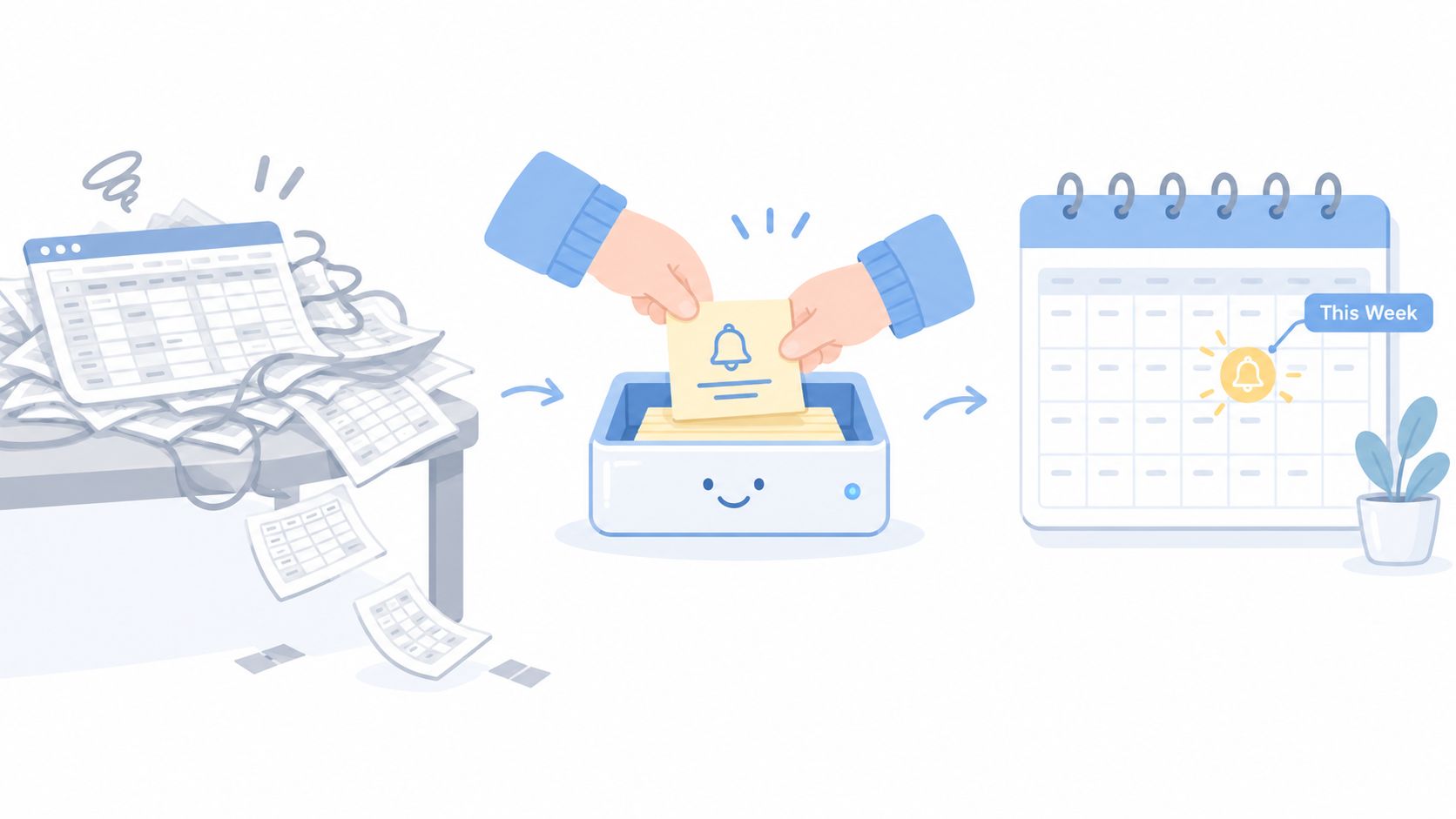
A spreadsheet can list every deadline. Someone still has to act, escalate and preserve evidence, so the operational improvement is connecting reminders to assigned work rather than swapping cells for notifications.
Automate preparation, not the decision
Configure a rule that opens a renewal task early enough to complete the review before the notice window closes. Assign a fallback owner and escalate unanswered tasks. A notification sent to someone who has left the company is a calendar entry with a dead mailbox, not a working control.
Generate a standard renewal packet from the contract record: current terms, performance evidence, proposed changes and the approval checklist. For CRM-driven customer agreements, Captiwate's guide to automating renewal and expansion workflows offers useful context for connecting account activity with operational handoffs.
Spreadsheet tracking versus a CLM-based renewal process
| Renewal task | Spreadsheet tracker | CLM-based process |
|---|---|---|
| Expiry and notice alerts | Calendar reminders that depend on one person | Automated alerts at 180, 120, 90 and 30 days with escalation |
| Owner assignment | Named cell in a shared file | Named owner per contract with a fallback approver |
| Proof of notice | Email threads searched after the fact | Logged delivery evidence and separate signing record |
| Clause visibility | Manual reading of each PDF | AI extraction of renewal dates, termination rights and escalators |
| Audit trail | Versions scattered across drives | Central record of amendments, approvals and signed copies |
| CRM data | Re-keyed from HubSpot or Salesforce | Synced through a configured CRM integration |
An AI-powered contract platform can surface renewal terms and risky clauses from uploaded PDFs alongside calendar tools and CRM task queues. AI contract review should prepare the review; a contract manager still verifies extracted dates against the signed wording before the decision gate.
Reusable templates, eSignature requests and HubSpot integration reduce repeated entry. Where teams add signature to Google Form workflows, keep intake answers distinct from the controlled agreement that is ultimately signed.
The video offers a practical view of digital signing workflows.
Start with the contracts that matter this week
- List upcoming expirations. Pull every agreement expiring in the next 180 days.
- Record each notice deadline and whether the agreement automatically renews.
- Assign a named owner, plus someone responsible for delivering notices.
- Set the four milestone alerts in the working calendar, moving them earlier where necessary.
- Score the five highest-value renewals first. Assign actions for missing evidence.
- Book the decision gate before the earliest notice deadline with the business owner, finance, legal and compliance.
Record the outcome plainly: renew, renegotiate or exit. A high renewal rate is a warning sign, not a success metric, unless each renewal passes the same scorecard. Count a renewal as successful only when it clears that review and subsequent results support the approved baseline for price, service, risk and total cost.
BoloSign centralizes intake, redlining, approvals and execution in one AI-powered CLM, with an assistant that flags risky clauses and secure eSignature for final execution. Visit BoloSign to see how it can track renewal dates, route approvals and send your next approved PDF for signature.

Paresh Deshmukh
Co-Founder, BoloForms
30 Oct, 2026
Take a Look at Our Featured Articles
These articles will guide you on how to simplify office work, boost your efficiency, and concentrate on expanding your business.