

A Guide to Recruitment Agency Agreement Templates
Craft a clear and effective recruitment agency agreement template. Our guide breaks down key clauses and shows how to streamline your process with eSignatures.


Tired of nonsense pricing of DocuSign?
Start taking digital signatures with BoloSign and save money.
In the fast-paced world of talent acquisition, a handshake deal just isn’t going to cut it. A solid recruitment agency agreement template is the foundation for any successful client relationship. It's what protects your agency from the inevitable headaches over fees, scope, and candidate ownership right from the start.
Why Your Agency Needs a Strong Agreement
Think of your recruitment agreement as the blueprint for the partnership. Without one, you’re basically navigating a complex client project without a map. This isn’t just about having legal cover; it's about setting crystal-clear expectations that build trust and prevent costly misunderstandings down the line.
The global recruiting market is absolutely booming. Projections show it could hit USD 924.29 billion by 2030, which tells you just how complex hiring has become. As more businesses lean on specialized agencies like yours, the need for a formal, professional partnership has never been more critical.

Avoiding Common Pitfalls
Vague terms are a recipe for conflict. I’ve seen it happen time and time again. Picture this: a staffing agency in the US places a great software developer with a tech startup. Three months later, the client quietly hires another candidate from that same shortlist for a different team.
Without a clear candidate ownership clause, the agency might lose out on a placement fee they absolutely earned. A well-structured agreement removes that ambiguity from day one.
Here's a quick look at the essential clauses that form the backbone of any strong recruitment agreement and why each one matters for your business.
Core Components of an Effective Recruitment Agreement
| Clause | Primary Purpose | Why It's Critical |
|---|---|---|
| Scope of Services | Defines exactly what you will and won't do for the client. | Prevents scope creep and ensures you're paid for all the work you perform. |
| Fee Structure | Outlines how you get paid—contingency, retained, split-fee, etc. | Eliminates confusion over payment triggers, amounts, and deadlines. |
| Candidate Ownership | Specifies the period (e.g., 12 months) you're owed a fee if a client hires a candidate you presented. | Protects your revenue from "backdoor" hires and ensures you get credit for your introductions. |
| Exclusivity | Determines if you are the sole recruiter for a specific role or period. | Gives you the confidence to invest significant resources into a search without competition. |
| Warranties | Outlines any guarantees you offer, like a replacement if a candidate leaves early. | Builds client trust and manages expectations around placement success. |
| Confidentiality | Protects sensitive information shared by both your agency and the client. | Essential for building a professional, trustworthy relationship. |
| Termination | Defines the conditions under which either party can end the agreement. | Provides a clear, professional exit strategy if the partnership isn't working out. |
These clauses work together to create a clear, enforceable framework that protects both you and your client, letting you focus on what you do best: finding amazing talent.
Adapting to Modern Hiring Challenges
Today's hiring landscape is all over the place—remote teams, global placements, and niche skills in hot sectors like healthcare, logistics, and professional services. Your agreement has to be flexible enough to handle these modern complexities.
For instance, a contract for a hospital in Australia needs clauses that address local privacy laws. Placing a remote employee in the UAE for a Canadian company means you have to think about cross-border legal jurisdictions. Understanding the unique value your agency provides is key, which is why a comprehensive agreement is so important, as highlighted in the benefits of partnering with a Web3 recruiting agency.
A robust agreement isn't a barrier to business; it's an enabler. It signals professionalism, manages risk, and allows everyone to focus on the real goal—finding the perfect hire.
Ultimately, having a standardized yet customizable template is your agency's secret weapon. It drives consistency, saves a ton of time, and gives you a solid starting point for every new client.
You can take this foundational document and turn it into a slick digital workflow with the right tools. Platforms offering compliant contract automation let you create, send, and get agreements signed in minutes, transforming a clunky manual process into a real competitive advantage.
Breaking Down Your Agreement Clause by Clause
Let's be honest, diving into a legal document can feel like trying to read another language. But your recruitment agency agreement doesn't have to be a source of anxiety. The best way to think about it is that each clause is a building block for a strong, clear, and fair partnership with your client.
We're going to pull apart the most critical components you'll find in any solid recruitment agency agreement template.

This isn’t about just copy-pasting legal jargon. It’s about understanding the why behind each section so you can adapt it to any situation that comes your way. Whether you're placing tech talent in Canada or healthcare professionals in Australia, these core principles hold up.
Defining the Scope of Services
This is arguably the most important clause in the entire agreement. It draws a clear line in the sand, spelling out exactly what you'll deliver for the client. Any ambiguity here is a one-way ticket to scope creep and doing work you're not getting paid for.
Your Scope of Services needs to be specific and actionable. Don't just settle for "recruitment services." Break it down into tangible deliverables.
- Sourcing and Screening: Will you run initial phone screens? What about technical assessments or reference checks? Get it in writing.
- Interview Coordination: Clarify your role in scheduling interviews between the client and your candidates.
- Offer Management: Will you be part of negotiating offers and navigating the final steps? Outline it here.
By being explicit from the get-go, you manage client expectations and protect yourself, ensuring you’re compensated for every ounce of effort.
Nailing Down the Fee Structure
Money talk can be awkward, but your agreement is the perfect place to make it straightforward and professional. This clause removes all doubt about how, when, and how much you get paid. The most common models are contingency and retained search, but the devil is in the details you include here.
A well-defined fee clause is your best defense against payment disputes. It must clearly state the fee percentage, what that percentage is based on (e.g., the candidate's first-year base salary), and the payment trigger—like the candidate's official start date.
Real-World Example: A Tech Staffing Firm
Imagine you've just placed a Senior DevOps Engineer with a SaaS company in Toronto. The agreed-upon fee is 20% of their first-year base salary of $150,000 CAD.
Your fee structure clause should look something like this:
"The recruitment fee shall be twenty percent (20%) of the placed candidate's guaranteed first-year annual base salary. For a candidate with a base salary of $150,000 CAD, the fee will be $30,000 CAD, due within 30 days of the candidate's official start date."
There's absolutely no room for misinterpretation there.
Establishing Candidate Ownership
Think of this clause as your "no backdoor hires" protection. It ensures you get paid for introducing a candidate, even if the client tries to hire them for a different role or waits until after your direct engagement ends.
A typical candidate ownership period is between 6 and 12 months. This means if the client hires any candidate you presented within that window, your placement fee is still due. It's a standard and fair practice that recognizes the value of your sourcing work.
Clarifying Exclusivity
Are you the only agency working on this role? The exclusivity clause settles that question upfront.
- Exclusive Agreement: You're the sole recruiter for a specific role or for a set period. This is common for high-priority or tough-to-fill positions, as it justifies dedicating significant resources without worrying about competition.
- Non-Exclusive Agreement: The client can engage multiple agencies at the same time. The fee simply goes to whichever agency makes the successful placement.
Your agreement has to state which model applies to avoid confusion and potential conflicts down the line. To get a better feel for how these clauses are structured, it's always a good idea to look at examples of general terms and conditions from established platforms in the industry.
Warranties and Guarantees
What happens if a placement just doesn't work out? A warranty or guarantee clause tackles this head-on. It’s essentially a safety net for your client, and it goes a long way in building trust.
A common approach is a replacement policy. For instance, if a candidate leaves within the first 90 days (for any reason other than redundancy or a major change in the job scope), you agree to find a replacement at no extra charge. Some agencies prefer a pro-rated refund. Whatever you choose to offer, define it clearly.
Confidentiality and Data Protection
In our line of work, we handle a mountain of sensitive information—from a client's strategic business plans to a candidate's personal data. This clause is a legally binding promise from both you and the client to keep all of that information under lock and key.
This section is especially critical when you're recruiting in sectors like healthcare, where HIPAA compliance in the US is a big deal, or in regions governed by GDPR, like Europe and the UK. It's a clear signal of your professionalism and commitment to data security.
Managing Termination
Sometimes, for one reason or another, a partnership just doesn't work out. A termination clause provides a clean, professional off-ramp for both you and the client.
It should clearly spell out:
- The notice period required to end the agreement (e.g., 30 days written notice).
- Any conditions that would allow for immediate termination (like a material breach of contract).
- What happens to fees for candidates who are already in the pipeline.
This clause prevents messy breakups and ensures a smooth, professional separation if it ever becomes necessary.
Putting It All Together with Digital Tools
Crafting the perfect agreement is only half the battle. The next, equally important step is getting it signed and managed efficiently. This is where a modern digital signing solution really shines.
With a platform like BoloSign, you can turn your master recruitment agency agreement template into a reusable digital document. When a new client comes on board, you can quickly customize the key clauses we've just covered, pop in their details, and send it off for an eSignature in a matter of minutes.
The best part? BoloSign offers unlimited documents, templates, and team members at one fixed price. That means no more surprise per-envelope fees, making it up to 90% more affordable than some of the traditional tools out there. Your entire agency can work from the same standardized, compliant agreements.
This process doesn't just speed up your workflow; it also provides a secure, timestamped audit trail for every single agreement. That's critical for enforcing clauses like candidate ownership down the road. Ready to see how simple it can be? Start a 7-day free trial and experience a smarter way to manage your client agreements.
Navigating Compliance and Legal Risks
A well-drafted recruitment agency agreement does more than just spell out your fees and services; it's your first line of defense against a whole world of legal and compliance headaches. When you're sourcing talent globally—especially across different legal frameworks like the US, Canada, Australia, and the UAE—understanding the legal landscape isn't just a "nice-to-have," it's a core part of your business strategy.
This is where your agreement really earns its keep, specifically in the clauses that deal with governing law, data protection, and what happens if things go south. Skimping on these details isn't a minor slip-up; it can leave your agency wide open to serious financial and reputational damage.
Establishing Governing Law and Jurisdiction
When your client is in another country, whose laws apply if you end up in a dispute? The "Governing Law" clause is your answer to this critical question. Without it, you could be dragged into a costly, confusing, and frankly, nightmarish international legal battle.
Picture this: your Canadian staffing firm places a key hire with a tech company in Texas. You need your agreement to state, in no uncertain terms, whether Canadian provincial law or Texas state law will govern the contract. That single sentence brings much-needed clarity and predictability for everyone involved.
Given the explosion in international hiring, this clause is no longer negotiable. With 71% of teams now recruiting across borders, your agreements have to be built for this new reality. And while it's fantastic that 87% of employers are filling multiple roles with global talent, that success is built on contracts that are legally solid everywhere they operate. You can dig into more of the data on these widespread hiring practices to see just how common this is.
Baking In Data Protection and Industry-Specific Compliance
Let's be clear: handling candidate data is a massive responsibility. Your agreement needs to explicitly state your commitment to data protection standards. If you work with European clients, that means GDPR. For other regions, it means their local privacy laws. This isn't just about looking professional—it's a legal requirement.
In certain specialized sectors, the compliance demands get even more specific.
- Healthcare Recruitment: If you're placing talent in the US healthcare field, mentioning HIPAA compliance is non-negotiable. Your agreement must detail how you’ll manage Protected Health Information (PHI) for candidates like nurses or medical administrators, proving that all data is handled securely.
- Professional Services and Finance: When recruiting for roles in a New Zealand-based accounting firm that deal with sensitive financial information, your contract has to include rock-solid confidentiality provisions that line up with strict industry standards.
A proactive approach to compliance isn't just about dodging fines; it's about building trust. Clients in regulated industries are actively looking for partners who get it—partners who respect their compliance obligations from day one.
A practical way to back this up is by using a secure platform for your agreements. A compliant digital signing solution like BoloSign ensures that these sensitive documents live within a secure, auditable workflow.
The Power of a Strong Termination Clause
Think of a clear termination clause as your professional safety net. Imagine you’ve sunk two months and significant resources into a tough senior-level search for a client in the logistics sector. Then, out of the blue, they cancel the search because of an internal reshuffle. What about all your work?
Without a solid termination clause, you could be left holding the bag. A well-written one protects you by:
- Defining a "Kill Fee": It specifies that if the client pulls the plug for reasons outside your control, a pre-agreed fee is owed to compensate for the work you've already put in.
- Outlining Notice Periods: It requires the client to give written notice (say, 30 days), creating a clear and professional process for winding down the engagement.
- Protecting Your Pipeline: The clause should also make it crystal clear that you retain ownership rights to any candidates you presented before the termination date.
This part of the agreement ensures you get paid fairly for your time and expertise, even when a partnership ends sooner than expected.
Mitigating Risk with Secure Digital Workflows
Trying to manage all these legal details manually is a recipe for disaster. It’s inefficient and incredibly risky. A misplaced email or an unsigned PDF can create massive compliance gaps. This is precisely why BoloSign's secure, AI-powered platform for your agreements is so critical.
BoloSign creates an end-to-end secure environment for the entire lifecycle of your contracts. The platform was built with compliance as a core feature, adhering to ESIGN, eIDAS, HIPAA, and GDPR standards to meet even the most stringent needs. You can Learn About BoloSign's Commitment to ESIGN and HIPAA Compliance to see how it’s designed to support your agency's specific needs.
When you use a tool like BoloSign, you get a detailed audit trail for every single document—who signed it, when they signed it, and from where. This unchangeable record is invaluable for enforcing your agreement and showing clients that you run a secure, professional operation.
Ready to see how it all works? Start your 7-day free trial today.
Putting Your Agreement to Work with Automation
Having a rock-solid recruitment agency agreement template is your foundation. But in a market that moves at lightning speed, how you deploy, sign, and manage that agreement is just as critical. The old-school shuffle—print, sign, scan, email, chase—is a massive drag on your time and makes for a clunky first impression with a new client.
It’s time to ditch the manual grind. Your agreement should be working for you, not creating more work. This is where modern eSignature and AI-powered contract automation platforms become a non-negotiable part of your toolkit, turning a static document into a streamlined, active workflow.
The Shift to Smarter Workflows
Recruitment is all-in on tech. The latest figures show that a staggering 93% of companies are planning to invest in recruitment technology this year, and 34% are specifically weaving AI into their hiring processes. This tech-first mindset absolutely extends to how contracts are handled, making manual processes feel like a relic from another era. You can get a better sense of where the industry is heading by checking out these emerging global staffing industry trends.
What does this mean for you? Clients, especially in fast-moving sectors like tech and professional services, now expect a seamless digital experience from the word go. Kicking things off with an automated agreement process immediately signals that your agency is modern, professional, and easy to do business with.
From Static Template to Active Tool
The real magic happens when you convert your master PDF into a reusable digital template. A platform like BoloSign lets you upload your agreement and layer in interactive fields for signatures, dates, and any other client-specific info.
This simple move delivers a few immediate wins:
- Speed: You can onboard a new client in minutes, not days. Just grab your template, tweak a few details, and send it off for a secure eSignature.
- Accuracy: Say goodbye to typos from manual data entry. BoloSign's AI-powered automation can auto-populate standard fields, keeping your agreements consistent and error-free.
- Centralized Management: All your signed contracts live in one secure, searchable hub, complete with a detailed audit trail. No more frantic searches through old email threads.
This infographic breaks down how a smooth workflow supports the key compliance pillars of your agreements.
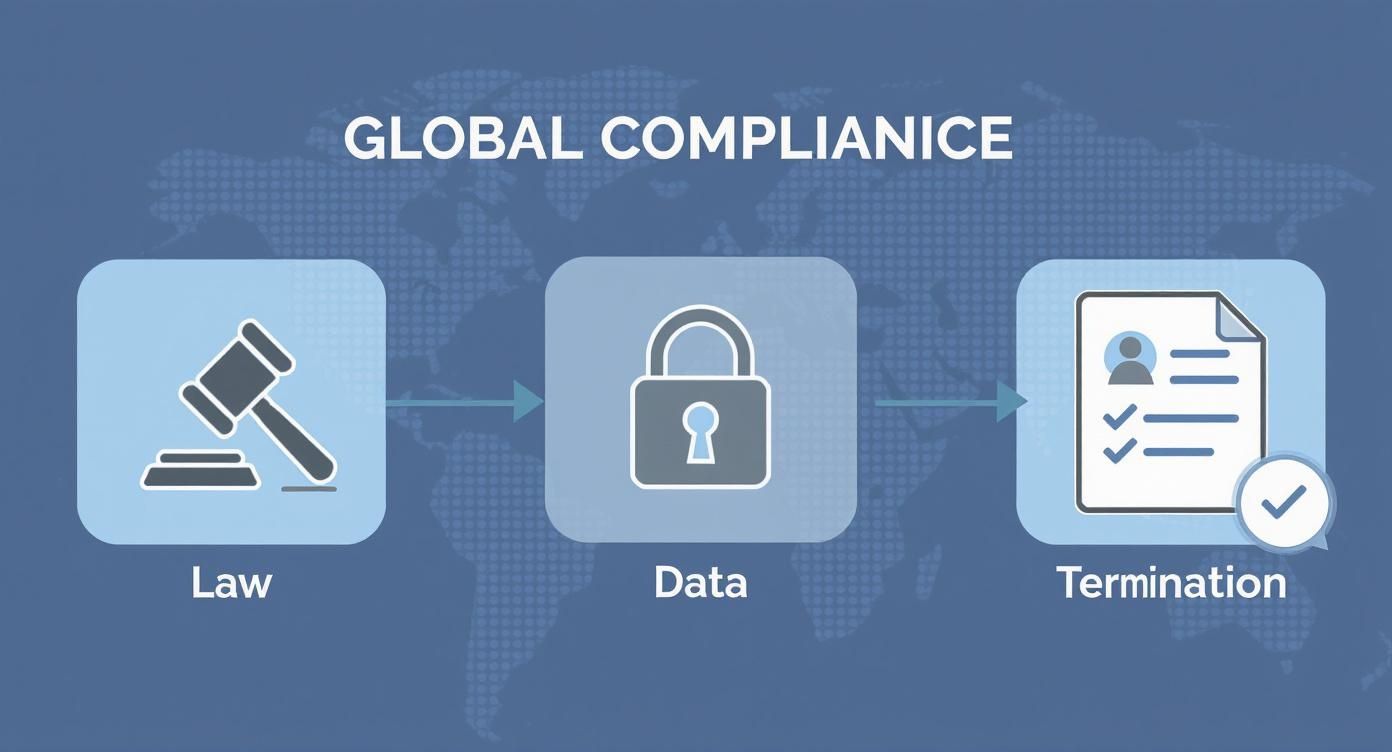
As you can see, every stage of the contract lifecycle—from the legal definitions to data privacy—is strengthened by a structured, automated process.
Automating Complex Signing Orders
Recruitment agreements often need more than one signature. You might need sign-off from the hiring manager, the head of HR, and maybe someone in finance. Chasing down all those people manually is a nightmare we’ve all lived through.
This is exactly what automated signing orders were made for. You can map out the precise sequence for signatures, and the platform does all the heavy lifting. The document automatically routes from one person to the next, sending out polite nudges along the way.
Imagine you're working with a logistics firm in the UAE that requires three different department heads to sign your agreement. With a tool like BoloSign, you set the workflow once. The system takes it from there, making sure everyone signs in the correct order without you having to play coordinator. If you want to dive deeper, you can learn how to set up an efficient approval workflow to handle these multi-stakeholder deals.
Unlocking Affordability and Scalability
Let’s be honest: one of the biggest hurdles for small and growing agencies has been the sky-high cost of eSignature tools. Many of them charge per user or per "envelope" (every single document you send), a model that punishes you for growing and makes your costs unpredictable.
BoloSign flips that script with a simple, fixed-price model. For one flat rate, you get unlimited documents, unlimited templates, and unlimited team members. This approach is often 90% more affordable than the per-envelope alternatives, letting your entire team standardize on one platform without you having to worry about the bill climbing every month.
This isn’t just about saving a few bucks. It’s about empowering your agency to operate at peak efficiency as you scale. By using a secure, compliant, and automated digital signing solution, you can spend less time pushing paper and more time building relationships and finding incredible talent.
Ready to see how simple this can be? Start a 7-day free trial and experience a better way to manage your recruitment agreements.
Turning Your Agreement into a Partnership
A recruitment agency agreement template is far more than just a legal document. Think of it as the handshake that officially kicks off a strong, professional partnership. It’s what turns ambiguity into clarity and lays the groundwork for you and your client to win together. When you nail down a clear, comprehensive, and legally sound agreement from the start, you build a foundation of trust that lets everyone focus on what really matters: finding exceptional talent.
Before any new agreement goes out the door, it’s always a good idea to run a final check. A simple review can save you from major headaches down the road and ensures every client relationship starts on solid footing. This final once-over protects your agency and shows the client you’re a pro.
Your Pre-Send Checklist
Run through these key points before hitting 'send' on any new agreement:
- Is the Scope Clear? Have you spelled out exactly what services, deliverables, and timelines are involved? No gray areas.
- Are Fees Unambiguous? Is the fee structure (contingency, retained, etc.), percentage, and payment trigger perfectly clear?
- Is Ownership Defined? Does the candidate ownership clause specify a fair and standard period, like 6-12 months?
- Are Compliance Clauses Included? Have you covered the essentials like governing law, data protection (especially GDPR or HIPAA if they apply), and confidentiality?
This quick exercise creates consistency and seriously cuts down the risk across all your client partnerships.
The Full Contract Lifecycle
Your agreement is a living document, and its journey doesn't just stop once it’s signed. The entire lifecycle—from creation and negotiation all the way to secure storage and renewal—is where a platform like BoloSign truly shines. It’s not just about getting a signature; it’s about managing the entire relationship professionally from start to finish.
A seamless contract process reflects the quality of your agency. When you make it easy for clients to engage with you, you’re not just saving time—you’re building your brand and fostering the kind of collaboration that leads to long-term success.
BoloSign is built to handle this entire process on a single, secure platform. You can create your go-to templates, send them out for a legally binding eSignature, track their status in real-time, and then store them in a compliant, central spot. This workflow is secure, auditable, and just plain easier for everyone involved. For more insights on this, you might be interested in our guide on how to increase collaboration for teams.
By making your agreements simple to create, secure to sign, and easy to manage, you're not just closing a deal—you're cementing a partnership.
Start your 7-day free trial of BoloSign to build stronger client partnerships today.
Your Top Recruitment Agreement Questions, Answered
Even with the best template in hand, questions are bound to come up. Nailing your recruitment agency agreement means getting into the weeds and understanding the why behind each clause. Here are a few of the most common questions we see, along with the practical answers you need.
What’s the Real Difference Between Retained and Contingency?
Think of it this way: a contingency agreement is a pure pay-for-performance model. You only get your fee when a candidate you sourced accepts an offer and starts their new job. It's the go-to for most mid-level roles or when you're not the only recruiter on the search.
A retained agreement is a whole different ballgame. Here, the client pays an upfront fee to secure your dedicated time and resources for an exclusive search. This is the model you’ll want to use for those high-stakes, senior-level, or super niche roles that demand a serious investment from your side. Your recruitment agency agreement template needs to spell out which model you're using in no uncertain terms, including any milestone payments if it's a retained search.
How Long Should My Candidate Ownership Period Be?
This clause is your financial safety net. It’s what ensures you get paid if a client decides to hire a candidate you introduced within a set timeframe, even long after the initial search is over. You're protecting the value of your work—the candidates you spent time finding and vetting.
A 6 to 12-month period is the industry standard and is generally seen as fair to both sides. It protects you from a situation where, for instance, a client rejects your candidate for a senior analyst role but then turns around and hires them as a manager eight months later. This is where a digital signing solution like BoloSign becomes invaluable; it creates a timestamped audit trail that proves exactly when you submitted that candidate’s profile.
A rock-solid candidate ownership clause is non-negotiable. It shuts the door on "backdoor hires" and guarantees your hard work gets compensated, reinforcing the immense value you bring.
Can I Just Use My Standard Template for International Clients?
While a standard template is a fantastic starting point, using it for international clients without any changes is asking for trouble. A one-size-fits-all approach to cross-border agreements can lead to serious legal headaches.
You absolutely have to zero in on these three areas:
- Governing Law: Whose rules apply if there's a dispute? Your agreement must clearly state the jurisdiction, whether it’s the laws of Ontario, Canada, or the state of New South Wales, Australia.
- Data Privacy: If you’re sourcing candidates from Europe, your agreement must be GDPR compliant. Placing healthcare professionals in the United States? You'll need to make sure you're following HIPAA regulations.
- Payment Terms: Get specific. Always name the currency (e.g., USD, AUD) and lay out any details for international bank transfers to prevent confusion and payment delays.
Skipping over these regional details can expose your agency to huge legal and financial risks. Again, modern tools can save the day. Platforms offering contract automation let you manage different templates for different regions, so you can confidently send the right, compliant document to every client, no matter where they are in the world.
Keeping track of all these moving parts doesn’t have to feel overwhelming. With BoloSign, you can create, send, and securely sign all your recruitment agreements from one straightforward, affordable platform. It’s time to turn your templates into smart, reusable workflows and start building stronger client partnerships.
Ready to see it in action? Start your 7-day free trial of BoloSign today.

Paresh Deshmukh
Co-Founder, BoloForms
3 Dec, 2025
Take a Look at Our Featured Articles
These articles will guide you on how to simplify office work, boost your efficiency, and concentrate on expanding your business.