

Purchase Order vs Contract: Which One Do You Really Need?
Struggling with purchase order vs contract? This guide clarifies the key differences, legal risks, and when to use each for smarter procurement.

Tired of nonsense pricing of DocuSign?
Start taking digital signatures with BoloSign and save money.
When you're managing business purchases, the line between a purchase order (PO) and a formal contract can feel a bit blurry. At their core, the difference is straightforward: a purchase order is a specific, direct request for a one-time transaction. It details the items, quantities, and prices you need right now.
A contract, on the other hand, is a much broader legal agreement. It's designed to govern an entire relationship over time, covering crucial terms like liability, confidentiality, and how you'll handle disputes. While an accepted PO does become legally binding, it offers minimal protection compared to a full-blown contract.
Purchase Order vs Contract: A Quick Breakdown
In any business, from a staffing agency in Canada to a real estate firm in the UAE, smart procurement is the backbone of financial health and operational stability. Knowing when to use a purchase order versus a contract is a fundamental skill in this process. Getting it wrong can lead to miscommunication, financial loss, or legal headaches that strain supplier relationships.
A PO is your go-to for simple, routine purchases. Think of a healthcare clinic in Australia ordering standard medical supplies or an education provider in New Zealand buying new textbooks. The transaction is low-risk, the terms are clear, and there's no need for complex negotiations.
You save contracts for situations with higher stakes—things like ongoing services, custom deliverables, or high-value partnerships where managing risk is the top priority.

To help you make the right call instantly, here’s a clear breakdown of what separates a PO from a contract.
Key Differences at a Glance: Purchase Order vs Contract
Choosing between a PO and a contract isn't just a paperwork exercise; it's a strategic decision that shapes your legal standing and operational efficiency. This table breaks down the fundamental differences to guide your choice.
| Attribute | Purchase Order (PO) | Contract |
|---|---|---|
| Primary Purpose | To initiate and confirm a specific, one-time purchase of goods or services. | To define the terms of a long-term or complex business relationship. |
| Scope & Detail | Narrowly focused on item descriptions, quantities, prices, and delivery dates. | Broad and comprehensive, covering liability, warranties, confidentiality, and dispute resolution. |
| Legal Nature | Becomes a legally binding document once the seller accepts the order. | Legally binding as soon as all parties execute it with a valid signature. |
| Use Case | Ideal for simple, low-risk, and routine transactions with established vendors. | Essential for complex projects, ongoing services, and high-value partnerships. |
| Flexibility | Generally inflexible and tied to a single transaction; a new PO is needed for each order. | Designed for flexibility, often governing multiple transactions or projects over time. |
While this table gives you a high-level view, the real-world implications run much deeper. The document you choose impacts everything from your legal exposure to your team's day-to-day efficiency.
With BoloSign, organizations can instantly create, send, and sign PDFs online with compliant eSignatures, whether you're approving a simple PO or executing a multi-page agreement. This ensures every procurement action is fast, secure, and perfectly suited for the situation at hand.
Understanding the Core Procurement Documents
Before you can decide between a purchase order and a contract, you need a solid grasp of what each document actually does. They aren't interchangeable tools; each one plays a very specific commercial and legal role in the procurement process.
Think of a purchase order (PO) as a direct, transactional request. It’s a commercial document a buyer sends to a seller, making an official offer for specific goods or services. Its entire job is to nail down the details of a single transaction: exactly what’s being bought, how many, the price for each, and when it needs to be delivered.
What Is a Purchase Order
At its heart, a PO is built for speed and clarity in routine buying. It works like a precise order form that, once the vendor accepts it, becomes a simple, legally binding agreement for that one purchase. This makes it perfect for low-risk, high-volume, or repeat orders where the terms are already crystal clear.
For instance, a professional services firm in the US ordering standard office supplies doesn't need to get bogged down in a lengthy negotiation. With BoloSign, they can create a PO template, send it to the vendor, and get a secure eSignature back in minutes, creating an official record for accounting without any unnecessary legal baggage.
A purchase order is the accelerator for everyday business operations. It’s designed for efficiency, providing a clear and simple framework for routine transactions that keeps supply chains moving without the friction of extensive legal review for every purchase.
That simplicity is its biggest advantage. But its laser focus on the transaction's specifics is also its main weakness, as it lacks the protective clauses you need for more complex relationships.
What Is a Contract
On the other hand, a contract is a comprehensive, legally binding agreement built to manage a relationship and protect against risk over time. It goes way beyond the "what" and "how much" of a single purchase to define the entire rulebook for how two or more parties will work together.
A contract creates the long-term framework for the partnership. It includes critical clauses that a PO would never touch, like:
- Scope of Work: Detailing complex service deliverables or project milestones.
- Liability and Indemnification: Defining who’s on the hook if something goes wrong.
- Confidentiality: Protecting sensitive business information.
- Dispute Resolution: Outlining the process for handling disagreements.
This level of detail is absolutely essential for high-value purchases, ongoing services, or any scenario involving significant risk or intellectual property. While POs often come into play after initial sourcing steps, you can learn more about how they differ from early-stage inquiries in our guide comparing RFPs and RFQs.
With modern digital signing solutions like BoloSign, handling both document types is straightforward. You can create, send, and sign PDFs online—whether it's a standardized PO template for your procurement team or a complex contract involving multiple stakeholders. This ensures every agreement, big or small, gets executed with speed, security, and full compliance.
Comparing Legal Standing and Risk Mitigation
When you get down to brass tacks, the biggest difference between a purchase order and a contract is their legal muscle and how well they protect your business. A PO can become a legally recognized document once a vendor accepts it, but its protections are often paper-thin, leaving you exposed to some serious operational and financial risks.
A PO is built for speed and simplicity, usually covering just the basics—what you’re buying, how many, and for how much. That’s great for routine buys, but it becomes a major liability when things inevitably go wrong. What’s your recourse if a critical shipment is delayed, grinding your production line to a halt? Or what if a service provider’s mistake leads to a data breach? A standard PO offers very little legal ground to stand on in those situations.
The Limits of a Purchase Order
Think of a purchase order’s legal standing as transactional, not relational. It confirms a single order but does a poor job of defining the broader rules of engagement. This creates dangerous gaps in crucial areas that can come back to bite you.
Relying only on POs opens you up to a few key risks:
- Undefined Service Levels: Without a contract, there are no agreed-upon standards for quality, uptime, or performance. You’re left with little power to address subpar service.
- Liability Exposure: POs rarely include indemnification clauses. That means if your vendor's product causes harm or damage, your business could be the one footing the bill.
- Lack of Confidentiality: If you’re sharing sensitive information, a PO offers no legal framework to stop a vendor from misusing or leaking that data.
- Vague Termination Rights: Need to end the relationship? Good luck. You might be stuck with a poor-performing vendor with no clear, penalty-free way to disengage.
This is especially true in high-stakes environments like government procurement, where legal standing and risk are everything. For anyone navigating that world, something like a complete guide to Australian government contracts makes it clear why a simple PO just doesn't cut it.
How Contracts Fortify Your Business
This is precisely where a formal contract becomes your best defense. A contract is intentionally designed for risk management. It forces you to think through potential problems ahead of time and establishes clear, legally enforceable terms that protect everyone involved. A well-drafted agreement contains all the critical clauses a purchase order completely ignores.
A contract acts as a strategic shield for your business. It anticipates potential conflicts and establishes a clear set of rules for liability, performance, and confidentiality before any issues can arise, transforming risk into manageable, predictable outcomes.
Imagine a logistics company in the US that relies on its fleet to meet tight deadlines. A PO for vehicle maintenance is a gamble; if a shoddy repair leads to a breakdown, the PO offers no protection against the massive business losses that follow. A formal service contract, on the other hand, would include warranties on the work, liability clauses for operational failures, and defined service-level agreements (SLAs) for repair times.
This is where a tool like BoloSign’s AI contract review becomes indispensable. When you receive a vendor agreement, our AI-powered analysis instantly flags risky, missing, or non-standard clauses. It helps your team spot potential liabilities in third-party paper before you sign, ensuring your contracts are built to protect you.
From there, you can use the BoloSign platform for seamless contract automation, sending the revised document for a secure eSignature with a complete, compliant audit trail. This intelligent approach makes it simple to ensure every agreement, from vendor services to major partnerships, is built to safeguard your business interests.
Mapping Document Lifecycles and Approval Workflows
The journey a purchase order takes from creation to fulfillment is worlds apart from the path a contract travels. A PO follows a clean, linear progression designed for speed. A contract, on the other hand, navigates a complex, often cyclical, route that pulls in multiple stakeholders for negotiation and revisions.
Understanding these two very different lifecycles is the key to managing them effectively.
A PO workflow is all about efficiency. It's a simple, predictable process: someone on the team identifies a need, submits a request, a manager signs off, and the PO is sent to the vendor. The main goal here is to get the order placed quickly and without any fuss.
In sharp contrast, a contract’s lifecycle is a dynamic and collaborative affair. It kicks off with drafting, then moves into a back-and-forth negotiation with legal teams, involves rounds of redlining and version control, and often requires multiple layers of executive sign-off before it’s even ready for an eSignature.
The Linear Path of a Purchase Order
The PO approval process is designed to be as frictionless as possible. It’s a purely transactional workflow focused on internal controls and making sure the purchase fits the budget.
- Request: An employee fills out a requisition form for specific goods or services.
- Internal Approval: A department head or manager reviews the request against their budget and gives it the green light.
- Issuance: The procurement team generates the official PO and sends it over to the vendor.
- Fulfillment: The vendor accepts the PO, delivers the items, and sends back an invoice for payment.
This process is repeatable and easy to scale, making it perfect for routine, everyday procurement. That simplicity, however, means it just isn't robust enough for managing significant business relationships.
This simple three-step flow shows why moving from a basic PO to a formal contract is a critical risk mitigation strategy.
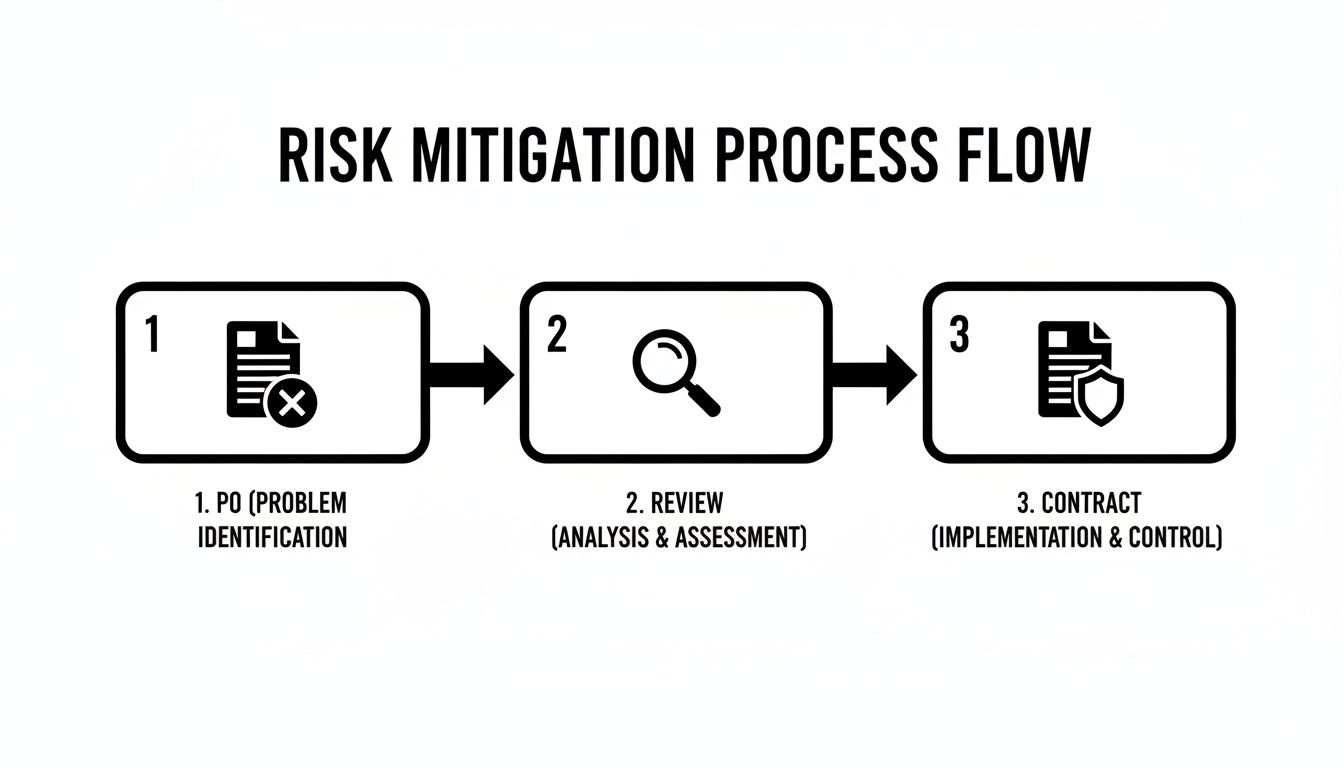
It’s clear that while a PO gets a transaction started, it’s the review and implementation of a proper contract that provides real business protection.
The Dynamic Workflow of a Contract
The contract lifecycle is far more intricate, demanding a platform built for collaboration, security, and a detailed audit trail. It’s a strategic process designed to build a strong legal foundation for a lasting business relationship.
Where a PO workflow is a straight line, a contract workflow is a loop. It involves negotiation, legal review, and multiple approvals—a process that requires robust tools for version control, collaboration, and secure execution to manage complexity effectively.
For instance, a real estate agency in Australia uses BoloSign to manage both workflows seamlessly. Their facilities team can create and send PDFs for routine vendor POs with a simple, one-click approval chain. At the same time, their legal team uses the platform to manage complex, multi-signature lease agreements—negotiating terms, redlining the document, and executing it with a secure eSignature, all in one place.
This is where BoloSign’s contract automation really shines. Our platform is designed to handle the distinct needs of both document types. You can create, send, and sign PDFs online for simple purchase orders and complex agreements alike. To get a better handle on these processes, check out our guide on contract lifecycle management best practices for deeper insights into building efficient, compliant workflows.
By bringing these processes together, BoloSign provides a complete, auditable trail for all your procurement activities. Our AI-powered tools, combined with full ESIGN and eIDAS compliance, ensure every document is managed with the right level of rigor. And with our single fixed price for unlimited documents and users, you get this powerful capability at a cost up to 90% lower than platforms like DocuSign or PandaDoc.
Why not see how it works for your unique workflows? Start a 7-day free trial today to experience firsthand how BoloSign simplifies every step of your procurement and contracting process.
Choosing the Right Document in Your Industry
The whole purchase order vs. contract debate isn't just a legal thought experiment—it has real, everyday consequences that look completely different from one industry to another. The right choice boils down to the context of the deal, the amount of risk involved, and the kind of relationship you have with your vendor. What works for a simple order of office supplies will absolutely not hold up for a complex software development project.
Global procurement teams lean on both POs and contracts to manage trillions in spending every year. In fact, public procurement alone is estimated at USD 13 trillion annually. While a PO is perfect for a one-off transaction where you just need to lock in quantity and price, legal experts will tell you it becomes a binding contract the moment it's accepted. That's precisely why big companies often use a master contract to set the ground rules for risk across thousands of individual POs. You can get a better sense of the scale of global procurement from recent market analyses.
Let's dig into how a few different industries handle this decision.
Healthcare Operations and Compliance
In healthcare, the line between a PO and a contract is often drawn by compliance. A clinic in the US can easily use a purchase order to restock standard supplies like gloves, masks, and syringes from a distributor they’ve worked with for years. The transaction is simple, low-risk, and happens over and over.
But things change fast when that same clinic brings on a third-party billing service. Now you’re talking about access to sensitive patient data, which makes HIPAA compliance a non-negotiable. A PO is completely out of its depth here. You need a formal contract to spell out data security protocols, liability for breaches, and strict confidentiality clauses. It's about protecting both the clinic and its patients.
Staffing and Professional Services
For a staffing agency, the choice is all about the scope and length of the client relationship. Placing a temp for a two-week gig? A detailed purchase order that lists the role, hourly rate, and duration will do the job. It's a straightforward, transactional arrangement.
On the other hand, if you're setting up an ongoing partnership with a corporate client to fill multiple roles over a year, a Master Service Agreement (MSA)—which is a formal contract—is the only way to go. The MSA establishes the big-picture terms for the entire relationship: payment schedules, who owns the candidate relationship, liability, and how either party can end the agreement. Individual placements can then be kicked off with simple statements of work that fall under that master agreement.
The decision to use a PO or a contract in professional services really comes down to one question: Are you handling a single transaction or building a long-term partnership? Your answer determines the level of legal protection your business needs.
Education and Research Institutions
Universities and schools are constantly juggling a massive volume of both simple and complex procurement needs. The accounts department at a university in New Zealand can fire off POs for new textbooks or lab equipment without a second thought. It's a fast, simple workflow that's perfect for handling dozens of routine purchases every day.
But when that university's research department partners with a private company to fund a multi-year study, a detailed contract becomes absolutely critical. That agreement needs to cover intellectual property rights, funding milestones, publication rules, and confidentiality—all complex terms a PO was never designed to handle.
With a platform like BoloSign, an educational institution can manage both of these workflows from one place. You can instantly create, send, and sign PDFs online for vendor POs while using contract automation tools to manage those complicated research agreements. Our AI-powered contract intelligence ensures every document gets the right level of review and compliance, from ESIGN to GDPR.
BoloSign makes this kind of sophisticated management simple and affordable, giving you unlimited documents, templates, and team members for one fixed price. This model is up to 90% more affordable than alternatives like DocuSign or PandaDoc, so your organization can handle every agreement the right way without blowing the budget.
Ready to see how BoloSign can adapt to your industry's specific needs? Start a 7-day free trial to experience seamless document management firsthand.
Unifying Your Procurement with Smart Technology
The whole purchase order vs. contract debate often misses the most powerful strategy of all: using them together. The savviest procurement teams don’t see these as competing documents. They see them as complementary tools in a unified system. The best approach is to establish a strong, comprehensive master agreement with a key supplier and then issue simple, transactional POs under its protective terms.
This hybrid model gives you the best of both worlds—the strategic risk mitigation of a contract and the operational speed of a purchase order. It creates a seamless flow where your foundational legal protections are always in place, no matter how routine the purchase is.

Building a Cohesive Procurement Ecosystem
Creating this unified system starts with centralizing your document workflows. With BoloSign's contract automation and digital signing solutions, you can manage the entire lifecycle from a single, secure platform. The process is straightforward but powerful, letting you build a robust framework that supports your business as it grows.
Here’s how it works in practice:
- Negotiate the Master Contract: You work with a key supplier to draft a Master Service Agreement (MSA) that covers all the critical terms—liability, confidentiality, warranties, and payment schedules.
- Execute with a Secure eSignature: Using BoloSign, you send the agreement for a compliant eSignature, creating a legally binding foundation for your partnership. Our platform ensures compliance with global standards like ESIGN, eIDAS, and GDPR.
- Store in a Central Repository: The executed contract is stored securely, becoming the single source of truth for the relationship.
- Issue POs that Reference the Contract: Your procurement team can then issue individual POs for specific orders. Each PO simply references the master agreement, automatically incorporating all its protective terms into every transaction.
This setup ensures every purchase is shielded by the comprehensive legal terms you negotiated, without bogging down your team with a full contract process for every routine order. A professional services firm, for example, can establish an MSA with its IT provider and then issue POs for new hardware as needed, confident that every purchase is covered.
The ultimate goal of procurement technology isn't just to manage documents, but to build an intelligent system where contracts provide the strategic framework and purchase orders execute the day-to-day tactics. This creates a scalable, low-risk, and highly efficient operation.
Driving Efficiency and Cost Reduction
Unifying your procurement process with technology does more than just mitigate risk; it unlocks significant cost savings and operational efficiency. By streamlining workflows and centralizing document management, you reduce manual effort, minimize errors, and accelerate purchasing cycles. As you consider this approach, exploring proven methods for savings can provide additional benefits. For a deeper look into actionable ideas, these 10 Proven Procurement Cost Reduction Strategies offer valuable insights.
BoloSign is designed to make this sophisticated strategy accessible and affordable for any organization. We offer unlimited documents, templates, and team members for one fixed price, a model that makes us up to 90% more affordable than competitors like DocuSign or PandaDoc. You can build a scalable, compliant, and robust procurement system without facing the prohibitive costs that often come with enterprise-grade software. Whether you need to sign PDFs online or implement a full AI contract review workflow, our platform provides the tools you need. If you're comparing different platforms, our detailed procurement software comparison can help guide your decision.
Ready to build a smarter, more unified procurement ecosystem? Start a 7-day free trial to experience how BoloSign makes it simple.
Frequently Asked Questions
Here are a few common questions that come up in the purchase order vs. contract debate. Getting these details right can make a huge difference in how you manage risk and relationships.
Can a Purchase Order Ever Replace a Contract?
While an accepted PO is technically a legally binding document, it's not a substitute for a formal contract in any significant, complex, or long-term business relationship.
A PO is great for the "what, when, and how much" of a single transaction. But it completely misses the critical clauses you need for liability, confidentiality, intellectual property, and dispute resolution. Think of it this way: use POs for routine, low-risk buys. For everything else, a formal contract is the only way to fully protect your business.
How Do eSignatures Impact PO and Contract Validity?
Electronic signatures make both POs and contracts legally binding and fully enforceable under global laws like the ESIGN Act in the U.S. and eIDAS in the EU.
Using a compliant digital signing solution like BoloSign does more than just speed up approvals. It adds a powerful layer of security with a verifiable audit trail, making it a far more secure and efficient alternative to printing, signing, and scanning any business document you need to sign PDFs online.
With BoloSign, an eSignature does more than just execute a document—it creates a secure, compliant, and instantly auditable record, strengthening the legal standing of both your purchase orders and your most critical contracts.
What Happens If a PO Conflicts with a Master Contract?
In almost every scenario, the terms of the master contract will override any conflicting terms on a purchase order. In fact, well-drafted contracts include an "order of precedence" clause specifically to handle this kind of conflict and eliminate ambiguity.
This is a key reason businesses set up master agreements in the first place—to create a single, authoritative set of rules that governs the entire relationship with a supplier, regardless of how many individual POs are issued.
With BoloSign's AI contract review tools, you can make sure your master agreements are solid and that your day-to-day procurement workflows align perfectly. Our platform makes it simple to manage both document types within a unified system, ensuring consistency and compliance across every single transaction.
Ready to streamline your procurement and contracting processes with a single, powerful platform? BoloSign offers unlimited documents, templates, and team members at a fixed price up to 90% more affordable than other providers. Start a 7-day free trial today to experience intelligent contract automation firsthand.

Paresh Deshmukh
Co-Founder, BoloForms
29 Dec, 2025
Take a Look at Our Featured Articles
These articles will guide you on how to simplify office work, boost your efficiency, and concentrate on expanding your business.