
Your Guide to a Non Disclosure Agreement Template
Create, customize, and securely sign a non disclosure agreement template. Learn how to protect your confidential information with our step-by-step guide.

Tired of nonsense pricing of DocuSign?
Start taking digital signatures with BoloSign and save money.
Staring at a legal document can feel like trying to read a foreign language, but a Non-Disclosure Agreement (NDA) is one of the most practical tools you have to protect your business's brilliant ideas. Think of it as a formal, legally-binding handshake that creates a confidential relationship before you spill the beans with employees, contractors, or potential partners. A solid non disclosure agreement template is your starting point for secure, worry-free collaboration.
Protecting Your Big Ideas With a Solid NDA

Every business has its "secret sauce"—that special something that gives it an edge. For a professional services firm, it might be a meticulously curated client list. For a tech startup in the US or Canada, it could be a groundbreaking new algorithm. You often need to share this information to grow, but doing so without a safety net is a huge gamble.
An NDA, sometimes called a confidentiality agreement, is that safety net. It’s a contract that legally binds the other party to keep your secrets under wraps and only use them for the specific reason you’ve agreed to. It's that simple, and that powerful.
The Problem With Old-School NDA Processes
For too many businesses, the NDA process is a frustrating bottleneck. The traditional way of doing things is slow, clunky, and frankly, a bit of a headache.
- Sky-High Legal Bills: Calling a lawyer to draft a custom NDA for every single contractor, new hire, or potential partner can get expensive, fast.
- The Endless Back-and-Forth: The whole print-scan-email-chase routine feels stuck in the past. It delays projects, stalls deals, and wastes everyone's time.
- Administrative Nightmares: Trying to keep track of who signed what, when, and where the paper copies are stored is a recipe for chaos and security risks.
These pain points are especially sharp in industries where speed is everything. A staffing agency needs to onboard candidates yesterday. A healthcare provider has to securely share data with a new tech partner without delay. In these cases, waiting isn't just an inconvenience—it's a lost opportunity.
A Smarter Way to Handle NDAs With BoloSign
This is where a modern digital signing solution completely changes the game. Instead of reinventing the wheel every time, a platform like BoloSign lets you create, send, and sign your trusted non disclosure agreement template as a reusable digital asset you can deploy in seconds.
Imagine this: you create your standard NDA just once, save it as a template, and then send it out for a legally binding eSignature with just a few clicks. With BoloSign, you can manage unlimited documents, templates, and team members for one simple, fixed price, making it 90% more affordable than traditional tools.
Our platform is built with AI-powered automation and bank-grade security, ensuring full compliance with global standards like ESIGN, eIDAS, HIPAA, and GDPR. That means you can create secure document workflows and sign PDFs online with total confidence.
Choosing the Right NDA: Unilateral vs. Mutual
Not all NDAs are built the same, and grabbing the right one is the first, most critical step to protecting your information. Think of it like a one-way vs. a two-way street—each is designed for a specific flow of traffic. Picking between a Unilateral and a Mutual non disclosure agreement template right from the start ensures you're using the right tool for the job.
A Unilateral NDA is your classic one-way street. In this situation, only one side (the "Disclosing Party") is sharing sensitive information, and the other side (the "Receiving Party") promises to keep it under wraps. This is the most common type of NDA, perfect for when the flow of confidential info is heading in just one direction.
This is your go-to agreement when you're pitching a game-changing app idea to an investor, bringing on a freelance designer for a secret rebrand, or showing a potential buyer your company's financials. In every one of those cases, you're the one spilling the secrets, and they're the ones promising silence.
When to Use a Unilateral NDA
Here are a few real-world examples where a unilateral agreement is the only one that makes sense:
- Real Estate: A brokerage firm in Australia shares its closely-guarded market analysis and client list with a new marketing agency it's hiring. The firm discloses, the agency receives.
- Education: A university in New Zealand gives a curriculum developer access to its internal pedagogical research to build a new online course. The sensitive data flows from the university to the contractor.
- Staffing: A recruitment agency in the UAE hands over its confidential candidate database and client contracts to a new recruiter. The agency needs to make sure its most valuable assets don't walk out the door.
NDAs have become a standard part of doing business, especially in employment. Research shows that somewhere between 33% and 57% of U.S. workers are bound by an NDA. A more recent survey found that figure to be 45%, showing just how common they are for protecting company secrets. You can learn more about how NDAs have permeated the workforce to understand their full impact.
When to Use a Mutual NDA
On the flip side, a Mutual NDA is a two-way street. It's built for collaborations where both parties will be sharing and receiving confidential information from each other. This agreement is a must-have when two companies are exploring a partnership, a joint venture, or a potential merger, as it guarantees both sides are on equal footing.
Imagine a logistics company and a healthcare provider talking about a partnership to streamline medical supply deliveries. The healthcare provider will need to share sensitive patient data protocols, while the logistics company will reveal its proprietary route-optimization software. Both are trade secrets, so a mutual NDA is the only safe way forward.
A Mutual NDA builds trust right out of the gate. It sends a clear signal that both parties are serious about working together and respect each other's intellectual property, setting the stage for a strong partnership.
Unilateral vs. Mutual NDA: Which Is Right for You?
To make the decision crystal clear, just look at the scenario you're in. Choosing the correct non disclosure agreement template from the get-go saves a ton of time and avoids confusion later on. After you've picked one, you can easily manage and send your agreements with a solid contract automation platform.
Use this quick comparison to select the correct Non-Disclosure Agreement template for your business needs.
| Scenario | Unilateral NDA (One-Way) | Mutual NDA (Two-Way) |
|---|---|---|
| Hiring a Contractor | Ideal. You share your project details; they agree to protect them. | Not suitable. The contractor isn't typically sharing confidential data with you. |
| Exploring a Merger | Inadequate. Only protects one side, leaving the other completely exposed. | Essential. Both companies need to share sensitive financials and strategies. |
| Pitching to Investors | Perfect. You disclose your business plan; they agree to confidentiality. | Overkill. Investors are listening, not sharing their own trade secrets. |
| Joint Product Dev | Risky. Fails to protect your partner's contributions and IP. | Required. Both parties are sharing code, designs, and go-to-market plans. |
At the end of the day, just ask yourself one simple question: "Who is sharing sensitive information?" If it's just you, go with a unilateral NDA. If the secrets are flowing both ways, a mutual NDA is the only choice.
Anatomy of a Strong Non Disclosure Agreement
A Non-Disclosure Agreement can look like a wall of dense legal text. But once you understand the core pieces, it's like learning the rules of a game—it gives you the power to protect your interests and play with confidence. Let's break down the anatomy of a standard NDA, clause by clause, into plain English so you know exactly what you’re sending and signing.
This simple diagram shows the two paths an NDA can take, which forms the foundation of any confidentiality agreement.
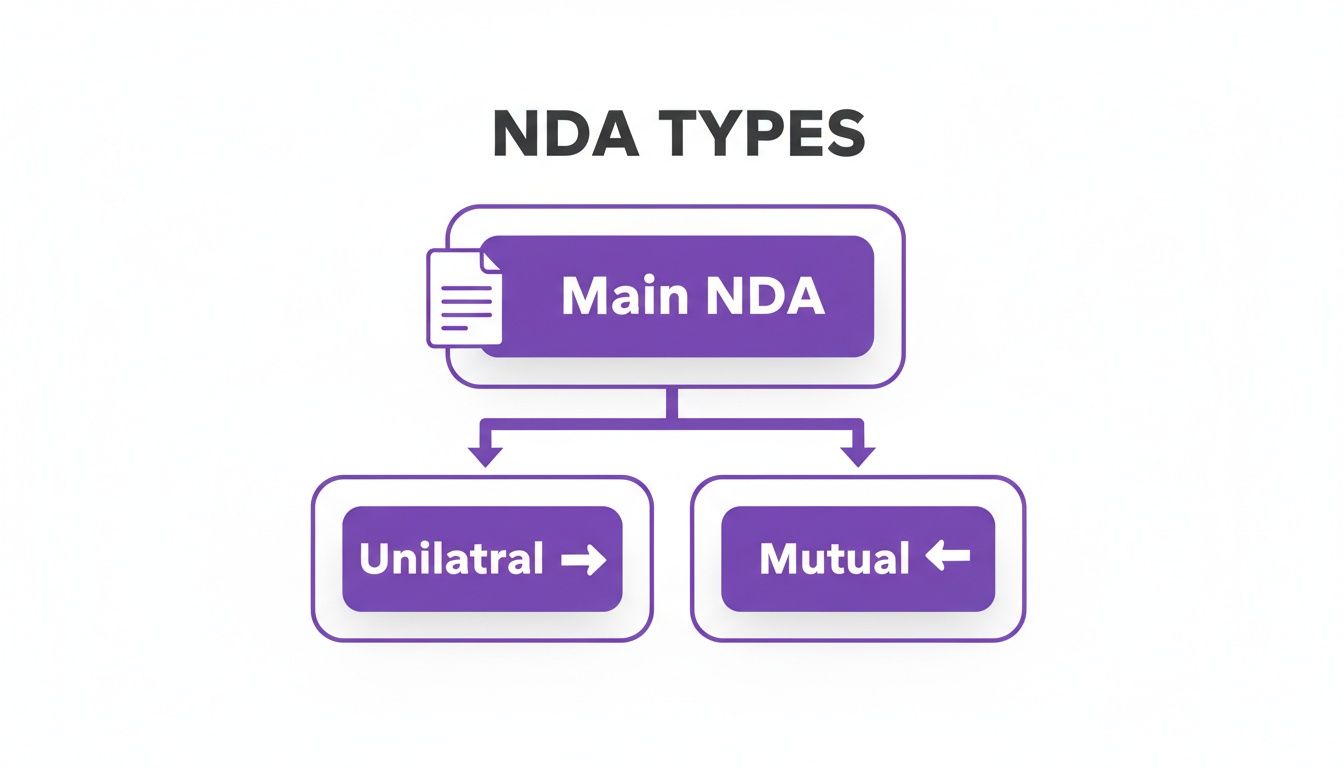
As you can see, every NDA starts from the same place but splits into either a one-way (unilateral) or two-way (mutual) street, depending on who is sharing the sensitive information.
Identifying the Parties
This might seem like the most basic part of the agreement, but getting it wrong can cause big headaches later. This clause clearly names the people or companies involved. The "Disclosing Party" is the one sharing secrets, and the "Receiving Party" is the one promising to keep them safe.
In a mutual NDA, both sides wear both hats, acting as both a disclosing and receiving party. Accuracy here is non-negotiable—make sure you use the full, legal names for everyone to avoid any confusion down the line.
Defining Confidential Information
This section is the absolute heart of your NDA. If this definition is vague, the whole document might as well be useless. You can't just say "business information"; you need to spell out exactly what counts as confidential.
A solid definition clause will typically cover things like:
- Trade Secrets: Think proprietary formulas, a unique manufacturing process, or a custom algorithm.
- Business Information: This is a broad category covering marketing plans, financial data, product roadmaps, and internal procedures.
- Customer and Supplier Lists: These are gold for many businesses, especially in service-based industries.
- Intellectual Property: This includes concepts, designs, code, and any other creative or technical work still under wraps.
Being specific here leaves no room for the Receiving Party to later claim, "I didn't know that was supposed to be confidential." It draws a clear line in the sand right from the start.
Outlining the Receiving Party's Obligations
Okay, so you've defined what's confidential. This part explains how it must be protected. This clause lays out the core promises the Receiving Party is making.
Usually, these obligations boil down to a few key duties:
- Non-Disclosure: A straightforward promise not to share the confidential information with any unauthorized person or company.
- Limited Use: A commitment to use the information only for the agreed-upon purpose, like evaluating a partnership or finishing a freelance project.
- Reasonable Care: An obligation to guard the information with the same level of security they'd use for their own most sensitive data.
This clause is what gives the NDA its teeth, turning a simple promise into a legally binding duty. To see how these duties function within a larger legal framework, it’s helpful to look at a complete software engineering contract.
Specifying Exclusions from Confidentiality
Not every piece of information that changes hands can be locked down. A fair and enforceable NDA will always include specific carve-outs. This clause protects the Receiving Party from being on the hook for information that isn't genuinely a secret.
Common exclusions include information that:
- Is already public knowledge.
- The receiver already had in their possession before the NDA was signed.
- Was developed independently by the receiver without using the confidential info.
- Was obtained rightfully from a third party who had no confidentiality obligations.
Setting the Term of the Agreement
The "Term" clause is all about the timeline—how long do these confidentiality rules last? This isn't a one-size-fits-all detail; the duration should make sense for how sensitive the information is.
For most general business info, a fixed period of two to five years is pretty standard. But for true trade secrets—like the recipe for Coca-Cola—the term can be indefinite, lasting as long as the information remains a secret. Having clear terms is a huge part of managing your legal documents well, and BoloSign can help you keep your whole library of business contracts organized.
Establishing Jurisdiction
Finally, the jurisdiction clause (sometimes called "Governing Law") names the state or country whose laws will be used to interpret the agreement if there’s a dispute. This is a critical detail, especially for businesses working across state lines or internationally, because it creates predictability and a clear legal path if someone breaks their promise.
Tailoring Your NDA for Any Industry
A generic, off-the-shelf NDA template is a decent starting point, but in the real world, the details are everything. A one-size-fits-all approach can leave dangerous gaps in your protection simply because the confidential information at a healthcare startup looks nothing like the trade secrets of a logistics company.
Tailoring your NDA to your specific industry isn’t just a "nice-to-have"—it's a critical step in building a legal shield that actually works.
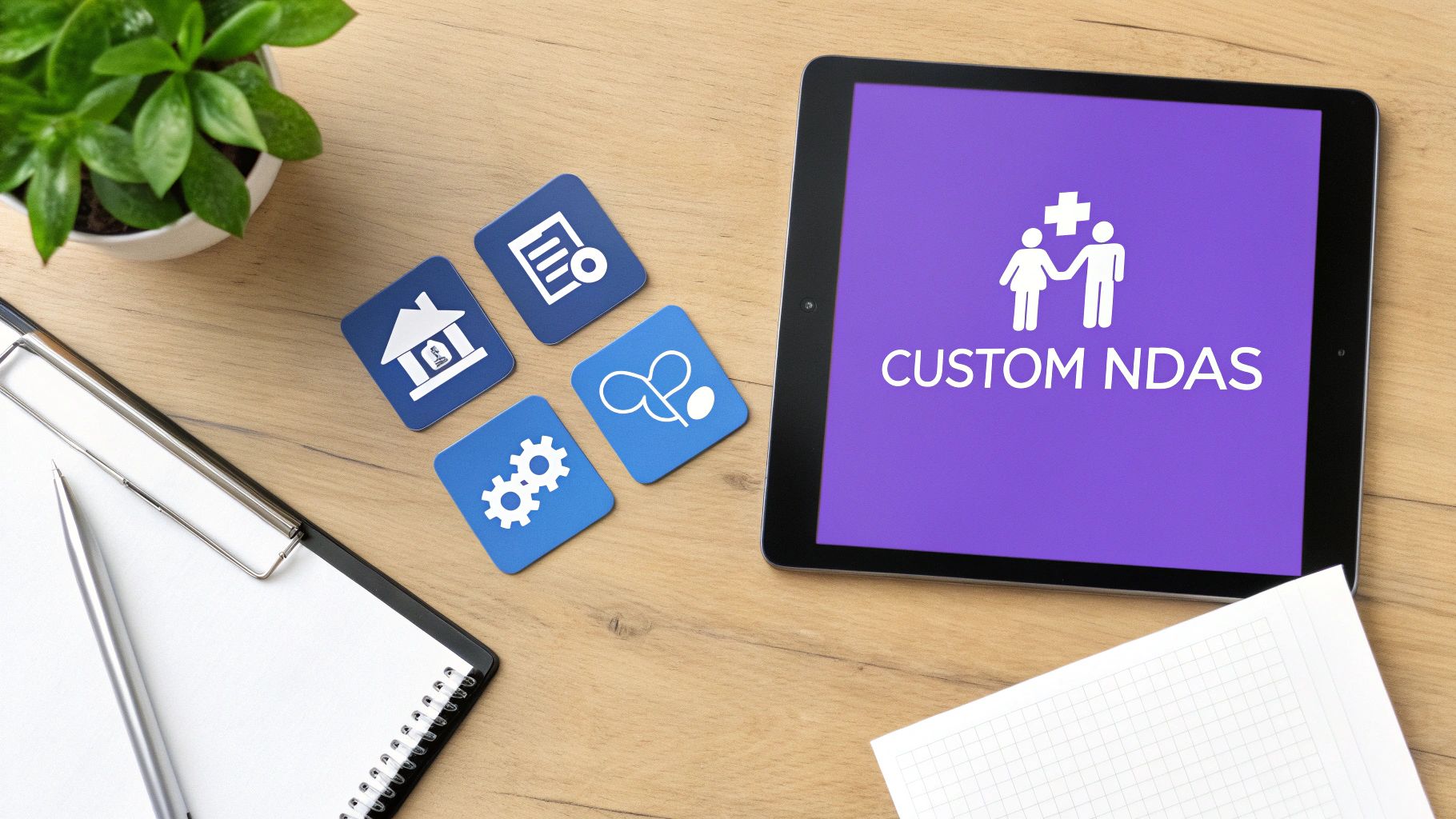
This is where having a flexible digital signing solution really pays off. Instead of reinventing the wheel for every new partner or project, you can create and save a whole library of industry-specific templates. With a tool like BoloSign, you can manage an unlimited number of templates under one simple, fixed-price plan, making sure you always have the right document ready to go in seconds.
Custom Clauses for High-Demand Sectors
Different industries have different "crown jewels" they need to protect. The most important tweak you can make is to customize the "Confidential Information" clause to reflect what's most valuable to your business.
Here are a few practical examples to get you thinking:
- Healthcare: It's not just about business data. Your NDA absolutely must mention Protected Health Information (PHI) and include clauses that ensure HIPAA compliance. When you're dealing with patient records, diagnostic methods, or proprietary medical software, this is non-negotiable.
- Professional Services: If you're a consultant, accountant, or lawyer, your client list is gold. Your NDA should specifically protect client identities, project details, and any unique business methodologies or analytical frameworks you've spent years developing.
- Staffing and Recruitment: A staffing agency’s entire business is built on its candidate database and private client agreements. The NDA has to explicitly forbid poaching candidates or spilling the beans on client placement terms and fee structures.
- Logistics and Supply Chain: The secret sauce in this industry often involves proprietary routing algorithms, supplier pricing lists, and detailed warehouse operational procedures. These specific data points need to be called out in the agreement.
Getting these documents right is more important than ever. The global disclosure management market is on track to hit USD 1,322.82 million by 2035. This boom is driven by tools that can slash review time. Think about it: what takes a legal team 92 minutes to review manually can be done in just 26 seconds with AI, freeing up experts for more strategic work. You can discover more insights about the disclosure management market to see just how much technology is changing the game.
A Checklist for Industry-Specific Customization
When you're adapting your non disclosure agreement template, always ask yourself: "What unique data and processes give my business its edge?"
Run through this quick checklist to make sure you've covered your bases.
What to specify:
- Key Data Types: Ditch the generic terms. Instead of "business data," get specific with things like "source code," "financial models," "customer usage analytics," or "geological survey data."
- Relevant Regulations: Is your industry governed by specific compliance rules? Name them. Mention HIPAA for healthcare, GDPR for data privacy in Europe, or specific financial regulations if you're in fintech.
- Scope of Use: Be crystal clear about how the information can be used. For example, a marketing agency can use client data for campaign analysis but can't turn it into a public case study without getting permission first.
- Survival Period: Think about how long your information stays sensitive. A product roadmap might only need protection for two years, but a chemical formula or a core trade secret should be protected indefinitely.
By creating these tailored templates in BoloSign, you’re not just making documents; you're building an arsenal of ready-to-use agreements that provide rock-solid protection for every situation. It’s a smart way to manage complex legal needs, ensuring you can send the right business contract for a secure eSignature in minutes.
The goal is to make your NDA so clear and specific that there's no room for interpretation. This doesn't just make it more enforceable—it sends a clear message to partners and employees that you're serious about protecting your most valuable assets.
How to Digitize and Automate Your NDA Workflow
Having a solid non disclosure agreement template is a great start, but its real value comes from how fast you can turn it into a signed, legally binding agreement. The old way—printing, scanning, emailing, and chasing people down for signatures—is a massive time sink. These manual steps create bottlenecks that stall deals and drag projects to a halt.
It’s time to reclaim your schedule and secure your confidential information faster by digitizing the entire workflow.
The friction from outdated NDA processes isn't just an annoyance; it's a real pain point for businesses. A 2022 survey revealed that 58% of professionals felt their company's NDA process was so slow it actively hurt their ability to close deals. Even worse, half of them said turnaround times stretched to three or four days, with a full 20% waiting five days or more. You can read more about these NDA frustrations to see how they impact strategic work.
Your Step-by-Step Guide to a Digital NDA Process
With a platform like BoloSign, you can wipe out these delays and manage your NDAs with speed and precision. The whole process becomes simple, trackable, and completely secure.
Here’s how you can transform your NDA workflow in just five simple steps:
- Create or Upload Your Template: Just drag and drop your finalized non disclosure agreement template (as a PDF) into your BoloSign dashboard, or create one from scratch. This document instantly becomes a reusable digital asset, ready to send whenever you need it.
- Add Fillable Fields: Use the intuitive editor to place fields exactly where you need them. You can add signature blocks, date fields, initial boxes, and text fields for names or company details, turning your static PDF into an interactive document.
- Send for eSignature: Pop in the recipient's email address, write a quick custom message, and hit send. You can send the NDA to one person or to multiple people in a specific signing order—perfect for agreements that need a chain of approvals.
- Track Everything in Real-Time: No more guessing games. Your dashboard gives you a live look at the document's status. You'll know the second it’s sent, viewed, and signed, keeping everyone in the loop and projects moving forward.
- Receive the Final, Secure Document: Once everyone has signed, all parties automatically get a copy of the completed, legally binding agreement. It also comes with a comprehensive audit trail that records every single action, giving you a tamper-proof record for compliance.
Bringing in Automation and Compliance
This digital approach does more than just save time; it builds a secure, compliant foundation for all your agreements. With BoloSign, you get AI-powered contract automation that ensures every step is handled correctly and efficiently.
This secure workflow is critical in industries where confidentiality and speed are everything:
- A staffing agency can send an NDA to a new candidate and get it signed in minutes, speeding up onboarding without cutting corners on security.
- A healthcare provider can share sensitive data with a tech partner, confident that the agreement is protected on a HIPAA-compliant platform.
- A professional services firm in the UAE or Australia can work with global clients, knowing the eSignatures are compliant with international standards like ESIGN and eIDAS.
By ditching the manual methods, you aren't just digitizing a document—you're building a reliable system that protects your business, accelerates deals, and frees up your team to focus on what actually matters.
This modern approach ensures every NDA is managed in a secure, auditable environment. You can discover how to automate your company approval workflow to bring even more efficiency to your organization. Best of all, BoloSign offers all this—unlimited documents, team members, and templates—for a single fixed price, making it 90% more affordable than the traditional tools out there.
Got Questions About NDA Templates? We’ve Got Answers.
Jumping into the world of NDAs can feel a bit daunting, especially when you’re just trying to get a deal done or bring on a new team member. Let's clear up some of the most common questions that pop up when using a non-disclosure agreement template. My goal here is to give you straightforward, practical answers so you can protect your information with confidence.
Is an Electronically Signed NDA Legally Binding?
Yes, absolutely. In most of the world—including the US, Canada, Australia, New Zealand, and the UAE—electronic signatures carry the same legal weight as a good old-fashioned pen-and-ink signature. This isn't a new development; laws like the ESIGN Act in the United States and the eIDAS regulation in Europe have been cementing this for years.
But here's the catch: the proof is what matters. Simply pasting a JPG of your signature onto a Word doc probably won't cut it if you ever have to defend it in court. This is exactly why using a digital signing solution like BoloSign is a game-changer. Our platform creates a complete, tamper-proof audit trail that logs every single action—from the moment the document is sent to the final click to sign. This gives you a rock-solid, auditable record that proves who signed, when they signed, and that the document wasn't altered, making your eSigned NDA legally sound.
What Are the Consequences of Violating an NDA?
Breaking an NDA isn't just a misstep; it's a breach of contract. The fallout can be pretty serious, and it really depends on the damage done and the specific terms you laid out in the agreement.
Typically, the repercussions fall into a few categories:
- Financial Damages: If someone leaks your confidential info and it costs you money, a court can order them to pay up. This is meant to compensate you for the financial hit you took.
- Injunctions: This is a fancy legal term for a court order that tells the person to stop what they're doing. An injunction can legally force the breaching party to cease using or sharing your confidential information immediately.
- Termination of Relationship: For an employee or contractor, this is almost always the immediate outcome. Breaking an NDA is a huge breach of trust that usually results in getting fired, and it can do serious, long-term damage to their professional reputation.
How Long Should an NDA's Term Be?
This is a classic "it depends" question. There's no magic number for an NDA's duration because it should be directly tied to the lifespan of the information you're protecting. For most everyday business secrets, like a new marketing strategy or the details of an upcoming project, a term of two to five years is pretty standard and generally seen as reasonable.
However, if you're protecting a true trade secret—we're talking about the secret sauce, like a proprietary software algorithm, the formula for Coke, or a unique manufacturing process—the confidentiality needs to last as long as the information is valuable and secret. In these cases, the obligation can and should be indefinite. When you add a signature to a Google Form or PDF with BoloSign, you can easily create different templates with varying term lengths for these different scenarios.
Is a Generic Online Template Safe for My Business?
Using a generic template you found online can be a decent starting point, but treating it as a finished document is a big risk. Think of it like a blueprint for a house—it gives you the basic structure, but you still need to make sure it’s right for your specific piece of land. These one-size-fits-all templates almost never have the specific clauses needed to protect what’s unique about your business.
For instance, a generic template won't mention HIPAA compliance for a healthcare startup or have clauses to protect a candidate database for a recruiting agency. The smart move is to use a solid, vetted template as your foundation and then customize it to fit your actual needs. Even better, manage those customized templates on a secure platform like BoloSign. That way, your agreements are not only tailored to your business but are also handled in a secure, compliant workflow that respects data protection standards like GDPR. You get the convenience of a template with the real-world protection your business actually needs.
Ready to stop worrying about paperwork and start securing your business secrets with confidence? BoloSign offers a simple, secure, and incredibly affordable way to manage all your NDAs and other agreements. With unlimited documents, templates, and team members for one fixed price, you can streamline your entire workflow.
Experience the ease of AI-powered automation and compliant eSignatures firsthand. Start your 7-day free trial today and see how simple contract management can be.

Paresh Deshmukh
Co-Founder, BoloForms
13 Feb, 2026
Take a Look at Our Featured Articles
These articles will guide you on how to simplify office work, boost your efficiency, and concentrate on expanding your business.