

How to Write an Agreement Contract That Actually Protects You
Learn how to write an agreement contract with this practical guide. We'll cover essential clauses, common mistakes, and how to automate the entire process.


Tired of nonsense pricing of DocuSign?
Start taking digital signatures with BoloSign and save money.
Writing an agreement from scratch can feel like a tall order. The secret is to start by nailing down the absolute basics: who is involved, what's being exchanged, and what's the ultimate goal? From there, you can build out the document with the essential clauses that protect everyone, covering things like payment terms, key responsibilities, and a plan for when things don't go as expected.
Building Your Agreement From the Ground Up
It’s easy to get overwhelmed when you’re staring at a blank page, trying to draft a contract. The best approach is to break the whole process down into smaller, more manageable pieces, beginning with the absolute fundamentals.
Before a single word hits the page, you have to be crystal clear on the agreement’s core purpose. Think of this as the "who, what, and why" of your deal. Getting this foundation right ensures every clause you add later serves a specific, intentional goal and prevents a world of confusion down the road.
Before any agreement can be considered legally sound, it has to meet a few core requirements. These aren't just suggestions; they're the pillars that hold up the entire deal.
Here's a quick reference table to keep these fundamentals in mind:
The 5 Pillars of an Enforceable Contract
| Pillar | What It Means | Real-World Example |
|---|---|---|
| Offer | One party proposes a specific deal. | A freelance designer sends a proposal to a client offering to design a logo for $1,500. |
| Acceptance | The other party agrees to the offer's exact terms. | The client replies via email, "I accept your proposal to design the logo for $1,500." |
| Consideration | Something of value is exchanged (money, goods, services). | The designer's logo creation is the consideration for the client's $1,500 payment. |
| Capacity | All parties are legally competent to enter a contract. | Both the designer and the client are of legal age and sound mind, not under duress. |
| Legality | The purpose of the agreement is lawful. | The agreement is for a legal business activity, not for something that violates the law. |
Understanding these five elements is non-negotiable. They are the legal litmus test for whether your agreement will hold up if challenged.
Defining the Core Components
The first real step is to move from a general idea to specific, documented facts. This means getting everyone's correct legal names down on paper and detailing the central exchange of value. What is each party giving, and what are they getting in return?
Let's look at a few examples:
- For a staffing agency, you need to identify the client company and the specific candidate being placed. The value exchange is simple: the candidate’s services for the client's payment of a placement fee.
- A logistics provider has to name the shipper and the consignee. The core exchange is the transportation of specified goods in return for freight charges.
- An educational institution will identify the student and the specific program. The exchange involves providing educational services for the payment of tuition fees.
This initial clarity is everything. Without it, the rest of the contract is built on a shaky foundation, just waiting for a dispute over basic expectations to bring it down.
Key Takeaway: A contract's strength comes from its specificity. Vague descriptions of parties or obligations are a primary source of future conflict. Always start by defining the fundamentals in precise terms.
Setting the Scope and Expectations
Once the "who" and "what" are locked in, you have to define the "how" and "when." This is all about articulating the scope of work, listing out the deliverables, and setting clear timelines. This is where you forget the generic templates and really customize the agreement to your exact situation.
For a professional services firm, this means detailing project milestones, not just the final outcome. In healthcare, it could mean specifying the exact medical records to be shared under a Business Associate Agreement, ensuring HIPAA compliance from the start.
This level of detail is how you create a shared understanding so that everyone is perfectly aligned from day one. It helps prevent costly misunderstandings and builds a solid foundation for your business relationships. Interestingly, the same principle of clarity applies to internal documents; learning how to write compliant HR policies can offer some great structural insights you can borrow for your contracts.
Mastering the Essential Clauses in Your Contract
A solid framework is a great start, but the real muscle of any agreement is in its clauses. These are the nuts and bolts of your contract, turning broad intentions into specific, enforceable rules that protect your interests and spell out exactly what everyone is supposed to do.
Think of clauses as the DNA of your agreement. Each one has a specific job, whether it's detailing how you'll get paid or creating a clean exit strategy if things go south. Getting these right isn’t just important—it’s everything if you want a contract that actually works in the real world.
Payment Terms Clarity Is Key
One of the quickest ways for a business relationship to sour is confusion over money. It’s not enough to just state the price; you have to map out the entire payment process to prevent misunderstandings and keep your cash flow healthy.
This means you need to be crystal clear on:
- Payment Schedule: Is payment due on receipt of the invoice? Net 30? Net 60? Or maybe after hitting certain project milestones? For a staffing agency, this could mean invoicing on the candidate’s first day, with payment due within 15 days.
- Accepted Methods: Spell out how you take payments—bank transfer, credit card, check. This simple detail avoids the headache of a client trying to pay in a way you don't support.
- Late Fee Penalties: What happens if they pay late? A simple clause outlining a percentage-based interest charge incentivizes people to pay on time and gives you clear recourse if they don't.
For example, a marketing firm might include this line: "Payment is due within 15 days of the invoice date. A late fee of 1.5% per month will be applied to all overdue balances." It's direct, unambiguous, and leaves no room for guessing.
Confidentiality and Data Protection
In almost any collaboration, you're going to share sensitive information. A rock-solid confidentiality clause, often part of a Non-Disclosure Agreement (NDA), is your best defense against proprietary data being leaked or misused.
This clause needs to define exactly what you consider "Confidential Information" and lay out the other party's responsibility to protect it. If you're a healthcare provider creating a Business Associate Agreement, this is absolutely critical for HIPAA compliance, as it dictates how patient data can be handled.
Pro Tip: Make sure your confidentiality clause outlives the contract itself. This ensures that even after you part ways, your sensitive information stays protected for a set period, usually three to five years.
Termination The Clear Exit Strategy
Let's be realistic—not every business partnership is a home run. A well-written termination clause acts as a prenuptial agreement for your business, providing a clear and controlled exit strategy that prevents a messy breakup.
Your clause should cover two main scenarios:
- Termination for Cause: This kicks in when someone isn't holding up their end of the bargain (like not paying or failing to deliver services). The clause should define what a breach is, offer a "cure period" (a window of time to fix the problem), and explain the steps to terminate if the issue isn't resolved.
- Termination for Convenience: This allows either party to end the agreement for any reason, no questions asked, usually with advance written notice (like 30 days). It offers flexibility for when business priorities suddenly shift.
Having a clean exit plan is just as vital as having a strong start. It creates predictability and minimizes chaos if the partnership has to end. Understanding the details of structuring legally sound business contracts is crucial for protecting your company from the first handshake to the final invoice.
Liability, Disputes, and Unforeseen Events
Beyond the day-to-day operations, every contract needs a few "what-if" clauses to manage risk and handle the unexpected. These are your safety nets, and they can save you from major legal and financial pain down the road.
- Limitation of Liability: This clause puts a cap on the amount of damages one party can be held responsible for. Often, it's limited to the total value of the contract.
- Dispute Resolution: This section maps out how you'll handle disagreements. Will you go to mediation first? Arbitration? Or straight to court? You'll also need to specify the jurisdiction—the state or country whose laws will govern the contract.
- Force Majeure: This clause covers unforeseeable, uncontrollable events (think natural disasters or pandemics) that stop someone from doing their job. In complex situations, delegation of authority is key; for instance, knowing the legal framework of the Power of Attorney Ordinance can be incredibly relevant.
How these agreements are signed and executed has become just as important as the words inside them. The electronic signature market is projected to explode past $12-15 billion by 2025, with an incredible 35-39.3% compound annual growth rate expected through 2034.
This boom is fueled by over 80% of organizations switching to e-signatures, and with 70% of those signatures happening on mobile devices, approvals in industries like finance and real estate are shrinking from weeks to mere days. You can learn more about these global market trends on esignglobal.com. This trend makes one thing clear: integrating a secure eSignature process isn't just a nice-to-have anymore; it's a modern necessity.
Automating Your Workflow From Draft to Deal
Getting a solid contract written is a huge step, but let's be honest—it's just the starting line. Real efficiency kicks in when you optimize the entire lifecycle of that agreement, from the first draft all the way to the final signature and even how you store it long-term. Automating this whole dance saves an incredible amount of time, slashes the risk of human error, and gives you a crystal-clear view of every deal moving through your pipeline.
Think about the old way of doing things: drafting, emailing it over, waiting for feedback, printing, signing, scanning... it's a massive time sink. A much smarter way to work is by building a library of reusable PDF templates for your most frequent agreements. Imagine a staffing agency’s client onboarding packet or a consulting firm’s standard Master Service Agreement. With a template ready to go, you can spin up a new, mistake-free contract in minutes, not hours.
This is where a modern digital signing solution completely changes the game. Using a platform like BoloSign, you can create, send, and sign PDFs online with unbelievable speed. Instead of reinventing the wheel every single time, your team just pulls up an approved template, plugs in the client's details, and sends it off for signature in one smooth motion.
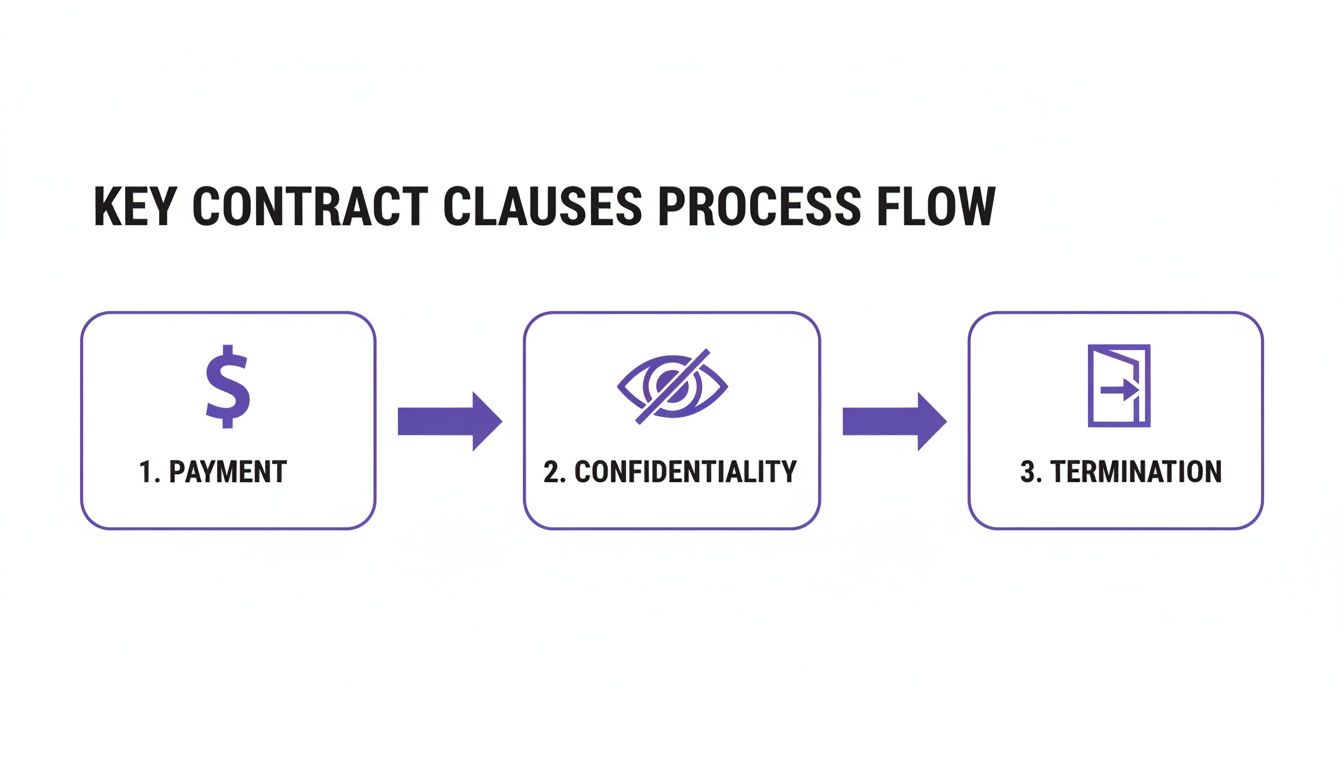
This diagram nails the key checkpoints in any agreement—payment, confidentiality, and termination. These are the exact kinds of clauses that are perfect for standardizing in your templates. By locking in this essential language, you guarantee consistency and protection across every deal, which means less risk and faster reviews.
Centralizing and Streamlining Approvals
One of the biggest slowdowns in any contract process is the internal approval chain. Chasing down signatures and manually tracking who needs to sign off next is a recipe for delays. This is precisely where contract automation becomes your secret weapon.
Picture a logistics company that needs to finalize a new vendor contract. That agreement has to get eyes on it from the Operations Manager, then Finance, and finally Legal before the vendor even sees it. A centralized system handles that entire sequence for you, automatically.
- Real-Time Tracking: You can see exactly where a document is in the approval process at any given moment. No more pinging colleagues for status updates.
- Automated Reminders: The system gently nudges the next person in line when it's their turn, keeping the ball rolling without you having to play traffic cop.
- Secure Audit Trail: Every single action—from someone just viewing the document to signing it—is logged with a timestamp. This creates an airtight, compliant audit trail that's invaluable for legal and regulatory peace of mind.
This level of control is a game-changer. By putting a structured system in place, you can seriously shorten your deal cycle and let your team get back to more important work. If you want to dive deeper, you can explore how to automate your company approval workflow and build in even more efficiency.
Connecting Your Tools for Maximum Impact
The real magic of workflow automation happens when all your tools start talking to each other. Lots of businesses use forms to gather information, but there's often a clumsy, manual handoff to turn that data into a signed agreement.
Let's take an educational institution managing student enrollment. They can use a tool that lets them add a signature to a Google Form. When a student fills out their registration, their info instantly populates a consent agreement, which they can sign electronically right then and there. This completely wipes out manual data entry and merges two steps into one fluid experience.
This integration is a perfect example of what smart automation can do. By linking form data directly to your contract templates, you build a powerful, hands-off workflow that’s faster, more accurate, and just plain better for everyone involved.
The benefits are huge across any industry. A healthcare clinic could use a similar process for patient intake forms, ensuring HIPAA compliance from the get-go. A real estate agency can capture a buyer's details in a form and have a purchase offer generated and ready for eSignature in seconds.
When you find a platform that offers unlimited documents, team members, and templates for one flat price, this powerful technology becomes accessible to everyone. This model is often 90% more affordable than old-school tools that nickel-and-dime you per user or per "envelope," letting you automate every workflow you can think of without your costs spiraling out of control.
How to Securely Sign and Execute Agreements Online

An agreement isn't really an agreement until it’s signed. In a world where business moves at the speed of a click, this final step has shifted from the pen to the pixel. Using secure, legally binding electronic signatures isn't just a nice-to-have anymore—it’s a necessity for closing deals quickly and safely.
But executing contracts online is about more than just speed. It's about making sure the whole process is compliant and legally enforceable. You need to be confident that the digital signature on your agreement will actually hold up if it's ever challenged.
Understanding the Legal Framework for eSignatures
Thankfully, the legality of electronic signatures is well-established across the globe. Key laws give them the same legal weight as a traditional "wet ink" signature, creating a reliable environment for digital business in the United States, Canada, Australia, and beyond.
- ESIGN Act (U.S.): In the United States, the Electronic Signatures in Global and National Commerce Act gives eSignatures the same legal status as handwritten ones.
- eIDAS (EU): For anyone doing business in Europe, the electronic IDentification, Authentication and trust Services regulation standardizes eSignatures across the EU, making cross-border deals much smoother.
These laws provide the backbone of trust for digital transactions. The trick is to choose a digital signing solution that strictly follows these standards.
What to Look for in a Secure eSignature Platform
Let's be clear: not all eSignature tools are created equal. When your agreements contain sensitive information, security and compliance are non-negotiable. The right platform gives you an ironclad, unchangeable record of the entire signing process.
The most critical feature here is a detailed audit trail. Think of it as the digital evidence that proves who signed, when they signed, and that the document wasn't altered afterward. A platform like BoloForms Signature captures every single action—from the moment a document is viewed to the final signature—logging IP addresses, timestamps, and user activity. This creates a court-admissible certificate of completion for every single agreement.
For businesses in regulated fields, compliance is even more important. A solid platform should be built to meet strict standards like HIPAA for healthcare and GDPR for data privacy. This built-in compliance lets you focus on the deal itself, not on navigating a maze of regulatory worries.
Managing Complex Signing Workflows with Ease
Real-world agreements often involve more than just two people. Picture a real estate deal: the buyer, seller, and agent all need to sign, often in a specific order. Trying to manage that sequence manually is a recipe for delays and mistakes.
This is where a robust platform really shines. You can set up a multi-recipient workflow in seconds. Just upload your PDF, specify the signing order, and assign fields to each person. The system automatically routes the document to the right person at the right time and even sends reminders to keep things moving.
Example in Action: A real estate agency can create a template for a purchase agreement. When a deal is ready, they input the buyer and seller details. The platform sends it to the buyer first. Once signed, it automatically goes to the seller, and finally to the agent for countersigning—all without a single confusing email attachment.
This AI-powered automation is changing how agreements get done. The market for contract intelligence is projected to hit $7.2 billion by 2033, driven by solutions that slash review times. You can explore detailed market analysis on astuteanalytica.com to see how this trend is reshaping business. By adopting a modern platform, you're not just signing documents; you're building a smarter, faster, and more secure deal-making process.
Common Contract Writing Mistakes to Avoid
Even the most buttoned-up agreements can fall apart because of small, completely avoidable mistakes. These common slip-ups can turn a solid deal into a source of conflict, draining your time, money, and energy. Knowing what these pitfalls are is the first step to drafting truly bulletproof contracts.
The financial stakes are higher than you might think. On average, businesses lose 8.6% of a contract's total value simply due to sloppy drafting, negotiation snags, or flawed execution. For every $1 million in deals, that's a staggering $86,000 gone. This shows just how critical precision is from the get-go. As you can discover more insights about contract management trends on contractpodai.com, standardizing your approach is the best defense against these leaks.
The Danger of Vague and Ambiguous Language
One of the most common—and damaging—mistakes is using language that's open to interpretation. Words like "reasonable," "promptly," or "best efforts" might feel flexible, but without clear definitions, they're just arguments waiting to happen. Each party will naturally interpret them in the way that benefits them most.
Picture this: a marketing agency agrees to provide "ongoing support" for a new client. The client assumes this means 24/7 access for urgent issues. The agency, however, planned for standard business-hour email responses. This simple misunderstanding can spiral into unmet expectations, frustration, and a potential legal fight over the scope of work.
Pro Tip: Define your key terms, always. If a word could mean more than one thing, spell out exactly what you mean right there in the agreement. Instead of "prompt payment," specify "payment is due within 15 calendar days of invoice receipt."
Forgetting to Include Essential Clauses
It's so easy to get laser-focused on the main event—the price and the deliverables—that you forget about all the "what if" scenarios. Leaving out critical clauses is like building a house without a roof. It might hold up on a sunny day, but you're completely exposed when the storm hits.
What happens if a project gets canceled halfway through? Who owns the brilliant new software or design that was created? How will you handle disagreements without heading straight to court?
A few commonly overlooked clauses include:
- Termination Clause: Without a clear exit ramp, ending a business relationship can get incredibly messy and expensive.
- Intellectual Property Rights: Failing to state who owns the work product is a classic mistake, especially for creatives, consultants, and tech companies.
- Dispute Resolution: Deciding on mediation or arbitration upfront can save you from a long, drawn-out, and public court battle down the road.
Using a system with pre-vetted templates is one of the smartest safeguards against this. With BoloSign, you get access to unlimited templates at one fixed price, making sure these protective, essential clauses are baked into your agreements from the start. It's the key to building consistent, reliable contracts every single time.
Ignoring Future Scenarios and Scalability
A contract shouldn't just work for you today; it needs to hold up tomorrow. Businesses grow, markets shift, and regulations change. An agreement that seems perfect now might become a lead weight a year from now if you don't build in some flexibility.
For instance, a small shipping company might sign a three-year deal with a client based on fixed pricing. If fuel costs suddenly skyrocket, they could be trapped in a contract that loses them money on every delivery. A well-drafted agreement would include a clause allowing for price adjustments tied to specific, measurable market changes.
This is where a modern, adaptable system really shines. As your business needs evolve, you can easily update your master templates within BoloSign without starting from scratch. Better yet, integrating your agreements with your other tools—like when you see how to add signatures directly to your Google Forms—creates a nimble workflow that can scale right alongside your business.
By sidestepping these common blunders, you’re not just writing a contract; you're crafting a strategic tool that protects your business now and in the future. The goal is always clarity, completeness, and foresight—three things a powerful contract automation platform helps you lock down effortlessly.
Got Contract Questions? We’ve Got Answers.
Jumping into the world of contracts can feel like learning a new language. You're not alone. Here are some of the most common questions we hear from business owners, with straightforward answers to help you get it right.
What Actually Makes a Contract Legally Binding?
At its core, a legally binding contract needs a few key ingredients: there has to be a clear offer, an acceptance of that offer, and something of value exchanged (what lawyers call consideration). Both sides also need to intend for the agreement to be a real, legal deal, and they must be legally able to make that deal (so, not minors or someone mentally incapacitated).
This is where a solid digital process really shines. When you use a digital signing solution like BoloSign, the platform itself helps lock in these elements. The secure audit trail captures the whole offer and acceptance workflow, adding a powerful, verifiable layer that proves everyone was on the same page.
Can I Really Write My Own Contract Without a Lawyer?
Yes, you absolutely can, especially for the kind of straightforward deals that happen every day in business. For things like client service agreements, NDAs, or simple vendor contracts, you can create a solid, protective agreement on your own once you understand the essential parts.
Of course, if you're dealing with a multi-million dollar merger or something incredibly complex, getting a lawyer's eyes on it is smart. But for most day-to-day needs, a tool like BoloSign is a lifesaver. It comes loaded with unlimited, customizable templates that already cover the critical legal bases, making the whole process safer and way more efficient than starting from scratch.
How Does an eSignature Actually Hold Up in Court?
This is a big one, but the answer is clear: electronic signatures are legally binding and fully enforceable in most parts of the world. In the U.S., they're backed by the federal ESIGN Act, with similar laws in Canada, Australia, the UAE, and beyond.
The key to their validity in court comes down to proof. Can you prove who signed the document and that the document hasn't been altered since it was signed?
A compliant eSignature platform is non-negotiable here. BoloSign, for instance, generates a detailed, court-admissible audit trail for every document. It records every single action—timestamps, IP addresses, you name it. This creates a rock-solid chain of evidence that's often even more difficult to dispute than a traditional pen-and-ink signature.
What's the Best Way to Manage Contracts After They're Signed?
Stop using your email inbox or a messy shared drive! That's a recipe for disaster. You'll lose track of versions, struggle to find what you need, and create huge security risks.
The only sustainable way to handle this is with a centralized, secure digital system. A dedicated contract automation platform lets you store, search, and track every agreement in one place. With BoloSign, all your signed documents are locked down and organized automatically. No more lost paperwork—you can pull up any agreement in seconds, right when you need it. A clean, organized system is the foundation of good contract management.
Ready to stop guessing and start getting your contracts done right? With BoloSign, you get unlimited documents, team members, and templates for one simple price—making it up to 90% more affordable than the other guys. See for yourself how easy AI-powered, secure, and compliant eSignatures can be.

Paresh Deshmukh
Co-Founder, BoloForms
29 Dec, 2025
Take a Look at Our Featured Articles
These articles will guide you on how to simplify office work, boost your efficiency, and concentrate on expanding your business.