

How to Negotiate a Commercial Lease: A Practical Guide for Tenants
Learn how to negotiate commercial lease terms with expert tips, key clauses, and strategies to secure favorable terms.

Tired of nonsense pricing of DocuSign?
Start taking digital signatures with BoloSign and save money.
When it comes to negotiating a commercial lease, the real work happens long before you sit down at the table. Preparation is power. The best deals aren’t won with last-minute tactics; they’re secured through careful, deliberate homework done weeks or even months in advance.
By locking down your needs, understanding the market, and setting a rock-solid budget before you ever talk to a landlord, you shift the entire dynamic. You’re no longer just reacting—you’re in control.
Your Pre-Negotiation Playbook for Success
Walking into a lease negotiation without a clear game plan is a recipe for a bad deal. It’s like trying to build a house without a blueprint. You'll waste time, take on unnecessary risks, and end up with something that doesn’t quite work for your business.
This early stage is all about getting crystal clear on what you need. It’s about turning vague "wants" into a list of concrete, non-negotiable requirements. This goes way beyond just square footage.
Defining Your Absolute Must-Haves
Think about the day-to-day reality of your business. What does the physical space need to do to support your team and your operations?
A healthcare clinic, for example, will need a specific layout with private examination rooms, a sterile environment, and compliance with accessibility standards. A logistics company couldn't care less about client-facing space; their must-haves are high ceilings for racking, multiple loading docks, and immediate access to major highways.
To nail this down, start a list covering these areas:
- Space & Layout: Do you need an open, collaborative floor plan or walled-off offices for focused work? What about a reception area, storage closets, or specialized rooms?
- Technical Needs: Is high-speed fiber internet a deal-breaker? Do you need specific power outputs for machinery or a high-capacity HVAC system?
- Accessibility & Location: How critical is foot traffic, public transit access, or dedicated client parking? For a retail shop, visibility is everything. For a back-office operation, it might be irrelevant.
Getting this detailed from the start ensures you’re not just looking for a space, but the right space. This level of detail is also a core part of any thorough due diligence process.
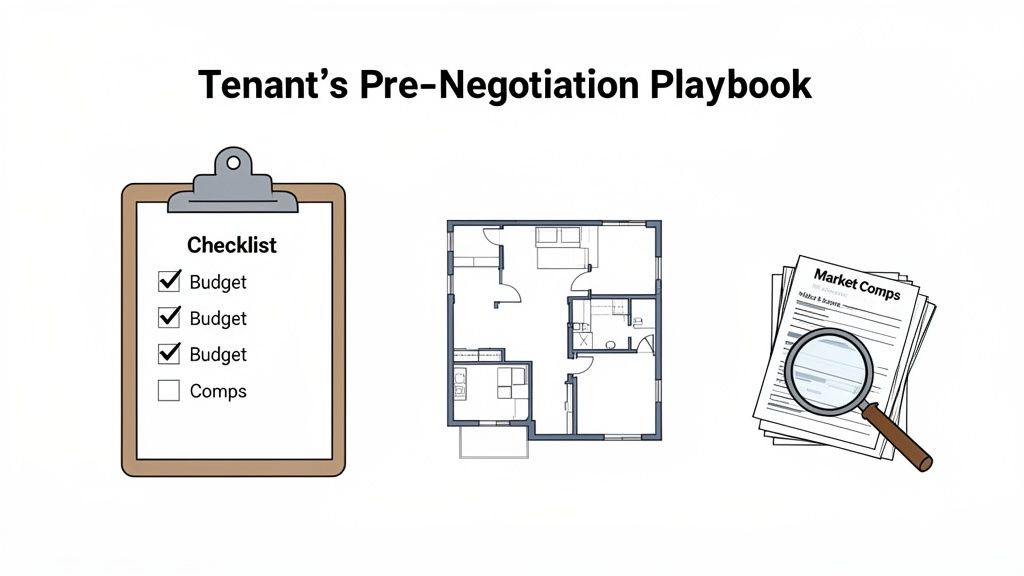
The whole pre-negotiation process can be broken down into three core steps.
Think of this as a strategic loop. Defining your needs helps you research the right properties, which in turn informs your budget. Each step strengthens the others.
Building Your Financial Framework
With your operational needs mapped out, it’s time to build a realistic budget. A common mistake is focusing only on the base rent. Your total occupancy cost is always much, much higher.
Your budget needs to account for everything:
- Base Rent: The headline number, usually priced per square foot.
- Common Area Maintenance (CAM) Charges: Your slice of the costs for lobbies, elevators, security, and landscaping.
- Property Taxes & Insurance: Landlords almost always pass these costs through to tenants.
- Tenant Improvements (TI): The money you'll need to spend to build out the space to fit your layout.
- Utilities & Other Fees: Don't forget electricity, water, trash removal, and even parking fees.
By forecasting your total costs, you establish a firm walk-away point. Knowing the absolute maximum you can afford stops you from getting emotionally attached to a property that will bleed your business dry.
Finally, you need to arm yourself with market intelligence. Researching comparable properties—or "comps"—in the area is the single most powerful tool you have. When you know the average rental rates, current vacancy rates, and what concessions other landlords are offering (like a few months of free rent or a generous TI allowance), you ground your entire negotiation in reality.
It's one thing to ask for a lower rate. It's another thing entirely to say, "The building two blocks over is offering a similar space with a three-month rent abatement." Now you’re not just asking; you’re making a data-driven business case they can’t ignore.
Decoding the Lease Clauses That Impact Your Bottom Line
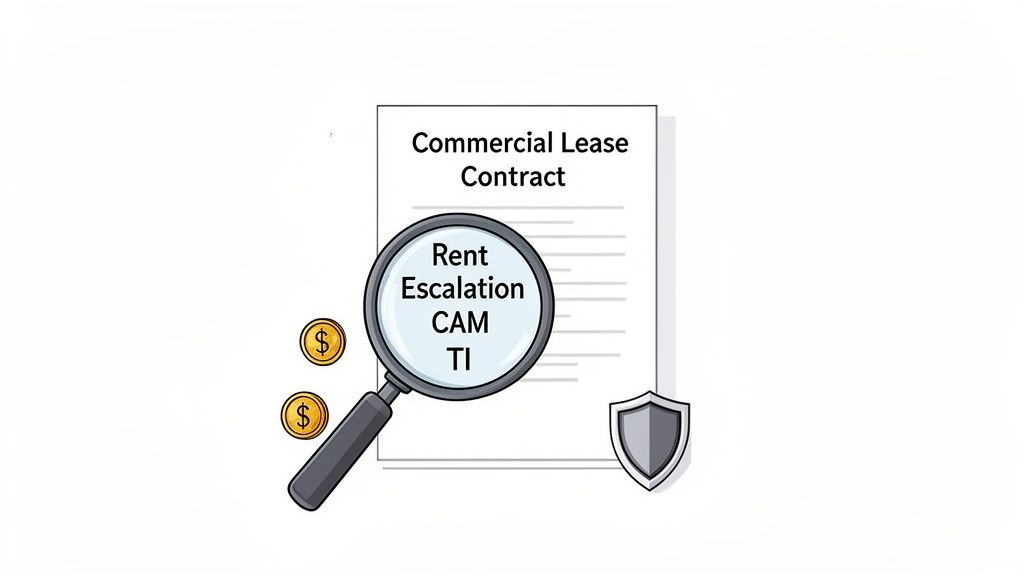
A commercial lease might feel like a dense legal document, but at its heart, it's a financial agreement. While everyone focuses on the base rent, the real money is made or lost in the fine print of the other clauses. These terms will dictate your future costs, your freedom to operate, and your ability to pivot when your business needs to.
Ignoring these details is a rookie mistake that can cost you thousands over the life of the lease, whether you're a staffing agency leasing a small office or a school leasing a large campus. Let's break down which clauses matter most.
Before diving into negotiation, it's critical to prioritize. You can't win on every single point, so you need to know which clauses are your "must-haves" versus your "nice-to-haves." This checklist will help you focus your efforts where they'll have the biggest financial and operational impact.
Commercial Lease Clause Priority Checklist
| Lease Clause | What It Controls | Your Primary Goal |
|---|---|---|
| Rent & Escalations | Your largest recurring expense and how it increases annually. | Lock in a low, fixed annual escalation (2-3%) or cap variable increases. Secure free rent upfront. |
| Term & Renewals | The lease duration and your right to stay longer. | Balance a shorter initial term (flexibility) with multiple renewal options at pre-set rates. |
| Tenant Improvements (TI) | Landlord's financial contribution to your space build-out. | Maximize the TI allowance to reduce your out-of-pocket construction costs. |
| CAM Charges | Your share of costs for maintaining shared building areas. | Cap annual increases and get an itemized list of what's included. Exclude capital improvements. |
| Subleasing & Assignment | Your right to rent your space to another business. | Secure the most liberal rights possible. This is your main exit strategy if your needs change. |
| Termination Rights | Your ability to exit the lease under specific circumstances. | Negotiate a "go-dark" or co-tenancy clause, especially for retail. Add disaster/unsuitability clauses. |
| Repairs & Maintenance | Who pays for what when things break. | Ensure the landlord is responsible for all structural elements (roof, HVAC, foundation). |
| Indemnity & Insurance | Who is liable for accidents and what insurance you must carry. | Limit your liability and ensure insurance requirements are reasonable, not excessive. |
Treat this as your negotiation roadmap. Knowing what you're fighting for is half the battle.
Rent Escalations and Concessions
Base rent is just the starting point. Almost every multi-year lease has a rent escalation clause that bumps up your payment each year. This could be a fixed rate (like 3%) or tied to an economic indicator like the Consumer Price Index (CPI). Your job is to negotiate the lowest fixed increase you can get or, at a minimum, cap any variable increases so your overhead doesn't spiral out of control.
But don't forget about concessions. In a soft market, this is where you can win big. With global commercial real estate sales volumes falling 59% in 2023, landlords are feeling the pressure to keep their buildings full. This gives you leverage. Smart tenants are successfully negotiating for months of free rent or generous tenant improvement (TI) allowances, effectively cutting their rent by 10–25% in the first few years.
Tenant Improvements and CAM Charges
Unless you’ve found a unicorn space that’s already perfect, you’re going to need to build it out. The Tenant Improvement (TI) allowance is the cash the landlord provides for that construction. This is one of the most important negotiating points. Push for the highest TI allowance possible to cover everything from new walls and paint to specialized plumbing for your clinic or data cabling for your office.
Then there are the notorious Common Area Maintenance (CAM) charges. This is your slice of the bill for maintaining shared spaces like lobbies, elevators, and parking lots.
CAM charges are where landlords often hide costs. Your goal here is simple: negotiate a hard cap on annual CAM increases and demand a crystal-clear list of what is—and isn't—included. You should never be on the hook for major capital improvements like a new roof or HVAC system.
Protecting Your Future Flexibility
Your business is going to change. Your lease needs to be able to change with it. Two clauses are absolutely critical for giving you that future flexibility: renewal options and the right to sublease.
- Renewal Options: This gives you the right to extend your lease, but not the obligation. Always negotiate for multiple renewal options with the rent either pre-determined or based on a clear formula (e.g., 95% of Fair Market Value).
- Subleasing and Assignment: This governs your ability to rent out some or all of your space (a sublease) or transfer the entire lease to a new tenant (an assignment). Landlords hate giving this up, but you have to fight for it. This is your primary escape hatch if you outgrow the space or need to downsize.
Managing Risk and Responsibilities
Finally, a few clauses define who's responsible when things go wrong, which directly translates to financial risk. Pay close attention to repairs, insurance, and your termination rights. The repair clause must clearly state the landlord is responsible for the big-ticket structural items—roof, foundation, core systems—while you handle routine interior upkeep.
Insurance requirements should be commercially reasonable, not a laundry list of expensive, unnecessary policies. Most importantly, you need a way out if disaster strikes. A well-negotiated termination clause is your safety net, defining your right to walk away if the property becomes unusable or if the landlord doesn't hold up their end of the bargain.
Mastering the Art of Negotiation and Communication
Knowing your must-have clauses is half the battle. The real magic happens when you can communicate your position clearly and steer the conversation toward a deal that works for everyone. The best lease negotiations feel less like a confrontation and more like building a long-term partnership.
This is where all that upfront preparation really shines. Your market research isn't just for you; it's the factual backbone of every single request you make. Instead of just saying, "I'd like a lower rent," you can walk in with confidence and state, "Comparable properties in this submarket are leasing for 8-10% less per square foot, and they’re including a larger TI allowance."
See the difference? You’ve just shifted the dynamic from a subjective ask to an objective, data-backed proposal.
Framing Your Proposals for a Win-Win
Landlords are business owners, just like you. They need to protect their investment and lock in stable, long-term tenants. Your job is to frame every request you make as a win-win scenario.
For example, when you’re pushing for a longer lease term, you aren’t just asking for stability for yourself. You’re offering the landlord guaranteed income for a longer stretch, which reduces their vacancy risk and the costs of finding a new tenant down the line.
Let's say you're a growing healthcare clinic. You might negotiate for a Right of First Refusal (ROFR) on an adjacent space. You can frame this not as a demand, but as a strategic partnership: "As our practice grows, we fully intend to expand. Giving us the ROFR ensures you have a built-in, creditworthy tenant ready to take that space the moment it's available, completely eliminating vacancy risk for you."
Strategic Concessions and Holding Firm
Negotiation is a dance of give and take. You won't win every single point, so it’s critical to know where you can be flexible and where you absolutely have to hold your ground. This all goes back to that priority list you made earlier.
- Concede on: Lower-priority items that matter to the landlord but are less critical for your operations. This could be something like agreeing to a specific insurance provider or being flexible on the exact move-in date by a week or two.
- Hold Firm on: Your non-negotiables. These are the clauses that directly hit your bottom line and operational freedom, like caps on CAM charges, flexible subleasing rights, or ensuring the landlord is responsible for major structural repairs.
The lease term itself is a major strategic lever. Historical data shows that even a one- to five-year difference in term length can dramatically alter landlord concessions. We've seen this shift incentives by tens of percentage points in major markets.
In fact, the market for commercial lease consulting has grown precisely because expert advice can optimize terms and shift risk away from the tenant, which can change cash flow by 10–30% over a lease's lifecycle. By carefully modeling your options, you can make a powerful case for a term structure that benefits you most.
Key Takeaway: The goal is to build rapport, not an adversarial relationship. Maintain a firm but collaborative tone. Articulating your value as a reliable, long-term tenant is often your most powerful negotiation tool.
Managing the Back-and-Forth
As proposals start flying back and forth, tracking changes becomes absolutely critical. This is where modern tools can save you from costly miscommunications. Juggling multiple Word documents with confusing track changes is a recipe for disaster. A streamlined redlining process is essential.
Properly managing edits, comments, and versions ensures both parties are always working from the most current draft. For a deeper dive into this crucial step, check out our guide on how to redline a contract efficiently. This process keeps negotiations clean and transparent, preventing key concessions from getting lost in the shuffle.
By mastering communication and using the right tools, you can transform a complex negotiation into a straightforward path toward a great deal.
Using Modern Tech to Get Your Lease Done Right
Negotiating a commercial lease is an intricate dance of offers, counter-offers, and endless redlines. If you've ever been stuck in the old-school cycle of emailing Word docs back and forth, you know how slow, messy, and risky it can be. A single missed edit or a crucial comment buried in an email chain can derail the whole deal.
That slow, manual process is a major roadblock when speed and clarity are everything. This is exactly where modern contract technology gives you a serious advantage.
Instead of wrestling with confusing file versions like "Lease_Draft_v5_FINAL_final_EDITED.docx," you can run the entire negotiation from a single, secure digital space. It’s not just about moving faster; it's about being smarter and safer.
Get an Edge with AI-Powered Contract Review
Let's be honest: the biggest challenge in any lease negotiation is figuring out what the document actually says. Landlord-drafted leases are naturally one-sided, packed with dense legalese written to protect their interests, not yours. Trying to manually review a 50-page lease to spot every unfavorable clause is a huge, mind-numbing task, even for pros.
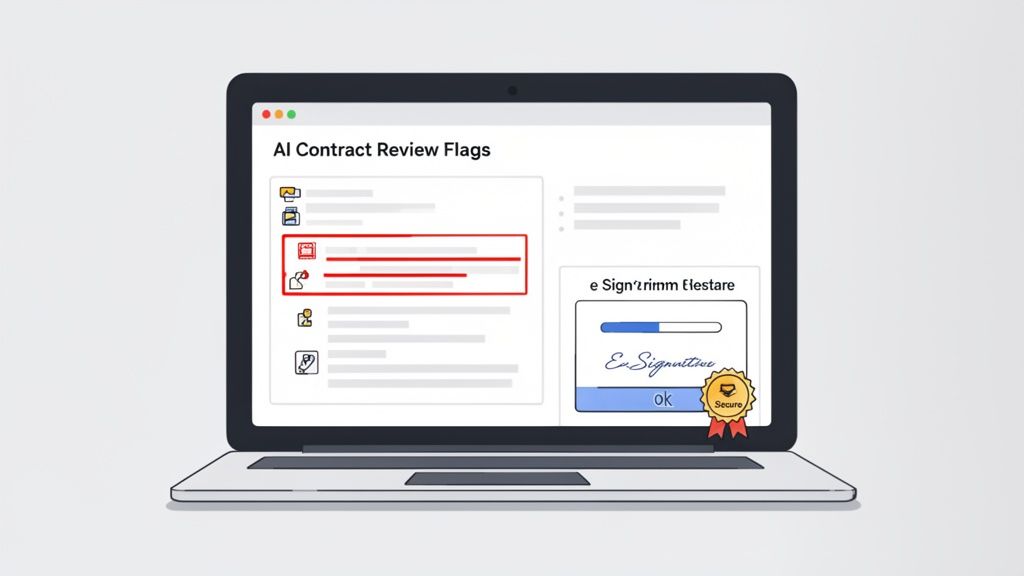
This is where an AI contract review tool becomes your secret weapon. Imagine uploading the draft and, in seconds, getting a clear, actionable analysis.
BoloSign’s AI can instantly:
- Flag Risky Clauses: It automatically spots problematic terms buried in the text—think sneaky CAM charges, unfair repair obligations, or restrictive subleasing rights that could hurt you later.
- Suggest Better Alternatives: The AI doesn’t just find problems. It provides balanced, tenant-friendly language you can immediately drop into your counter-offer.
- Check for Compliance: It scans the document to make sure it aligns with key regulations like HIPAA or GDPR, cutting down your legal risk.
For a busy real estate agency juggling multiple deals, this means you can analyze a dozen leases in the time it would normally take to read just one. For a healthcare clinic with specific compliance needs, it means you can verify the lease terms without waiting weeks for lawyers to trade notes. It gives you an expert-level advantage, leveling the playing field against landlords with big legal teams.
Stop the Redlining Madness
The back-and-forth redlining is usually the messiest part of the whole deal. Trying to track who accepted what change across a dozen different email attachments is a recipe for disaster.
Digital redlining and version control keep everyone on the same page. Every single change, comment, and suggestion is tracked in one shared document, creating a transparent and auditable record of the entire negotiation.
This completely eliminates the risk of working off an outdated version or seeing a hard-won concession "accidentally" disappear from the final draft. Platforms that provide contract automation bring order to this chaos, making sure what you agreed to is exactly what you sign.
This streamlined workflow is a game-changer. For a logistics company finalizing a warehouse lease under a tight deadline, it can cut the negotiation timeline in half. For a growing professional services firm, it means your team can focus on client work instead of playing document detective.
Get to the Finish Line Faster with eSignatures
After you've battled through negotiations and finally agreed on terms, the last thing you want is a delay at the finish line. Printing, scanning, and mailing documents can add days—or even weeks—to the process, leaving your deal hanging.
A secure eSignature solution lets you close the deal in minutes, not days. With BoloSign, you can send the final PDF instantly and have everyone sign online from any device. This is crucial for getting your business up and running faster.
This whole modern workflow—from AI review to digital signing—is built for speed and security. BoloSign ensures every signature is legally binding and compliant with global standards like the ESIGN Act and eIDAS, giving you a faster, more secure way to execute your lease and move forward with confidence.
Best of all, this tech is actually accessible. BoloSign is up to 90% more affordable than platforms like DocuSign or PandaDoc, offering unlimited documents, templates, and team members for one fixed price. You get enterprise-grade tools without the enterprise price tag.
Ready to see how this can change your next lease negotiation? Start your 7-day free trial and feel the power of a smarter contract workflow for yourself.
Finalizing the Deal with Confidence
You’ve navigated the market, decoded the fine print, and fought hard for every concession. You're at the finish line, but this is exactly where a small oversight can undo all your work. Locking in the deal is about precision and making absolutely sure the document you sign perfectly matches everything you agreed to.
This final push comes down to two things: an expert legal review to catch what you might have missed, and a seamless execution process to make it all official. Rushing either of these is a risk you simply can’t afford.
The Essential Final Legal Review
Before any ink hits the page—digital or otherwise—it's time to call in the professionals. Getting a commercial real estate attorney for a final look isn't an expense; it's a critical investment in protecting your business. Their trained eye is designed to spot liabilities hiding in plain sight within standard legal jargon.
An attorney's review goes deeper than the business terms you hammered out. They'll zero in on:
- Local Compliance: Making sure the lease aligns with all local and state zoning laws, ordinances, and property regulations that could trip you up later.
- Liability and Indemnity: Double-checking that indemnity clauses are fair and don’t saddle you with unreasonable risk.
- Verbal vs. Written: Methodically confirming every handshake agreement and verbal promise made during talks is explicitly spelled out in the final contract.
Think of this legal checkup as your last line of defense. It ensures the lease is not just a good deal, but also legally sound, shielding you from future disputes and surprise costs.
To truly button up the deal, it’s smart to run through a detailed commercial property due diligence checklist. This process ensures you've covered all your bases, from legal compliance right down to the physical state of the property.
Executing the Lease Instantly and Securely
Once you have the legal green light, it’s time to make it official. The old way of printing, signing, scanning, and emailing is not only slow but also introduces unnecessary security risks. This is where modern digital signing solutions come in, offering a faster and far more secure way to close the deal.
With a platform like BoloSign, the final step is simple and immediate. You can securely upload the final PDF lease and send it to all parties in just a few clicks. Everyone can then sign PDFs online from any device, anywhere in the world.
This is a game-changer for businesses that need to move fast. For a real estate agency, it means getting the keys to the new office a week sooner. For a logistics company opening a new distribution center, it means getting operations up and running that much faster.
BoloSign ensures the entire process is both quick and secure. Every action is recorded, creating a comprehensive, tamper-evident audit trail that confirms who signed, when, and where. This gives you a legally binding record that’s far more robust than a stack of paper.
The whole process is fully compliant with global standards like the ESIGN Act and eIDAS, giving you total peace of mind that your hard-won agreement is flawlessly executed. And because BoloSign offers unlimited documents for one fixed price, you can manage this crucial step for up to 90% less than the cost of platforms like DocuSign or PandaDoc.
Finalizing your lease shouldn’t be a source of anxiety. With a proper legal review and a modern execution platform, you can sign with total confidence. Experience this seamless workflow firsthand by starting a 7-day free trial of BoloSign today.
Your Commercial Lease Questions Answered
Even after you've nailed down your strategy, a few specific questions always seem to pop up during lease negotiations. Let's tackle some of the most common ones we see from businesses working through this process.
What Is the Most Important Clause to Negotiate?
This is a tough one, as every business has unique needs. But if I had to pick, the 'Use' and 'Subleasing/Assignment' clauses often have the biggest long-term impact on your flexibility.
A 'Use' clause that’s too narrow can handcuff you if your business model needs to pivot. Meanwhile, a restrictive 'Subleasing' clause takes away your best exit strategy if you suddenly outgrow the space or need to downsize. Nailing down broad rights in these two areas gives you the operational agility to let your business evolve without being trapped by a rigid lease.
How Much Can I Realistically Negotiate Off the Asking Rent?
Thinking in terms of a simple percentage off the asking rent is a common mistake. The smarter play is to negotiate for concessions that significantly lower your total cash outlay, especially in the first couple of years.
A realistic goal in many markets is to reduce your "effective rent" by 10-25%. You get there by securing several months of free rent or a generous Tenant Improvement (TI) allowance from the landlord. This strategy almost always provides more financial relief than a small discount on your monthly payment.
Are Digital Signatures Legally Binding for Commercial Leases?
Yes, 100%. Secure digital signing solutions like BoloSign aren't just legally valid—they're the modern standard for closing commercial real estate deals.
Thanks to laws like the ESIGN Act in the U.S. and eIDAS in Europe, electronic signatures carry the exact same legal weight as a wet ink signature. Using an eSignature platform gives you a faster, more secure closing process, complete with a comprehensive audit trail that's far superior to shuffling paper contracts around.
What Are CAM Charges and Can They Be Negotiated?
Common Area Maintenance (CAM) charges are what tenants pay for the upkeep of shared spaces—think lobbies, landscaping, security, and parking lots. They are one of the most important—and absolutely negotiable—parts of any lease.
When you're negotiating CAM, your main goals should be:
- To cap the annual percentage increase so your costs don’t spiral out of control.
- To exclude major capital expenditures. You shouldn't be on the hook for a new roof or HVAC system.
- To secure the right to audit the landlord's CAM records to make sure the charges are accurate and fair.
Getting these terms right is critical for protecting your bottom line from surprise costs. And thankfully, the entire process—from the first review to the final signature—can be managed seamlessly with the right tools.
From AI-powered contract review to secure and instant eSignatures, BoloSign provides an all-in-one platform to manage your entire lease lifecycle. It simplifies complexity, reduces risk, and helps you close deals faster—all for up to 90% less than other providers.
Start your 7-day free trial today and experience a smarter way to handle contracts.

Paresh Deshmukh
Co-Founder, BoloForms
3 Jan, 2026
Take a Look at Our Featured Articles
These articles will guide you on how to simplify office work, boost your efficiency, and concentrate on expanding your business.