

A Guide to Healthcare Document Management Solutions
Discover how healthcare document management solutions streamline clinical workflows, ensure HIPAA compliance, and enhance patient care.

Tired of nonsense pricing of DocuSign?
Start taking digital signatures with BoloSign and save money.
Healthcare document management solutions are specialized digital systems built to organize, secure, and automate the entire lifecycle of a medical facility's paperwork. Think of it as a digital nervous system for a hospital or clinic, connecting patient records, billing information, and consent forms into a single, instantly accessible, and compliant hub.
Why Healthcare Is Drowning In Paperwork
Walk into any hospital's administrative office, and you'll likely see a scene straight out of the past. It's a library of chaos, overflowing with mountains of paper—patient charts, insurance claims, physician credentials, and consent forms. Finding a single file can feel like a frantic search, wasting precious minutes that should be spent on patient care. This paper trail isn’t just inefficient; it’s a costly and risky way to operate.
This reality is the driving force behind a massive industry shift. The global market for medical document management systems is projected to surge from US$1.6 billion in 2025 to US$3.4 billion by 2032, growing at a robust 11.5% each year. This isn't just a trend; it's a direct response to the healthcare sector's urgent need to digitize. North America is leading the charge, holding nearly 47% of the market share thanks to strict regulations like HIPAA that demand ironclad data security. You can explore more data on this healthcare market growth to understand the full picture.
The Real Costs of Paper-Based Systems
Sticking with physical documents creates serious operational friction that impacts everyone, from the front desk staff to the surgeons in the operating room. These manual processes are more than just outdated; they actively undermine the efficiency and security of modern healthcare.
The problems are deeply rooted and feed into one another:
- Crippling Administrative Costs: Every sheet of paper has a price tag. It costs money for printing, copying, filing cabinets, and secure off-site storage. More importantly, it eats up countless staff hours spent on manual filing, hunting for misplaced documents, and physically walking paperwork around for approvals.
- Serious Security Vulnerabilities: Unsecured paper records are a huge liability. A misplaced file or an unauthorized glance at a patient chart can lead to a significant data breach, risking patient privacy and inviting steep HIPAA fines that can cripple an organization.
- Delayed Access to Critical Information: When a physician needs a patient's history immediately, a delay of even a few minutes can be critical. Paper-based systems make it nearly impossible to access information quickly, especially across different departments or locations, which can directly impact patient outcomes.
A healthcare document management solution does more than just store files. It actively automates entire workflows, from streamlining patient intake with digital forms to accelerating insurance claims with instant document retrieval and secure eSignatures.
This digital shift is no longer a luxury—it’s an essential foundation for any healthcare organization that wants to be more efficient, compliant, and patient-focused. By replacing the chaos of paper with structured, automated workflows, these systems create a more resilient and responsive healthcare environment. Ultimately, this change allows providers to focus on what they do best: delivering exceptional care, not managing paperwork.
Exploring the Core Features of a Modern HDMS
To really get what makes modern healthcare document management solutions tick, you have to look under the hood. These platforms are so much more than digital filing cabinets; they're powerful engines built to automate, secure, and connect every shred of information that flows through a clinic or hospital. It's not just about a list of features—it’s about understanding why each component is there and what problem it solves.
The whole journey from paper to digital kicks off with intelligent document capture. Think of it as a super-smart scanner that doesn't just take a picture of a document but actually reads it. This tech transforms mountains of physical records—like old patient charts or signed intake forms—into digital files that you can actually search. Suddenly, a nurse can find a specific note in a 100-page file in seconds instead of flipping through paper for ten minutes.
It’s no surprise that the solutions segment is dominating the medical document management market, capturing over 58.2% of the share in 2024. These aren't just standalone software products; they're comprehensive bundles that tackle everything from digitizing old paper archives to running AI-powered analytics. They directly address the massive challenge of ever-growing patient data volumes. You can learn more about these market-leading solutions and see the impact they're having on the industry.
Secure Storage and Granular Access
Once your documents are digital, you need a fortress to protect them. Modern systems provide secure, HIPAA-compliant cloud storage, which acts like a central vault for every piece of patient and administrative information. But what's even more critical is granular access controls.
Think of them as digital keycards. Administrators can define exactly who gets to see, edit, or share specific documents. For example, a billing specialist might only have access to insurance forms, while a physician has full access to the clinical records for their specific patients. This level of precise control is the bedrock of maintaining patient privacy and staying compliant.
The image below really drives home the core problems a modern HDMS is designed to fix: skyrocketing costs, constant security risks, and frustrating operational delays.
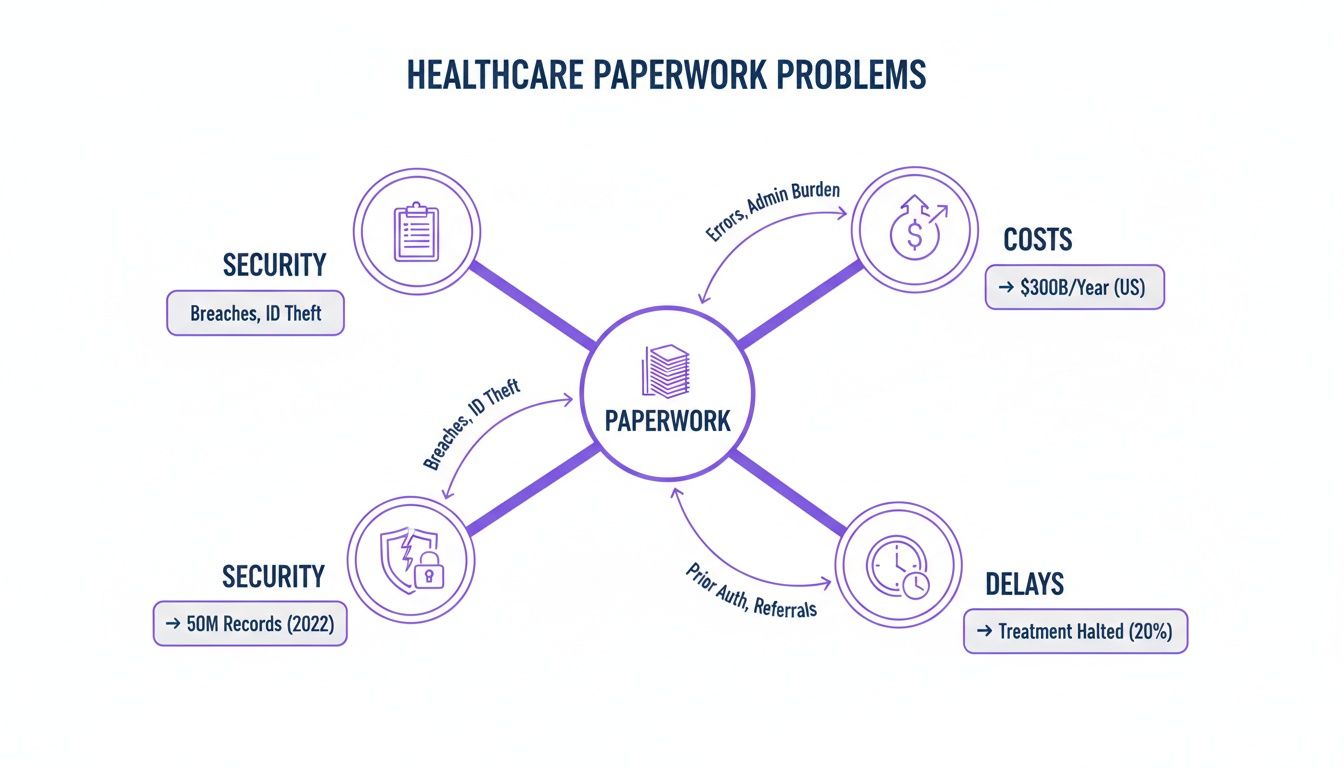
As you can see, these challenges are all connected. A solid digital system tackles them all at once by making things more efficient and way more secure.
Workflow Automation and EHR Integration
Here’s where the real magic happens: workflow automation. Instead of someone physically walking a form from one desk to the next for signatures and approvals, the system does it for them automatically.
Let’s walk through a common scenario. A new patient fills out an intake form. The system can immediately:
- Route the form to a physician for review.
- Send it for a legally binding eSignature from the patient using a tool like BoloSign.
- File the now-signed document directly into the patient's digital chart.
- Ping the billing department to let them know the patient is ready to be processed.
This kind of smooth automation only works with seamless integration with Electronic Health Record (EHR) systems. A great HDMS doesn’t try to replace your EHR; it makes it better. By linking the two, you create one unified source of truth for all patient information. This breaks down data silos and guarantees that clinicians always have the complete picture right when they need it. You can explore a full range of workflow automation and integration features that bring this all together.
BoloSign weaves secure, compliant eSignatures directly into these automated workflows. From treatment plans to provider agreements, every digital signature is legally binding and comes with a complete audit trail, satisfying ESIGN, eIDAS, and HIPAA requirements.
This tight integration turns potential compliance headaches into strengths. Every step is documented, secure, and auditable, freeing up your staff to focus on what they do best: taking care of patients, not shuffling paperwork.
Navigating HIPAA and Security Compliance
In healthcare, data security isn't just a good idea—it's everything. We're not just talking about best practices; we're talking about a strict legal and ethical mandate. This is where the Health Insurance Portability and Accountability Act (HIPAA) sets the non-negotiable standard for protecting sensitive patient information.
For any healthcare document management solution, HIPAA can't be an afterthought or a simple add-on. It has to be the bedrock upon which every other feature is built. But getting your head around compliance doesn't have to feel like you're studying for the bar exam. At its heart, HIPAA compliance for document management is all about a few key principles that create a digital fortress around patient data.
Core Pillars of HIPAA Compliance
A truly compliant system relies on a combination of safeguards working together, not just one standout feature. Here’s what you absolutely must have in place:
- Data Encryption: This is your first line of defense. Encryption essentially scrambles patient data, making it completely unreadable to anyone without the right key. This applies both when the data is just sitting on a server ("at rest") and when it's being sent from one place to another ("in transit").
- Role-Based Access Controls: This is the principle of least privilege. It means staff members can only see the specific information they absolutely need to perform their jobs. A billing specialist, for example, has no reason to view a patient's detailed clinical history, and this control ensures they can't.
- Comprehensive Audit Trails: Think of this as a digital footprint for every document. Every single action—who viewed it, who made a change, who signed it, and exactly when—is logged automatically. This creates an unchangeable record that is vital for accountability and any security investigations.
The fallout from a single data breach can be catastrophic. The financial penalties can easily run into the millions, but the damage to a provider's reputation can be even worse—and often, it's permanent. Patients hand over their most personal information with the expectation of trust, and a breach shatters that in an instant. Finding great resources for HIPAA compliance is a good step to make sure you're covering all your bases.
Fortifying Compliance with Secure eSignatures
Modern document systems are designed to be a sort of digital compliance officer, with security baked into every workflow. But often, the signature process is the weakest link in the chain. This is where a specialized tool like BoloSign can turn a potential vulnerability into a rock-solid strength. By integrating a secure digital signing solution, you close the final loop on compliance.
BoloSign was built from the ground up to meet the intense demands of healthcare. It's not just HIPAA compliant; it also adheres to global legal standards like the ESIGN Act and eIDAS. This ensures that every signature you collect is legally binding and is backed by a tamper-proof audit trail. When a patient signs a consent form or a doctor signs off on a treatment plan, BoloSign captures a complete, verifiable record of the entire interaction.
By embedding secure, compliant eSignatures directly into your document workflows, you create an end-to-end chain of custody for every patient authorization, provider agreement, and administrative form.
This simple integration drastically strengthens your security posture. BoloSign makes it easy to create, send, and sign critical PDFs and templates, all while guaranteeing every step is secure and fully documented. Its AI-powered automation also helps cut down on human error, giving you one less thing to worry about.
Ready to see how seamless and secure eSignatures can lock down your healthcare document management? Start your 7-day free trial of BoloSign and experience the platform firsthand.
Uncovering the True ROI of Going Digital
Let's be honest: bringing a new system into a healthcare setting often feels like just another line item on the expense report. But a modern healthcare document management solution isn't a cost center. It's an investment engine that delivers a real, measurable return on investment (ROI). The magic happens when you connect the system's features to what really matters—hard cost savings, operational speed, and ultimately, better patient care.
The most immediate win is cutting the cord with paper. It's a quick and obvious financial gain. Industry data shows that simply by getting rid of physical document storage and automating how you find files, organizations can pocket an average of 3-4% in cost savings. Just think about the constant bleed of money on paper, ink, printers, filing cabinets, and those secure off-site storage units. A digital system pretty much erases those costs from day one.
Boosting Operational Gains and Efficiency
Beyond saving on supplies, the real ROI multiplier is in operational efficiency. Paper-based workflows are, to put it mildly, slow. It's been found that healthcare workers can waste up to 16 minutes of every hour just hunting for patient documents. A digital system doesn't just speed that up; it completely transforms the bottleneck.
Imagine shrinking document retrieval times from minutes—or even hours—down to a few seconds. That speed creates a ripple effect that benefits the entire organization:
- Faster Billing Cycles: When the billing department has instant access to signed consent forms, insurance cards, and treatment notes, claims get out the door faster and with fewer errors. That means better cash flow.
- Empowered Administrative Staff: Automation frees your admin team from the soul-crushing work of filing, copying, and manually chasing down paperwork. They can now pour that time into higher-value activities like patient engagement, financial counseling, and making the clinic run smoother.
- Accelerated Patient Throughput: From check-in to discharge, digital workflows just keep things moving. Quicker access to information translates to less time in the waiting room for patients and more efficient schedules for providers.
The Ultimate Return: Better Patient Outcomes
While the financial and operational numbers are great, the most important ROI in healthcare will always be improving patient care. When a clinician can instantly pull up a patient's complete history—from old lab results to a specialist's notes—they're equipped to make better, faster decisions. A digital system takes away the risk of working with incomplete or outdated files, which can directly and positively impact clinical outcomes.
This is where BoloSign's unique approach really shines. So many digital solutions trap you with complicated, per-user pricing that quickly becomes a budget nightmare, especially for growing practices or big hospitals. This often forces you to limit who gets access, which just creates new information silos.
BoloSign smashes that barrier with a simple, fixed-price model. You get unlimited documents, team members, and templates for one predictable cost, making it up to 90% more affordable than the usual suspects.
This model ensures everyone on your team—from the front desk to the surgical suite—has the access they need without you worrying about the bill climbing higher. It puts efficiency within reach for everyone, making the full benefits of a healthcare document management solution a reality for any organization, whether you're a small private practice in Canada or a sprawling hospital network in the US.
The bottom line is clear: an HDMS, powered by a smart eSignature tool like BoloSign, is a strategic move for efficiency, compliance, and top-tier patient care. Ready to see the ROI for yourself? Start your 7-day free trial and see firsthand how BoloSign can transform your document workflows.
Putting Document Management Into Practice
Theory is one thing, but seeing how these systems actually perform in the real world is where it all clicks. Let's move beyond concepts and explore how healthcare document management solutions tackle specific, everyday challenges in different healthcare settings.
From the controlled chaos of a major hospital to the specialized focus of a multi-location clinic, the right system transforms operations. It’s about automating the tedious, securing the critical, and creating a smarter, more connected environment where technology genuinely supports patient care.
Streamlining Operations in a Bustling Hospital
Hospitals and large clinics are the epicenters of healthcare, and they deal with an absolutely staggering volume of patient records every single day. It’s no surprise they command a massive 52.8% revenue share of the medical document management market as of 2024. Think about the constant flood of data—admission forms, prescriptions, lab results, discharge summaries. Paper-based systems just can't keep up.
A modern document management system brings order to this chaos. Here’s what that looks like in action:
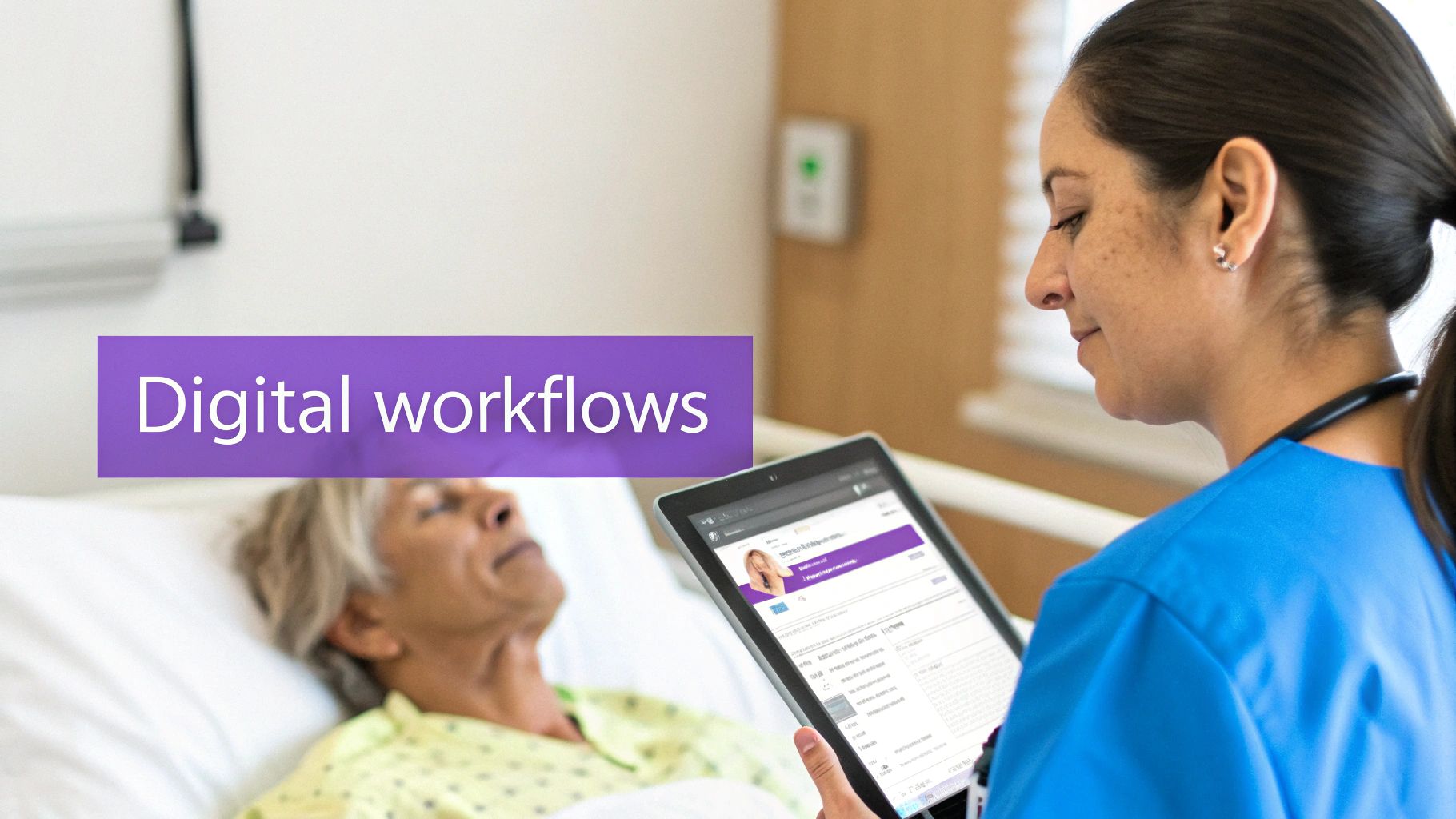
- Patient Admissions: Forget the clipboard. A patient completes their intake forms on a tablet, and the data is instantly and accurately captured. This kicks off automated workflows, notifying the right departments without anyone lifting a finger.
- Surgical Consents: A surgeon can send a consent form directly to a patient's device for a secure eSignature. With a tool like BoloSign, that signed PDF is automatically filed in the patient’s record with a complete audit trail, keeping everything HIPAA-compliant.
- Lab Result Distribution: When test results are ready, the system automatically routes them to the ordering physician’s inbox and attaches them to the correct patient file. No more manual sorting, no more delays.
Accelerating Onboarding for Healthcare Staffing Agencies
In the world of healthcare staffing, speed is the name of the game. Placing qualified nurses, doctors, and specialists quickly means navigating a mountain of paperwork: employment contracts, credentialing files, compliance forms, and tax documents. Every single day spent waiting on a signature is a critical role left unfilled.
This is where a powerful digital signing solution becomes a game-changer. An agency using BoloSign can build a standardized onboarding packet using reusable templates.
With a single click, they can send the entire packet to a new hire. The professional can then review and sign PDFs online from any device, returning the completed paperwork in minutes, not days. This rapid turnaround gets skilled staff into hospitals and clinics faster.
By leveraging an integrated platform, agencies can manage unlimited documents and team members for one fixed price, making the process 90% more affordable than traditional tools that nickel-and-dime you for every signature or user.
Centralizing Records for Specialized Clinics
Now, picture a specialized clinic with several locations. Trying to manage patient records and physician credentialing across different offices can quickly spiral into a logistical nightmare. A centralized document management system acts as that single source of truth, making sure every location is working from the same, up-to-date information.
For instance, when a physician's credentials are updated, they can be uploaded once and become instantly available to administrators at every single clinic. This simplifies compliance and makes quality assurance a breeze. Likewise, when a patient visits a different branch, their entire history is accessible in seconds, guaranteeing continuity of care. This seamless flow of information is absolutely critical for providing consistent care across a distributed network of facilities in the UAE or Australia.
Of course, effective implementation also hinges on great staff training documentation, and a good DMS helps manage all of that, too, ensuring everyone stays proficient.
These examples show that a healthcare document management solution isn't just a digital filing cabinet. It’s a dynamic tool that, when combined with BoloSign’s AI-powered automation and secure eSignatures, actively solves real-world problems.
Ready to see how it can work for you? Start your 7-day free trial of BoloSign to experience the platform firsthand.
Choosing the Right Healthcare DMS Partner
Picking a healthcare document management solution is a big deal. This isn't just about buying a piece of software; it's about choosing a long-term partner who will be responsible for protecting your patients' data and making your daily operations smoother. It's a decision that will echo through your organization's efficiency, security, and compliance for years, so a thorough evaluation is non-negotiable.
First things first, you need to look past the flashy marketing claims and get down to the essentials. Any vendor worth considering must be able to prove their HIPAA compliance, and that includes being ready and willing to sign a Business Associate Agreement (BAA). From there, it's all about how well it plays with your existing tech. How easily can it integrate with your Electronic Health Record (EHR) and billing systems? A solution that can't connect to your core platforms is just another data silo waiting to cause headaches.
Key Vendor Evaluation Criteria
As you start comparing solutions, you'll notice pricing models are all over the map. Many vendors have complex fee structures—charging per user or even per document—that make budgeting a nightmare. This kind of unpredictable pricing can actually discourage your staff from using the tool, which completely defeats the purpose of going digital in the first place.
This is where a different approach makes a real impact. BoloSign, for example, uses a simple, fixed-price model that includes unlimited documents, team members, and templates. This completely removes the financial guesswork and puts powerful document automation within reach, making it up to 90% more affordable than many traditional tools.
Vendor Selection Checklist for Healthcare DMS
Choosing the right partner requires a structured approach. This checklist is designed to help you cut through the noise and focus on what truly matters when evaluating a healthcare document management solution.
| Evaluation Criteria | What to Look For | Why It Matters |
|---|---|---|
| Compliance & Security | Certifications like HIPAA, GDPR, SOC 2, and ISO 27001. Look for features like robust audit trails, data encryption at rest and in transit, and a signed BAA. | This is non-negotiable in healthcare. A breach can lead to massive fines, reputational damage, and loss of patient trust. Strong security isn't a feature; it's the foundation. |
| Integration Capabilities | Pre-built connectors for your EHR, practice management, and billing software. Ask about the API and how easily it can create unified workflows (e.g., for contract automation). | The goal is to eliminate data silos, not create new ones. Seamless integration means less manual work, fewer errors, and a single source of truth for patient and operational data. |
| Scalability & Pricing | A transparent, all-inclusive pricing model that doesn’t penalize you for growth. Does the cost balloon as you add more users, documents, or departments? | Your DMS should support your organization's growth, not hinder it. Predictable costs allow for better long-term financial planning and encourage widespread adoption. |
| Ease of Use | An intuitive, user-friendly interface that requires minimal training for both clinical and administrative staff. Check for a clean design and straightforward navigation. | If the system is clunky or complicated, your staff won't use it. High user adoption is the only way to achieve a positive return on your investment. |
By systematically ticking these boxes, you can ensure your chosen DMS is a true partner that is secure, integrated, affordable, and easy for your team to embrace.
Best Practices for Implementation
Once you’ve made your choice, a successful rollout hinges on smart planning. Don't make the mistake of trying to flip the switch for the entire organization overnight. Start small. Run a pilot program in a single department to iron out any wrinkles, gather feedback, and build some internal success stories. Also, map out your data migration strategy carefully, focusing on active patient records first to ensure continuity of care.
The single most critical factor for success is staff adoption. Invest in good training that goes beyond just clicking buttons. Show your team how the new system makes their specific jobs easier. Demonstrate how they can create, send, and sign PDFs online in a matter of minutes, and you'll turn skeptics into champions.
BoloSign is built to be a smart, affordable, and powerful part of any modern healthcare document strategy. With its AI-powered automation and compliant digital signing solutions, it delivers the security and efficiency you need to not just survive, but thrive. The best way to understand the impact is to see it for yourself.
Experience just how simple and secure healthcare document management can be. Start your 7-day free trial of BoloSign and see the platform firsthand.
Frequently Asked Questions
When you're exploring healthcare document management, a few common questions always seem to pop up. Let's tackle some of the big ones to clear up how these systems actually work and the value they bring to the table.
How Does A Healthcare DMS Work With Our Current EHR System?
Think of it as creating a superhighway for your documents. Modern document management solutions are built to integrate directly and seamlessly with the major Electronic Health Record (EHR) systems you already use.
This connection isn't just one-way; it creates a fluid, two-way street for information. A patient's signed consent form or a scanned insurance card can be instantly visible right inside their EHR chart. This completely gets rid of the need for your staff to jump between different programs, slashes data entry errors, and gives clinicians a single, complete view of all patient information.
Is Moving From Paper Records To A Digital System Expensive?
There’s definitely an upfront investment, but the long-term payoff is huge. Right off the bat, a digital system eliminates the recurring costs of paper, printing, ink, and all that physical storage space.
More importantly, it frees up your staff's time and drastically reduces the risk of eye-watering HIPAA fines. Solutions like BoloSign are designed to make this jump affordable. With a fixed-price model for unlimited documents and users, it can be up to 90% more cost-effective than other tools that nickel-and-dime you with complicated per-user pricing.
How Do eSignatures Like BoloSign Guarantee Compliance?
eSignature platforms designed specifically for healthcare, like BoloSign, build compliance in from the ground up.
They are engineered to be fully HIPAA compliant, protecting every piece of patient data that flows through them. They also meet federal legal standards like the ESIGN Act and global standards like eIDAS, which makes every eSignature as legally binding as one signed with pen and ink. To top it off, every signed document is locked down with a comprehensive, tamper-evident audit trail, recording exactly who signed, when they signed, and from where—offering a level of security and proof that paper processes just can't match.
Ready to see how BoloSign can modernize your document workflows with secure, affordable, and compliant digital signing solutions?

Paresh Deshmukh
Co-Founder, BoloForms
17 Dec, 2025
Take a Look at Our Featured Articles
These articles will guide you on how to simplify office work, boost your efficiency, and concentrate on expanding your business.