
Enterprise Contract Management That Scales
Learn how enterprise contract management improves control, compliance, speed, and ROI while supporting secure digital signing workflows.

Tired of nonsense pricing of DocuSign?
Start taking digital signatures with BoloSign and save money.
Your sales lead can't find the signed client agreement. Finance is asking when a vendor contract renews, procurement has a different version in a shared drive, and legal is searching an inbox for the approval that may never have been documented. That's the moment most companies discover that enterprise contract management isn't a filing task. It's how you control revenue, obligations, and risk across every team that creates, signs, and has to deliver on an agreement.
Why Contract Management Becomes a Business Problem
A growing staffing firm offers a useful picture. Recruiters send candidate agreements from personal templates, account managers keep client terms in email, and HR stores onboarding forms somewhere else. At twenty contracts a month, people remember where things are. At two hundred, memory stops working as a system, and nobody can confidently answer who owns a contract or when it renews.

The scale explains why this breaks. Industry research summarized by Juro estimates that 60% to 80% of business-to-business transactions are governed by contracts, and Fortune 1000 organizations manage an estimated 20,000 to 40,000 active contracts at a time, as detailed in Juro's summary of contract management statistics. Those agreements cover sales, procurement, employment, partnerships, licensing, privacy, and service levels. Legal reviews language, but finance, procurement, sales, HR, operations, and security all live with the result.
Storage Isn't the Same as Control
Think of a warehouse. Boxes on shelves have value only if staff can find an item, confirm it's the right version, and act before it expires. Contracts work the same way. A signed PDF in a folder doesn't tell you who must deliver what, which price increase you can claim, or when notice of termination is due.
Weak administration gets expensive after signature. World Commerce & Contracting research cited in that same Juro analysis estimates ineffective contract management can cause value leakage of up to 9% of annual turnover. That leakage comes from ordinary misses, not dramatic failures.
- Missed price increases: The clause exists, but nobody tracks the date it can be applied.
- Overlooked renewals: An unwanted agreement rolls over because no owner received a reminder.
- Unenforced terms: Rebates, service credits, or negotiated discounts go unclaimed.
- Unclear ownership: Each team assumes another team is monitoring performance.
A contract creates value only when the business can find it, understand it, and act on it throughout its life.
Enterprise contract management fixes this by turning scattered documents into a managed lifecycle, from intake and drafting through review, approval, signing, performance, renewal, and closeout. You don't need an enterprise-sized legal department to start. You need clear ownership, a central record, and repeatable steps that don't depend on one person's inbox.
Understanding the Enterprise Contract Lifecycle
A sales agreement can be signed on Friday and still leave key questions unanswered on Monday: Who owns delivery? When does the renewal window open? Which team checks the security obligations? The contract lifecycle is the operating model that assigns those decisions from request through closeout. An eSignature records agreement; it does not manage the work that follows.
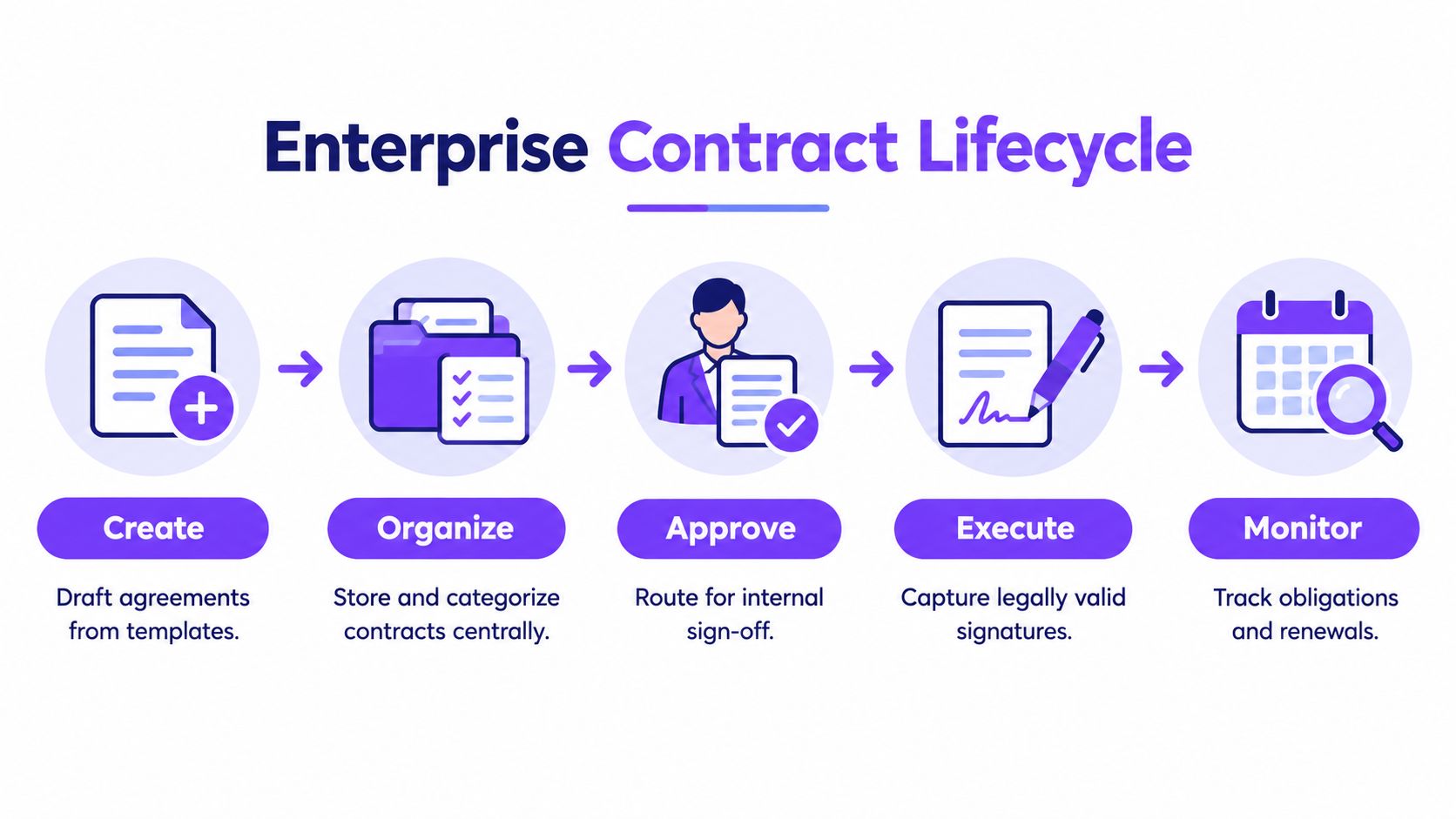
The work begins at intake, when the business owner identifies the need, parties, value, and potential risks. Drafting draws on approved terms. Review and approval then involve the people suited to the agreement's risk, such as legal, procurement, finance, IT, security, or compliance. A routine purchase should not wait behind a complex, high-risk negotiation because both entered the same queue.
What Happens After Signing Matters as Much
Signing is a checkpoint, not the finish line. The executed version and its history need to be retained, while an assigned owner tracks obligations, milestones, payments, and renewal dates. At closeout, the organization confirms that duties are complete, records are retained under policy, and relevant lessons can inform future decisions.
Public-sector findings illustrate how process design and complexity affect the work. A 2024 benchmark from the National Contract Management Association's Contract Management Institute reported that public-procurement cycle times for low- and medium-complexity acquisitions were double the average, while higher-complexity contracts took about 25% longer. In a study of 179 public procuring entities, researchers found that contract-management difficulty weakened procurement performance (β = −0.1447, p = 0.0190) (study of public procuring entities). Complexity may be unavoidable; unclear ownership and poorly designed handoffs are choices.
Cycle time helps teams locate those handoff problems. APQC Open Standards data, reported in Mindsprint's procurement KPI benchmark summary, shows that the fastest organizations establish supplier contracts in 37 calendar days or less, while the slowest take at least 51 days. A single end-to-end measure can hide whether delays occur during intake, review, approval, or signature. Break the timeline into stages, route routine agreements through approved paths, and capture required details before drafting begins.
A signing tool may record execution without assigning owners or tracking post-signature duties. Enterprise contract management connects those responsibilities across teams, systems, and decision points. The right workflow keeps the agreement's key information useful long after the signatures are complete.
Essential Contract Management Capabilities
Features only matter when you can place them in the workflow. Start with contract automation at the front door. Reusable PDF templates preserve approved language, and form-based data capture collects counterparty, value, term, and owner as structured fields rather than buried text. That structure later powers search, reporting, and renewal alerts without someone retyping the document.
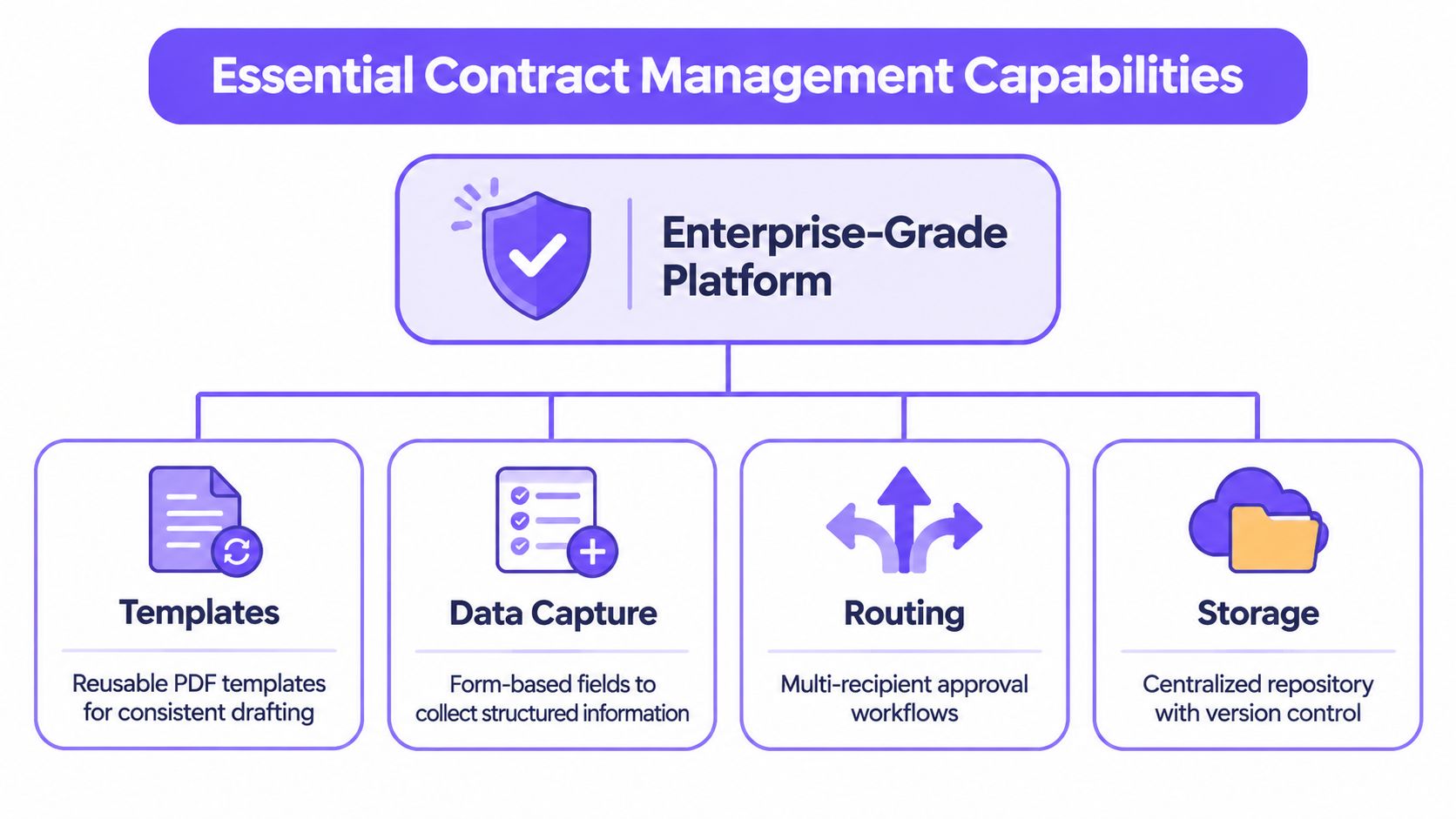
Approval workflows then route the right version to the right person in the right order. Role-based routing, customizable requests, and real-time status tracking replace follow-up emails asking where a document sits. If you're mapping this for the first time, BoloSign's guide to automating a company approval workflow is a practical place to see how routing rules translate into daily work.
The Capabilities That Work as a Chain
- Templates and clause control: Standard language reduces drafting variation and keeps legal review focused on real deviations.
- Multi-recipient eSignature: Ordered signing lets internal approvers and external parties complete the same record without version confusion.
- Searchable central storage: Metadata and full-text search help teams retrieve obligations, not just file names.
- Renewal and obligation tracking: Owners receive tasks tied to dates and duties extracted from the agreement.
- Dashboards: Managers see stalled approvals, upcoming expiries, and workload by team or contract type.
- Audit trails: Each view, approval, and signature event becomes part of a reconstructable history.
Capacity is part of the chain too. A small legal team may use outside support for routine intake, template cleanup, or tracking during peak volume. Teams exploring that option can review the best place to hire virtual legal assistants as one way to add hands without changing who remains accountable for legal decisions.
Seeing the sequence in motion is more useful than reading a feature list, so watch how a document moves from preparation to completion before judging any platform.
AI-powered automation sits on top of this foundation, not in place of it. AI can extract dates and parties, summarize long agreements, flag clauses that differ from your playbook, and help reviewers spot issues faster. It shouldn't approve risk, accept unusual liability terms, or decide that a contract is safe to sign. In demos, ask vendors to run your own messy documents, show where a human can override the result, and explain what evidence is saved. BoloSign combines reusable templates, multi-recipient requests, real-time status, and AI-assisted review in its digital signing solutions, so you can create, send, and sign PDFs online while keeping the record attached to the workflow.
Apply Contract Workflows Across Business Sectors
A staffing firm can lose a week if a signed placement agreement sits apart from the start-date and onboarding process. A recruiter may own intake, HR may approve the template, and the candidate and client may sign in sequence. The workflow should connect those steps so the team can see whether the placement is ready on time.
That operating model changes with the work. In healthcare, a provider agreement or business-associate contract may need privacy and legal review before signature. The U.S. Department of Health and Human Services says an electronic business-associate contract can meet HIPAA Privacy Rule requirements if it also forms a legally binding contract under applicable state law, as explained in HHS guidance on electronic business-associate contracts. Counsel should confirm the requirements for each agreement.
A real estate workflow might route purchase or lease documents from an approved template, then track contingencies after signing. Logistics can use a shorter path for delivery confirmations: the driver collects a customer's signature, and operations links proof of delivery to the shipment and billing record. The right workflow follows the risk and the work that happens after signature.
Education providers face a different challenge: collecting admissions, enrollment, and consent forms at volume, including from parents or adult learners. Connecting a form to a signature request lets administrators capture structured information and see which submissions remain outstanding, rather than sorting through email attachments.
Professional services firms can route statements of work from a partner to finance for payment-term review, then track delivery milestones and change orders. In each sector, the workflow should make ownership clear and carry the agreement into the next operational task.
Cross-border agreements add a choice about signature assurance. The European Commission states that eIDAS Regulation No. 910/2014 has applied directly across EU Member States since July 1, 2016, in its overview of eSignature legislation. For agreements spanning the US, Canada, Australia, New Zealand, the UAE, and Europe, choose the signing method based on governing law and transaction risk. A higher-assurance route may suit a sensitive agreement; routine forms may need a simpler process. BoloSign supports templates, multi-recipient requests, and online signing for PDFs and forms, with status and history kept together.
Protect Security Compliance and Audit Evidence
Suppose a supplier disputes a signed agreement six months after approval. Your team needs more than the final PDF: it needs to establish who signed, which version they saw, and whether the document changed afterward. That evidence depends on the operating rules around the signing process, as well as the technology that records it.
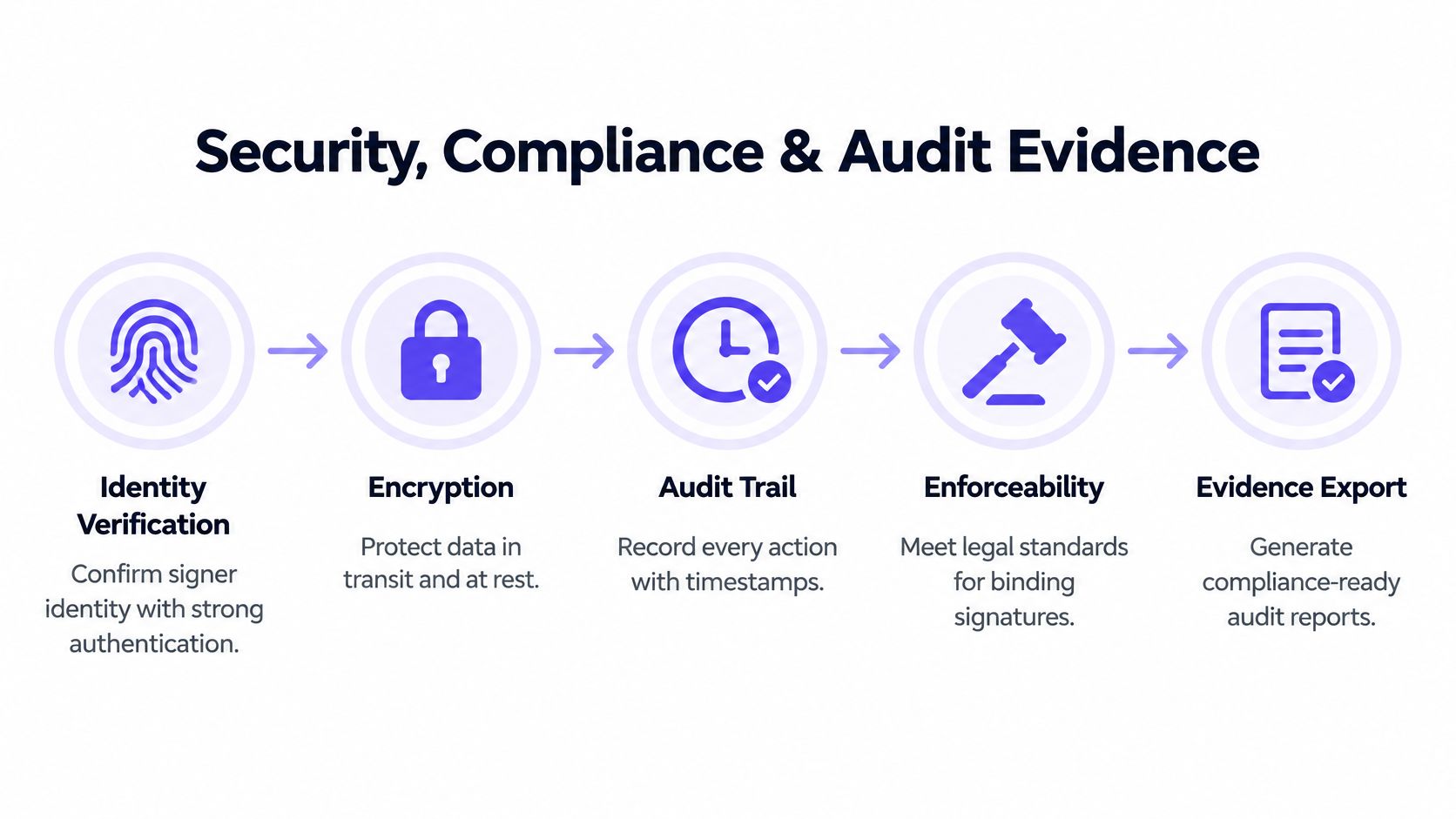
A useful audit package connects signer identity, authentication method, consent to sign, timestamps, document version, workflow events, relevant device or IP context, and a way to detect changes, such as a document hash. NIST-aligned governance emphasizes auditability, integrity protection, and controlled records rather than the signature alone, as explained in this electronic signature audit trail glossary. An independent reviewer should be able to reconstruct the signing history without relying on undocumented explanations from your team.
Match Controls to the Law and the Risk
ESIGN, UETA, eIDAS, HIPAA, GDPR, ISO 27001, and SOC 2 provide context for legal and security decisions, but they do not replace transaction-specific legal analysis. Under eIDAS, an electronic signature cannot be denied legal effect solely because it is electronic. A qualified electronic signature is the only type explicitly given the same effect as a handwritten signature across all EU Member States, according to the European Commission eSignature FAQ. Legal counsel can help determine when a transaction calls for stronger identity checks or signing assurance.
Build the evidence process into daily operations. For example, link signed documents to their audit events in tamper-evident storage, restrict access by role, and define retention schedules, legal holds, and export procedures. During a platform evaluation, inspect whether the audit trail for signed documents records and exports the events your reviewers need.
A practical test: can an outside reviewer follow the record from request to signature?
AI also needs clear boundaries. In a KPMG and Forbes survey report on AI in contract management, 73% of executives said generative AI was speeding drafting and review, while 67% said their organization lacked a formal AI policy for contract-lifecycle use; 38% described their CLM environment as integrated. Set rules before enabling AI: automate low-risk data extraction, require human review of issue spotting, and leave legal decisions to authorized counsel. A platform can record and enforce those boundaries, but people remain accountable for the judgment.
Plan Integration Migration and Governance
Don't start by buying for the largest possible future. Start by inventorying what you have. List contract types, where they live, who owns each one, which fields you must report on, and which dates create work after signature. That inventory often reveals duplicate templates and agreements with no owner, which are governance problems software alone won't fix.
The governance gap is common. Survey results show only 31% of leaders reported a single source of truth with established governance for their contract inventory, while 84% identified regulatory challenges and 62% identified complex governance structures as major pain points, in KPMG's analysis of legal managed services and contract governance. A further 35% cited poor alignment with business goals. Buying a platform before assigning ownership moves the confusion into a new interface.
A Sequence a Smaller Team Can Sustain
- Define minimum metadata: Counterparty, owner, value, start date, end date, renewal terms, and contract type for every record.
- Map intake and approvals: Decide where requests enter, who can approve by risk and value, and where requests escalate when someone is unavailable.
- Set access and retention: Assign permissions by role and agree how long each record type is kept.
- Pilot one workflow: Choose a high-volume, repeatable agreement and test it with real users before wider rollout.
- Validate migration: Clean legacy templates, map fields, resolve duplicates, and compare migrated records against originals.
Integrations should pass data once and report status back to where people already work. A CRM can trigger a sales agreement, storage can hold the executed copy, and chat can notify an owner that approval is waiting. BoloSign connects with Zapier, Make, Pabbly, HubSpot, Salesforce, Pipedrive, Google Drive, Google Sheets, Slack, and Microsoft Teams, and the available connections are listed on BoloSign's integrations page. It also supports one-click DocuSign template import, which reduces rebuilding work during a switch.
For a smaller enterprise, the minimum viable governance model is modest. One accountable owner per contract type, one intake route, approved templates, named approvers with backups, required metadata, and a monthly renewal review will outperform an elaborate policy nobody follows. Add sophistication only when a measured bottleneck or risk demands it.
Evaluate Platform Options and Build the Business Case
A feature checklist can't tell you whether a platform fits your operating model. Evaluate the work behind the features. Can business users start a request without legal retyping it, can approvers see why a document reached them, and can you report on renewals next quarter without exporting everything into a spreadsheet? Usability, integration depth, migration support, compliance posture, and total cost matter together.
Contract Management Priorities by Business Stage
| Business Stage | Primary Need | Must-Have Capabilities | Evaluation Focus |
|---|---|---|---|
| Small business | Stop losing documents and chasing signatures | Templates, eSignature, status tracking, audit trail | Ease of use, fixed cost, fast setup |
| Growing company | Standardize approvals across teams | Role-based routing, metadata, integrations, renewal alerts | Adoption, workflow flexibility, reporting |
| Enterprise organization | Govern risk and obligations at scale | Advanced permissions, evidence export, deep integrations, dashboards | Security review, auditability, change management |
Build ROI From Your Own Numbers
Avoid a vendor's generic savings claim. Model your current contract volume, the staff time spent searching and re-entering data, stage-by-stage cycle time, missed renewals, and the cost of switching and training. Then run conservative and expected scenarios with your own adoption assumptions. If a benefit can't be tied to a baseline you measured, label it as an assumption and test it in a proof of concept.
HR leaders use the same discipline when they compare operational platforms, which is why resources such as top benefits administration picks emphasize fit and total effort rather than headline features alone. Apply that lens here.
Pricing still matters. BoloSign offers unlimited documents, team members, and templates at one fixed price, stated to be 90% more affordable than traditional tools, which removes per-envelope and per-user penalties as volume grows. That's an advantage only if the platform passes your workflow test. Set proof-of-concept criteria in advance, such as successful template import, correct routing for three risk tiers, integration data passing accurately, and users completing a request without help. Measure baseline cycle time, completion rate, error rate, and renewal visibility before and after the pilot. The business case becomes credible when those results come from your documents, your staff, and your approval rules.
Take a Practical Path to Better Contract Operations
Pick one high-volume agreement workflow this quarter. It might be client onboarding, candidate placement, vendor approval, or enrollment consent. Don't attempt to redesign every contract type at once, because a narrow success gives you evidence and a pattern other teams can copy.
Name the owner and list the fields the business must capture before drafting starts. Choose one approved template, remove competing versions, and map approvals by risk so routine documents move quickly while unusual terms reach counsel. Connect one source system, such as your CRM or a form, instead of integrating everything in the first release.
Your First Measured Set
- Baseline first: Record current time from request to signature and how often staff chase missing information.
- Evidence requirements: Decide which audit events, permissions, and retention rules apply before go-live.
- Post-signature duties: Assign renewal and obligation owners at the moment the contract is created.
- Review date: Revisit the workflow after the pilot and fix the bottleneck users encountered.
Start with governance people can follow on a busy Tuesday, then automate the steps that prove repetitive.
That's how enterprise contract management scales without a high-risk launch. Standardize the intake, preserve the evidence, measure each stage, and expand one workflow at a time. BoloSign gives growing teams a practical starting point to create, send, and sign PDFs, templates, and forms quickly, with AI-powered automation, secure document workflows aligned to ESIGN, eIDAS, HIPAA, and GDPR, and fixed-price access without per-envelope pressure. Start a 7-day free trial, run one real agreement through the full path, and judge the result by whether your team can find it, prove it, and act on it months later.
Closer Innovation Labs Corp. builds BoloSign to help teams create, send, approve, and sign contracts with unlimited documents, templates, and team members at one fixed price. If you're ready to replace scattered files and manual follow-ups with secure, auditable contract workflows, visit Closer Innovation Labs Corp. and start your 7-day free trial with a real agreement from your business.

Paresh Deshmukh
Co-Founder, BoloForms
22 Oct, 2026
Take a Look at Our Featured Articles
These articles will guide you on how to simplify office work, boost your efficiency, and concentrate on expanding your business.