

E-Sign Platform Webhook Support Guide
Master e-sign platform webhook support to automate signing workflows. Learn event handling, security, retries, and real-time BoloSign integrations.


Tired of nonsense pricing of DocuSign?
Start taking digital signatures with BoloSign and save money.
Webhook support for an e-sign platform boils down to one thing: your systems get real-time notifications the moment a document changes status, rather than having to check repeatedly. Imagine a courier ringing your doorbell when a package arrives instead of pacing to the porch every five minutes.
Understanding E-Sign Platform Webhook Support
A webhook bridges BoloSign with the tools your team already relies on. When someone views, signs, declines, or completes a document, BoloSign pings your configured application so the next step starts automatically. That makes webhook support a core expectation for modern digital signing solutions, not just a developer feature.
Here's how it works in practice. A staffing agency sends an offer letter and automatically creates an employee record after the signature arrives. A healthcare clinic updates a patient file as soon as a consent form is finalized. A real estate team moves a lease to its next stage without refreshing a dashboard or sending a follow-up email. Logistics companies can release dispatch steps, education providers can update enrollment records, and professional services firms can launch project setup after a signed agreement.
BoloSign handles these connected workflows through its Document Signing API and embedded components. Teams can create, send, and sign PDFs, templates, and forms instantly inside their existing applications. Add AI-powered contract intelligence, and you can review agreements, spot risky clauses, and move approved contracts toward execution faster. It also supports everyday needs such as signing PDFs online, contract automation, and routing form data into downstream systems.
The platform speaks first, and your systems listen. That shift eliminates manual status checks and lets every department respond to the right event at the right moment.
Webhook adoption has become an important consideration when evaluating platforms. Research from Svix on webhook adoption across leading APIs shows how common event-based delivery has become. The reason is simple: immediate updates reduce delays, unnecessary API traffic, and maintenance work.
The integrations documentation page is a useful resource for webhook-related topics, since integrations often cover event delivery. Teams handling property data can also set up RealtyAPI.io integrations alongside their signing workflow.
| Signature Event | Automated Business Action |
|---|---|
| Offer letter signed | Staffing system starts onboarding |
| Consent form completed | Healthcare record receives the signed PDF |
| Lease signed | Real estate system creates an invoice |
| Sales contract completed | CRM advances the deal stage |
| Student agreement signed | Education system updates enrollment status |
| Carrier form signed | Logistics team releases the next dispatch step |
BoloSign wraps this automation in ESIGN, eIDAS, HIPAA, and GDPR support, helping organizations across the US, Canada, Australia, New Zealand, UAE, and Europe manage sensitive agreements with greater confidence. Its fixed-price model includes unlimited documents, templates, and team members, making it up to 90% more affordable than DocuSign or PandaDoc for growing teams.
Webhook support in an e-sign platform follows a straightforward sequence. Something happens to a document, BoloSign sends an HTTP POST to your endpoint, and your system parses the JSON payload to determine what happens next.
Think of the payload as a delivery receipt. It tells your application which document changed, who took action, when it happened, and where things stand. That lets teams connect eSignatures directly to onboarding, record management, billing, CRM updates, or approval workflows.
The infographic below walks through this four-stage flow — from a document event to an automated business action.
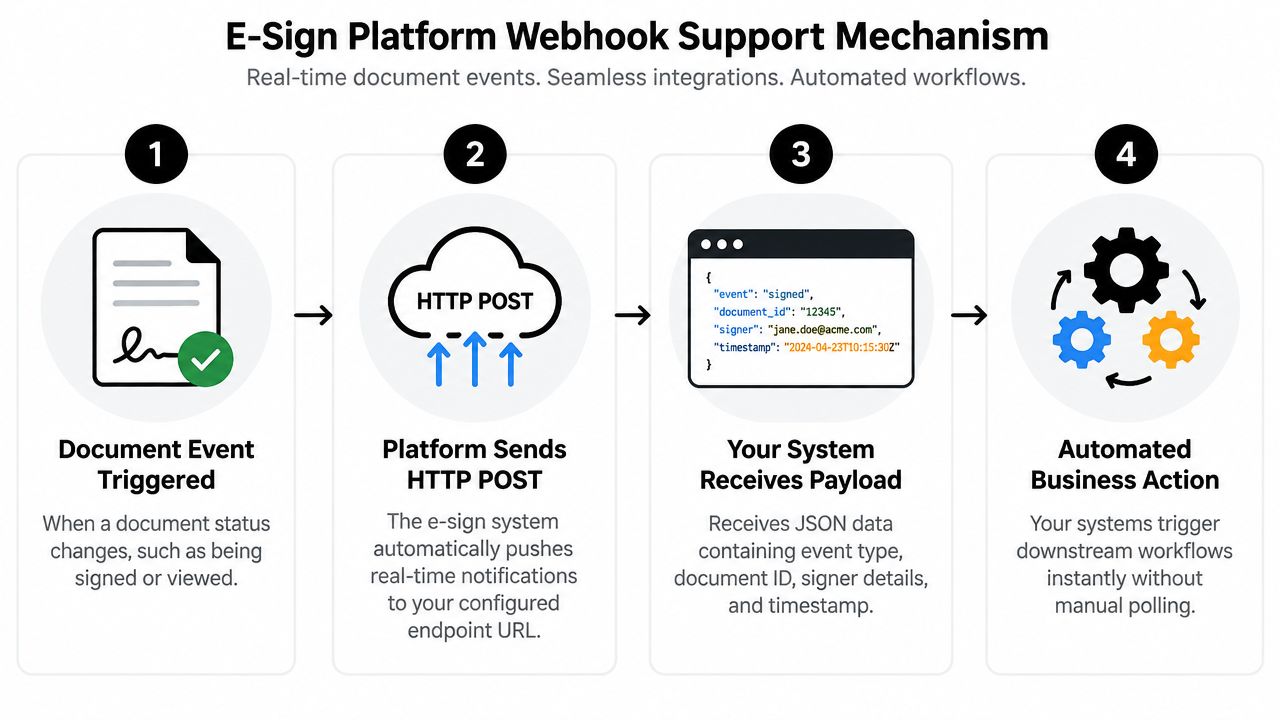
The core idea is simple: the platform pushes the update to you, your systems read structured data, and connected workflows respond — no manual polling required.
The platform speaks first, and your systems listen. A webhook turns a status change into an immediate next step.
Common Events and Payload Details
BoloSign fires webhook events for important moments in a document's lifecycle:
- Document sent — create a tracking record or notify a coordinator.
- Document viewed — give your sales or staffing team a timely follow-up signal.
- Document signed — start onboarding, update a deal stage, or release the next form.
- Document declined — alert the account owner or open a review task.
- Document expired — trigger a renewal request or send a reminder.
A typical payload carries an event type, document ID, signer name or email, timestamp, and status. For example: document offer-4821 was signed by Jordan Lee at 10:42 UTC, and the status is now completed.
Your application does not need to parse every field immediately. Capture the fields you need and route the event to the right workflow.
From Notifications to Contract Intelligence
With BoloSign, teams can create, send, and sign PDFs, templates, and forms instantly, then connect structured events to AI-powered contract intelligence. A completed healthcare consent form can update a patient record automatically, while an approved staffing agreement can start HR onboarding without manual data entry.
The same pattern works across industries. Professional services firms can launch projects after signed engagement letters. Logistics companies can process carrier agreements and dispatch forms. Education providers can update enrollment records. Real estate teams can move leases to billing, while healthcare organizations can route completed forms to the correct secure file. BoloSign supports ESIGN, eIDAS, HIPAA, and GDPR requirements, and its fixed-price plan includes unlimited documents, templates, and team members — up to 90% more affordable than DocuSign or PandaDoc.
Ready to connect signing with your existing tools? Check out BoloSign's Document Signing API and AI contract review, then start a 7-day free trial to experience automated eSignatures and contract workflows firsthand.
Imagine calling a front desk every ten minutes to ask whether a fax came through. That's essentially what polling does. Your system keeps contacting the e-sign platform, even when nothing has changed. It uses unnecessary API calls, slows updates, increases the risk of rate limits, and creates avoidable work for your engineering team.
Webhook support reverses this process. BoloSign pushes an event to your application as soon as a PDF is viewed, signed, declined, or completed. Your workflow reacts in real time — without dashboard refreshes or repeated status requests.
Here's a quick comparison:
| Area | Polling | Webhooks |
|---|---|---|
| Latency | Depends on how often you check | Near real-time |
| API usage | Repeated requests, many of them pointless | Requests only when something actually happens |
| Reliability | Changes can slip through between checks | Failed deliveries can be retried |
| Setup complexity | Simple at first, gets messy at scale | Requires a secure endpoint and event handling upfront |
Let's make it concrete. A staffing agency sends an offer letter and automatically creates an employee record the second it's signed. A healthcare clinic updates a patient consent form without anyone clicking refresh. A logistics company releases the next dispatch step when a completed form reaches the system. An education provider can update enrollment, while a professional services firm can open a project workspace after a signed engagement letter.
Polling asks for updates. Webhooks deliver them. That difference keeps everything downstream faster and easier to manage.
Why Webhooks Actually Save You Money
Polling can seem harmless during a proof of concept. At scale, frequent checks consume API capacity. You also need scheduling logic, rate-limit handling, response deduplication, and delayed-result management — none of which improves the underlying workflow.
Webhooks reduce that work by delivering meaningful changes as they happen. BoloSign supports workflows where teams create, send, and sign documents through its Document Signing API, embedded components, or connected business tools.
The cost difference is also practical. BoloSign includes unlimited documents, templates, and team members at a single fixed price, making high-volume signing workflows up to 90% more affordable than DocuSign or PandaDoc.
Whether you're managing leases, patient intake forms, student agreements, carrier documents, or client contracts, webhook-driven contract automation helps your team move from signature to the next action without waiting. Start a 7-day free trial of BoloSign to see the workflow in practice.
Securing Your Webhook Endpoints
Webhook security starts with payload signing. When an e-sign platform attaches a cryptographic signature to each notification, your application can verify that the message came from the expected service and was not altered. Think of it as a wax seal on an envelope: if the seal is missing or broken, investigate before opening it.
Always require TLS encryption for data moving between BoloSign and your endpoint. Keep signing secrets in a dedicated secrets manager, rotate them periodically, and never place them in source code, browser scripts, or shared documents.
An IP allowlist adds another layer by restricting which approved sources can reach your endpoint. Use it alongside signature verification rather than as a replacement. Network ranges and hosting arrangements can change, and an outdated allowlist may block legitimate traffic or create false confidence.
Treat every webhook like an important package. Verify the sender, protect the route, and reject anything that looks altered or replayed.
Replay protection matters when a valid notification is captured and submitted again by an attacker. Check the event timestamp, reject messages outside an approved time window, and store processed event identifiers so the same document update cannot trigger duplicate actions.
Match Security Controls to Compliance Needs
These safeguards support workflows where document integrity and privacy are essential. A healthcare clinic handling consent forms needs to consider HIPAA, while organizations operating in Europe must account for GDPR controls. Companies using electronic signatures across US and international markets also look for ESIGN and eIDAS alignment.
BoloSign maintains an enterprise-grade security posture with SOC 2 Type I and Type II, ISO 27001:2022, GDPR, and HIPAA certifications. Review current product and legal details with your security team before deployment, especially when creating, sending, or signing sensitive PDFs, templates, and forms.
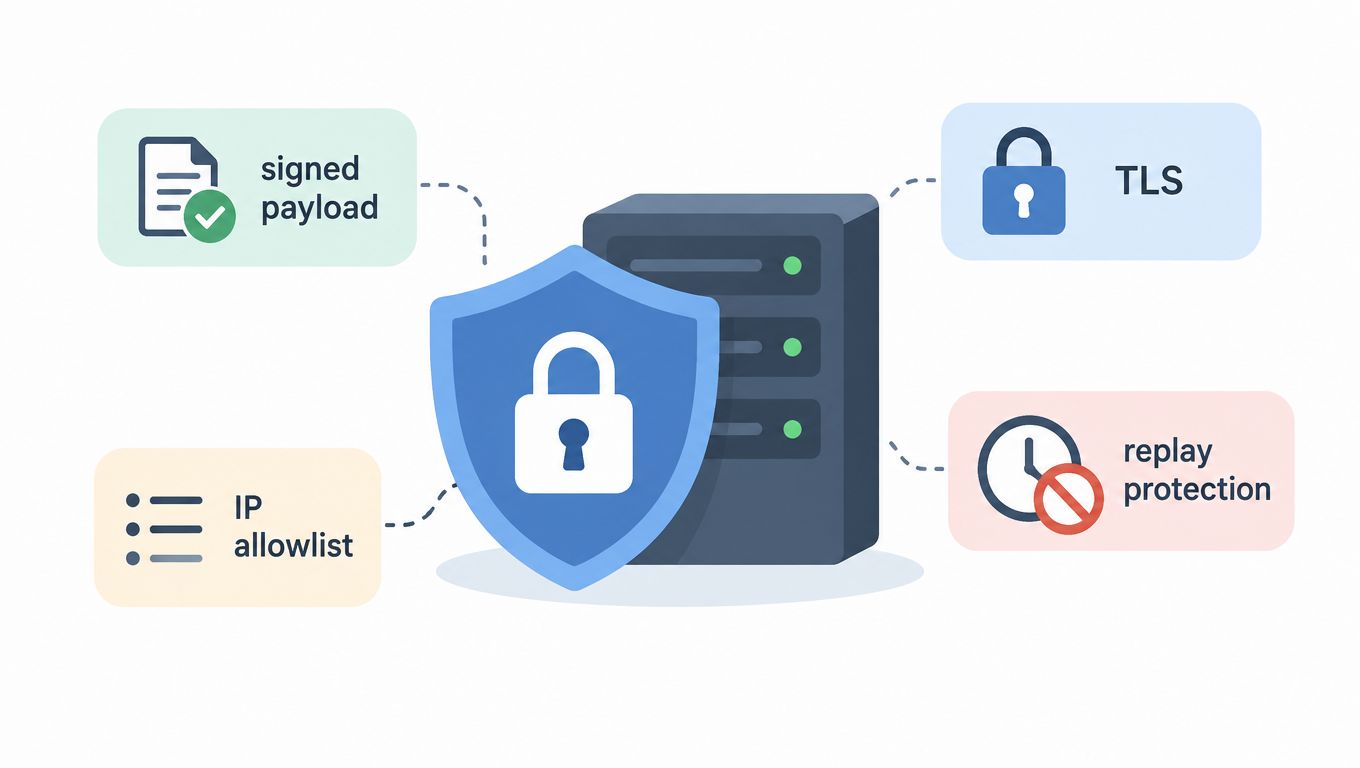
A practical security review should confirm the following:
- Signature verification is mandatory before processing any payload.
- TLS is enforced, with outdated or weak connections rejected.
- Secrets are stored centrally with limited, auditable access.
- Timestamps and event IDs prevent replay attacks and duplicate processing.
- Logs avoid exposing signer data or signing keys.
For healthcare, staffing, logistics, education, real estate, and professional services, these controls help connect secure digital signing solutions to everyday systems without weakening governance. Learn more about electronic signature technology before configuring your integration, then test each control with non-production documents.
Webhook delivery is built to survive temporary problems. If your endpoint times out or returns an error, the platform can try again, usually with exponential backoff, meaning the wait between attempts grows. That retry behavior comes with a rule every integration developer learns: make your handler idempotent. Save the event ID, check whether you have already processed it, and skip anything familiar. A "document signed" notification that arrives twice should never create two employee records, two invoices, or two closing tasks.
The same event can show up more than once — the business action behind it should only ever run once.
Speed matters on the response side too. Your endpoint should acknowledge receipt with a 2xx response right away, then hand heavier work — such as downloading the signed PDF, updating the CRM, or running an AI contract review — to a background process. Quick acknowledgments prevent timeouts and give the delivery service a clean confirmation before your queue takes over.
Build a Reliable Delivery Loop
A production-ready handler usually follows this sequence:
- Verify the webhook signature and timestamp before trusting the payload.
- Check the event's unique ID to confirm it is new.
- Return a 2xx response immediately.
- Drop the event into a durable queue for processing.
- Retry failed business actions and log the outcome each time.
The stakes vary by industry. A missed signature event can freeze employee onboarding in staffing, delay dispatch authorization in logistics, hold up a lease closing in real estate, or postpone a student's enrollment. Reliability is closely tied to customer trust and revenue.
Debug Failed Webhooks Faster
When an event never appears, run through this checklist:
- Verify the endpoint URL — and confirm you are using the correct environment.
- Check response codes for authentication failures, redirects, timeouts, or server errors.
- Inspect application logs for rejected signatures, malformed payloads, and duplicate-event handling.
- Replay missed events whenever the platform or your queue supports it.
- Test with sample payloads before connecting live documents.
- Confirm background workers are running and can reach internal systems.
BoloSign's Document Signing API documentation helps developers understand event behavior, payload handling, and integration settings. Teams can create, send, and sign PDFs, templates, and forms instantly, then route completed agreements into HR, healthcare, property, education, logistics, or professional services workflows.
Because BoloSign includes unlimited documents, templates, and team members at one fixed price, automated signing can cost up to 90% less than DocuSign or PandaDoc. Start a 7-day free trial and test reliable eSignature workflows and contract automation firsthand.
The best way to understand e-sign platform webhook support is to follow a document after someone signs it. BoloSign sends an event to your connected system, which immediately starts the next action instead of leaving staff to check a dashboard.
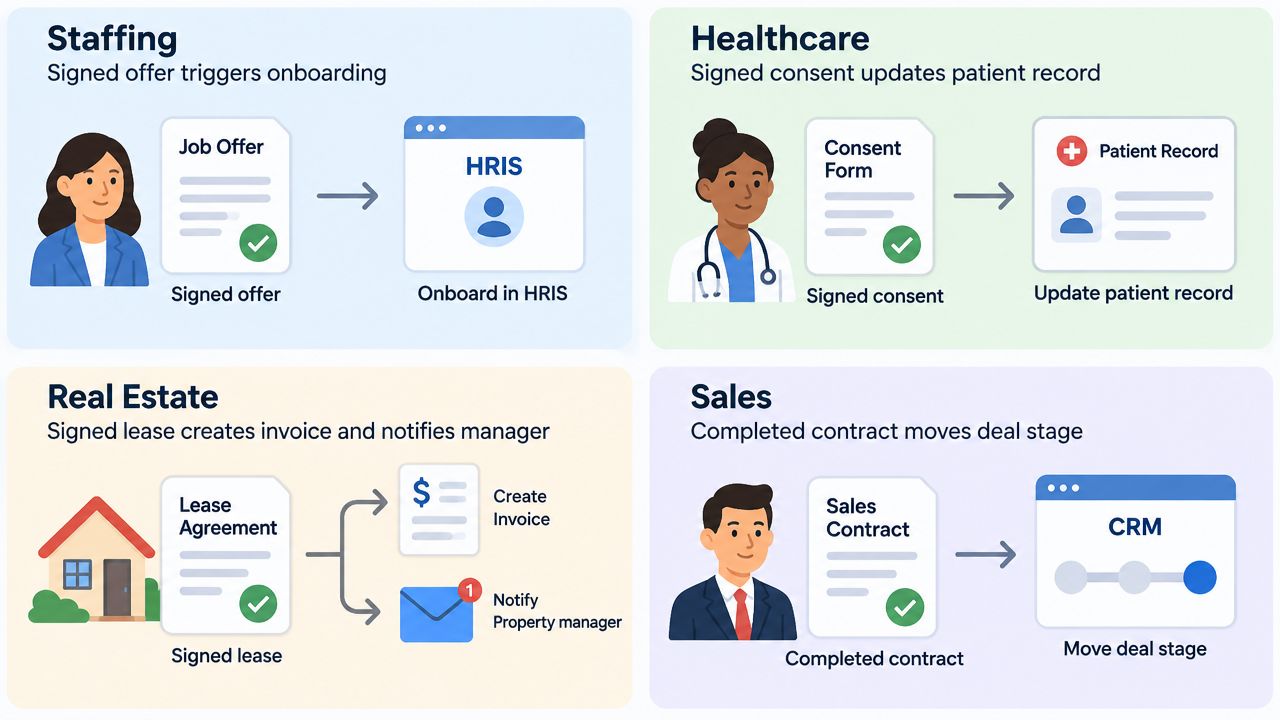
Connect Signing to Daily Operations
A staffing agency can create an offer letter from a template, send it for signature, and use the completed event to create an employee record in its HRIS. The workflow can also notify payroll, assign onboarding tasks, and store the signed PDF without duplicate data entry.
A healthcare clinic can collect a patient consent form through an embedded BoloSign experience. When the form is completed, the webhook can update the patient record, alert the care team, and place the signed document in the correct secure file.
Real estate teams can apply the same pattern to leases. A signed lease can generate an invoice, update the property record, and notify the property manager that the tenant is ready for the next step.
Education providers can use signed enrollment agreements to update student systems, while logistics companies can process carrier forms and release dispatch instructions. Professional services firms can start project setup after a client signs an engagement letter.
A signature should start the next business action, not create another manual follow-up task.
Use CRM Connections and Embedded Signing
For a CRM-driven sales team, a completed contract in BoloSign can move a HubSpot deal to “Closed Won” and alert the account owner. Professional services firms can trigger project setup, while logistics companies can release dispatch instructions after a signed carrier agreement.
BoloSign supports these workflows through its Document Signing API, embeddable components, and CRM connections. Teams can create, send, and sign PDFs, templates, and forms inside existing applications, then apply AI-powered contract intelligence to review terms, flag risky clauses, and route approvals.
You can learn more about embedded eSignature API workflows before planning your integration.
Choose a Cost-Friendly Integration Model
Webhook-driven automation reduces status checks and engineering maintenance as document volume grows. BoloSign adds predictable pricing with unlimited documents, templates, and team members at one fixed price, making it up to 90% more affordable than DocuSign or PandaDoc.
That model fits education providers, healthcare groups, real estate agencies, staffing firms, logistics companies, professional services teams, and global organizations requiring ESIGN, eIDAS, HIPAA, and GDPR support. Start a 7-day free trial to test BoloSign with your own signing workflow.
Webhook Support for E-Sign Platforms
Webhooks fire when something happens — a document is opened, signed, declined, or expires. Instead of your system contacting the platform every few minutes to ask "anything new?" you receive a POST request at your endpoint. The payload tells you what changed, who acted, and when.
That real-time push changes how teams build on top of e-sign infrastructure.
Before committing to a platform's webhook system, review these basics:
- Event coverage: Confirm it fires on every state you care about — sent, viewed, signed, declined, and expired.
- Security hygiene: Check payload signing, TLS, secret rotation options, and IP allowlists.
- Staging first: Test sample payloads against a sandbox endpoint before routing live contracts through it.
- Idempotent handling: Design your handler so the same event arriving twice does not create duplicate records.
- Respond fast, process slow: Return a 2xx within a couple of seconds, then queue heavier work such as database writes, notifications, and downstream triggers.
The pattern works across industries. A staffing agency triggers HR onboarding after an offer is signed. A clinic updates a consent record automatically. A real estate team generates an invoice when a lease execution webhook arrives. Logistics dispatch forms, student enrollment agreements, and client engagement letters follow the same reliable flow.
Where BoloSign Fits In
BoloSign handles the document side: PDFs, templates, and forms go from draft to signed in minutes. AI-powered contract automation supports review, approvals, and follow-up, so a webhook is not just an alert; it triggers a chain of useful automated steps.
Built-in compliance supports ESIGN, eIDAS, HIPAA, and GDPR, which matters when routing sensitive agreements across jurisdictions and keeping events logged and tamper-evident.
A strong webhook integration is fast, authenticated, observable, and built to handle the same event showing up twice without breaking anything.
BoloSign bundles unlimited documents, templates, and team members at one fixed price, making it up to 90% more affordable than DocuSign or PandaDoc for teams with steady volume. Check out BoloSign's eSignature API for SaaS apps and start a 7-day free trial to see how real-time signing events connect with your stack.

Paresh Deshmukh
Co-Founder, BoloForms
28 Sep, 2026
Take a Look at Our Featured Articles
These articles will guide you on how to simplify office work, boost your efficiency, and concentrate on expanding your business.