

Difference Between a Contract and an Agreement: Key Distinctions for Your Business
Explore the difference between a contract and an agreement and learn how to convert understandings into legally binding documents to protect your business.

Tired of nonsense pricing of DocuSign?
Start taking digital signatures with BoloSign and save money.
It's a classic mix-up. In everyday chat, we toss around "agreement" and "contract" like they're the same thing. But in the world of business, that simple mistake can open the door to serious risk.
The bottom line? The core difference between a contract and an agreement is legal enforceability. All contracts are a type of agreement, but not all agreements are legally binding contracts.
Think of it like this: agreeing to meet a friend for coffee is a simple agreement. But signing a lease for your new office? That’s a contract, built to be upheld in court if things go sideways. With BoloSign, you can create, send, and manage these critical documents instantly, ensuring your business is always protected.
Agreements vs. Contracts: The Fundamental Split
So, what exactly is the split? An agreement is just a mutual understanding between two or more people. It can be spoken, written down on a napkin, or even just implied by your actions. It’s a meeting of the minds.
A contract, however, is a very specific type of agreement that the law will enforce. It creates concrete legal obligations. If one person doesn't hold up their end of the bargain, the other can go to court to seek a remedy—like getting paid what they're owed or forcing the other party to do what they promised.
The Legal Framework: What Makes an Agreement a Contract?
For an agreement to cross the bridge into contract territory, it needs a few key ingredients. These are the elements that give it real legal muscle:
- Offer and Acceptance: One side has to make a clear, definite offer, and the other side has to accept it as is.
- Consideration: This is the legal term for "what's in it for me?" Something of value must be exchanged, whether it's money, goods, or a service.
- Capacity: Everyone involved must be legally capable of making a contract (for example, being of sound mind and legal age).
- Legality: The whole point of the deal has to be legal. A contract to do something illegal is void from the start.
When you have all four of these, your simple understanding transforms into a powerful legal tool. A casual email exchange might feel like you've struck a deal, but without these core elements, it probably won't hold water if a dispute pops up.
For a quick breakdown, here’s how the two stack up side-by-side.
Agreement vs Contract Key Differences at a Glance
This table offers a clear, at-a-glance summary of the essential distinctions between a general agreement and a legally binding contract.
| Attribute | Agreement | Contract |
|---|---|---|
| Enforceability | Not legally enforceable by default. | Legally enforceable in a court of law. |
| Legal Elements | Can be informal; no specific elements required. | Must have Offer, Acceptance, Consideration, Capacity, & Legality. |
| Form | Often verbal or implied. | Typically written to ensure clarity and proof. |
| Legal Consequences | No legal remedy if a party backs out. | Legal remedies (e.g., damages) are available for a breach. |
| Business Use | Casual understandings, informal plans. | Formal business deals, employment, sales, leases. |
Understanding these differences helps you know when a handshake is enough and when you absolutely need a formal, written document.
Why This Matters for Your Business
Getting this distinction right is fundamental to protecting your company. Different business arrangements carry vastly different legal weight. For example, understanding the nuanced joint venture versus partnership distinctions shows just how critical the right legal structure is.
Ultimately, formalizing your important understandings into airtight contracts isn't just good practice—it's essential for managing risk. It provides clarity for everyone involved and gives you legal recourse when things don’t go according to plan.
The Five Building Blocks of an Enforceable Contract
An agreement only becomes a legally enforceable contract when it contains a few specific, crucial ingredients. Think of them as the load-bearing walls of a house—without them, you're left with a flimsy structure that could collapse under pressure.
These five elements are what transform a casual handshake or a simple promise into an ironclad commitment that a court will actually uphold. For a deeper dive into these core components, you can explore the fundamental elements of a contract in our detailed guide.
This simple flowchart shows the critical fork in the road that separates a loose, non-binding agreement from a formal, enforceable contract.
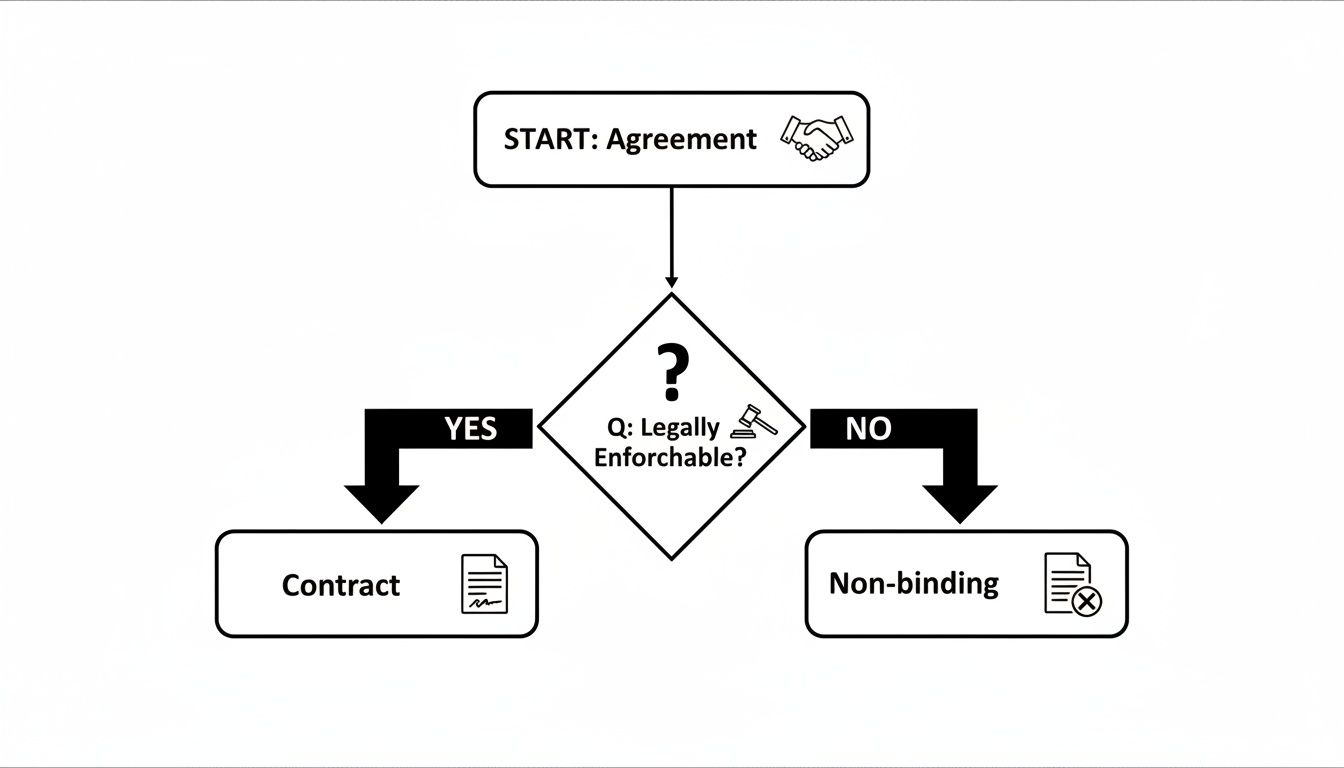
As you can see, the big question is always enforceability. If the core legal elements are in place, your agreement gets a serious upgrade.
Offer and Acceptance
Everything kicks off with a clear offer. This is where one party lays out specific terms for a deal. For a real estate agent, this is the formal purchase offer they present to a seller. The offer has to be definite, not vague.
Next, you need acceptance. The other party has to agree to the exact terms on the table. If they try to change anything, it's not an acceptance—it's a counter-offer, and the whole process starts over. In professional services, this happens when a client signs a proposal, accepting the project scope and fees. This mutual agreement is often called the "meeting of the minds."
Consideration
Consideration is the value that each person agrees to give up. It’s the "what's in it for me?" part of the deal and the entire reason the contract exists in the first place. It doesn't have to be cash; it can be goods, services, or even a promise not to do something.
- In a staffing agency, the consideration is the agency’s work to find a qualified candidate in exchange for the client's payment.
- For a logistics company, it’s the service of transporting goods in return for shipping fees.
This exchange is absolutely essential. A one-sided promise is usually just a gift, not a contract.
Capacity and Legality
For a contract to hold up, everyone involved must have the legal capacity to sign it. This means they're of legal age, are of sound mind, and aren't being forced or tricked into the agreement. For businesses, this is about making sure the person signing has the authority to actually bind the company to the deal.
Finally, the contract's purpose has to be legal. An agreement to do something illegal is worthless from the get-go and completely unenforceable. This basic rule ensures the legal system isn't used to uphold activities that go against the law or public policy.
A secure eSignature platform like BoloSign is built to capture these elements with total clarity. The system creates a detailed audit trail that documents exactly who made the offer, who accepted it, and when—giving you indisputable proof of the agreement. This digital paper trail is critical for proving a contract's validity and enforceability if a dispute ever comes up.
How to Turn Your Agreements into Ironclad Contracts
Moving from a verbal promise to a documented, protected business relationship is a critical step for any organization. This is about more than just paperwork; it’s about creating clarity, managing risk, and making sure everyone is on the same page about their obligations. A handshake might feel efficient, but a written document is your best defense when things don't go as planned.
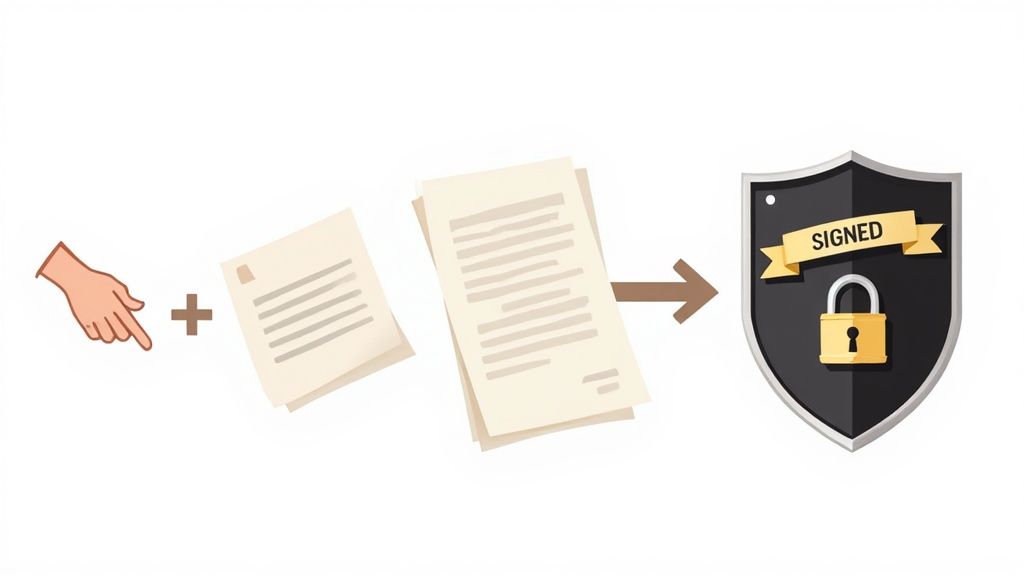
In high-stakes industries like logistics or real estate, ambiguity can be disastrous. A simple misunderstanding over delivery terms or property lines can spiral into costly, time-consuming disputes. The goal isn't just to have a document, but to create a legally sound contract that leaves no room for misinterpretation.
Start with a Clear Written Document
The first and most important step is always to put it in writing. This simple act forces everyone involved to think through the details—from payment schedules to performance expectations and everything in between. This is where you bring in those key legal elements like offer, acceptance, and consideration to give your agreement real teeth.
Writing it down isn't just a formality. It’s a practical risk-reduction strategy. In fact, studies show that clear written terms can slash downstream disputes by 30-50% compared to verbal arrangements. It's a simple step with a massive impact.
With BoloSign, you can instantly create, send, and sign PDFs or start with pre-built templates. Instead of staring at a blank page, a logistics company in the UAE or a healthcare provider in the US can get a solid foundation with all the essential clauses included from the get-go. To really nail this step, check out our guide on how to write a contract that truly protects your business.
Leverage AI for Smarter Drafting and Review
Let's be honest—wrestling with legal jargon is a common roadblock. It can be intimidating and often leads to unintentional loopholes that create massive risk down the road. This is where modern tools give you a serious advantage.
BoloSign’s platform uses AI contract review to simplify the entire drafting process. Its AI-powered automation can help you:
- Draft compliant contracts from scratch that are specific to your industry.
- Spot risky or non-standard clauses that could cause trouble later.
- Ensure your document meets compliance standards like ESIGN, eIDAS, and HIPAA.
Imagine a healthcare clinic in Canada using AI to instantly generate a HIPAA-compliant patient intake form. Or a staffing agency in Australia creating a service agreement that clearly defines scope and payment terms, heading off future disagreements before they start.
By using an intelligent digital signing solution, you transform a complex legal task into a simple, secure workflow. BoloSign’s AI acts as your co-pilot, helping you build robust, enforceable documents that safeguard your business interests—no law degree required.
Finally, getting that signature is the last piece of the puzzle. A platform that provides a secure eSignature complete with a comprehensive audit trail gives you undeniable proof of acceptance, making your contract truly ironclad.
Why This Distinction Matters in Your Industry
Knowing the difference between an agreement and a contract isn't just for lawyers. It's a practical reality that directly impacts your daily operations and financial security. A casual nod might be fine for planning lunch, but when risk and compliance are on the line, an informal agreement leaves your business dangerously exposed.
For successful companies, this distinction is built right into their core workflows. Every industry has unique challenges where only a legally enforceable contract offers the protection they need to operate safely and profitably.
Healthcare: Patient Consent and Compliance
In healthcare, patient consent is everything. A patient nodding "yes" to a procedure is an agreement, but a signed, HIPAA-compliant patient consent form is a contract. This document does more than just confirm understanding—it creates a legally binding record that protects both the patient and the provider.
When a patient adds their eSignature to a digital form, they are formally accepting the terms of care, acknowledging the risks, and consenting to treatment. This creates a clear, enforceable record that’s essential for compliance and heading off potential liability claims.
BoloSign ensures these critical documents are handled with full compliance, meeting strict standards like HIPAA and GDPR. A clinic in New Zealand, for instance, can instantly send a secure PDF intake form, capture a valid electronic signature, and store the document with a complete audit trail. This turns a routine administrative task into an ironclad legal safeguard.
Real Estate: Transactions and Legal Protection
The real estate world runs on contracts. A verbal agreement to sell a house for a certain price is completely unenforceable. It's just a conversation. A signed purchase agreement, on the other hand, is a powerful contract that legally obligates the buyer and seller to follow through.
It’s the same with leasing. A chat about renting a commercial space is just talk. A formal lease contract nails down every critical detail:
- Rent payments and due dates
- Maintenance responsibilities
- Lease term and renewal options
- Clauses for early termination
This level of detail is impossible to enforce without a written contract. It protects the landlord’s asset and the tenant’s right to occupy the space, leaving no room for "he said, she said" arguments down the road.
Staffing and Professional Services: Getting Paid for Your Work
For staffing agencies and professional services firms, revenue depends on clearly defined client relationships. An agreement to provide a service is a great start, but a client service agreement created with a contract automation platform like BoloSign is what actually ensures you get paid for your work. It specifies project scope, deliverables, timelines, and payment terms, turning a good-faith promise into a binding commitment.
This is where the difference between a contract and an agreement becomes a matter of financial survival. Without an enforceable contract, a client could dispute the scope or refuse payment, leaving the agency with little legal recourse. A contract gives you the legal muscle to enforce the terms you both agreed to.
BoloSign’s platform helps you create, send, and sign PDFs that formalize these relationships in minutes. This protects your agency from scope creep, payment disputes, and misunderstandings, ensuring your business relationships are built on a solid, legally sound foundation.
The Financial Impact of Using Contracts Over Agreements
Let's move beyond the legal theory and talk about what really matters to your business—the bottom line. Thinking of a formal, legally enforceable contract as just an added expense is a mistake. It’s actually a strategic investment in financial security and predictability.

At its core, a contract is there to protect your revenue. Imagine a logistics company transports a large shipment based on nothing more than a verbal agreement. If the client suddenly refuses to pay, the company is left with a costly, uphill battle to recover its funds. With a signed contract clearly defining payment terms, they have solid legal ground to stand on.
Even better, clear contracts are a powerful tool for preventing disputes in the first place. When every single obligation is documented and agreed upon, there’s far less room for the misunderstandings that mushroom into expensive arguments. This proactive approach saves not just money, but also time and valuable business relationships.
Reducing Litigation and Recovering Costs
The practical difference between an agreement and a contract has a real, measurable impact on your finances. A proper contract gives you the power to pursue damages or arbitration if the other side doesn’t hold up their end of the bargain. Legal studies consistently show that businesses using written, element-complete contracts see a significant drop in costly litigation.
In fact, market reports suggest that simply including clear dispute resolution clauses can slash the odds of a full-blown court battle by 25–40%, steering disagreements toward more efficient mediation or arbitration. You can dig deeper into how contracts reduce disputes on contractsafe.com.
A solid contract gives you the legal standing to:
- Recover damages for any financial losses caused by a breach.
- Enforce specific performance, compelling the other party to fulfill their promise.
- Seek resolution through predefined, less expensive channels like arbitration.
A Strategic Investment in Affordable Risk Management
This is where a tool like BoloSign completely changes the equation. We believe robust legal protection shouldn't come with an unpredictable, sky-high price tag. Unlike platforms such as DocuSign or PandaDoc that often charge per user or per document, BoloSign offers a refreshingly straightforward approach.
You get unlimited documents, unlimited templates, and unlimited team members for one fixed, predictable price. This model makes BoloSign up to 90% more affordable, putting enterprise-grade contract automation and security within reach for businesses of any size.
When you use BoloSign, you aren’t just getting an eSignature tool; you’re investing in a risk management platform that helps prevent devastating financial hits. The small, fixed cost of BoloSign is a fraction of what a single disputed agreement could cost your business.
This is your chance to build a rock-solid foundation of financial security. Stop relying on hope and handshakes. Start protecting your revenue with legally sound contracts, made simple and affordable.
Building a Smarter Contract Workflow
Knowing the difference between an agreement and a contract is step one. Step two is building a smart, secure system to manage them all. This means moving past just creating documents and into a world where you automate the entire contract lifecycle, turning a manual chore into a genuine business asset.
True automation creates a single, unbroken workflow. For example, a logistics company can use BoloSign to generate a new client onboarding packet, send it out for an eSignature, and then have the executed agreement automatically filed away in a secure, central repository. This simple flow eliminates missed steps and ensures every new relationship kicks off on a solid, legally protected foundation.
Streamlining with AI and Integrations
A truly smart workflow connects all the dots in your business. Imagine your sales team closes a deal in their CRM. With the right integration, that single action could automatically trigger a new sales contract inside BoloSign, already pre-filled with the client's details. The document is then sent, signed, and its status is updated back in the CRM—all without anyone lifting a finger.
This level of efficiency comes from tools like AI contract review and deep automation. BoloSign's AI assistant can help your teams:
- Create documents instantly: Generate compliant contracts, templates, and forms tailored to your industry’s specific needs.
- Spot risks automatically: Flag vague or non-standard clauses before they ever become a liability.
- Simplify complex tasks: Even niche needs like how to add a signature to a Google Form can be handled with just a few clicks.
To effectively manage your agreements and contracts throughout their lifecycle, consider implementing a robust contract management system.
Unlocking Affordability and Security
Building a better process shouldn't drain your budget. Too many businesses put off adopting powerful tools because they're worried about unpredictable, escalating costs. This is where BoloSign is different. While platforms like DocuSign or PandaDoc can get expensive fast, BoloSign is up to 90% more affordable by offering unlimited documents, templates, and team members for one flat price.
This predictable pricing model means your entire organization—from sales to HR to procurement—can use a world-class digital signing solution without worrying about rising costs. It’s enterprise-grade security and compliance (ESIGN, eIDAS, HIPAA) made accessible.
Ultimately, a smart workflow isn't just about moving faster; it’s about gaining control and protecting your business. By centralizing your documents and automating the key steps, you get full visibility and drastically reduce risk. You can learn more about this approach by exploring our guide on what is contract management software. It’s time to stop chasing paperwork and start building a more intelligent, secure, and cost-effective process.
Ready to transform your contract process? With BoloSign, you can build a faster, more protected workflow that saves time and minimizes risk. Experience the power of AI-powered automation firsthand.

Paresh Deshmukh
Co-Founder, BoloForms
19 Dec, 2025
Take a Look at Our Featured Articles
These articles will guide you on how to simplify office work, boost your efficiency, and concentrate on expanding your business.