

Cost Saving in Procurement: A Practical Guide to Smarter Spending
Explore cost saving in procurement with practical tactics like spend analysis, supplier negotiation, and contract automation to drive real savings.

Tired of nonsense pricing of DocuSign?
Start taking digital signatures with BoloSign and save money.
Modern cost saving in procurement isn't about squeezing your suppliers for every last penny. That old playbook is broken. Today, real savings come from a smarter, more strategic blend of data analysis, airtight process efficiency, and intelligent relationship management.
It’s about gaining full visibility into your spending, cutting out the manual work that slows everyone down, and using technology to make faster, better decisions.
Rethinking Your Procurement Savings Strategy
If your strategy still revolves around demanding discounts, you’re leaving a ton of value on the table—and probably damaging key supplier relationships in the process.
Leading organizations have made a critical mental shift. They no longer see procurement as a simple cost center. Instead, it’s a strategic lever for boosting profitability, whether you're a logistics firm managing a tangled supply chain or a healthcare provider sourcing critical equipment.
This guide is your playbook for making that shift. We'll skip the basics and jump straight into the pillars that support a truly modern procurement savings program.
The Pillars of Modern Procurement
You can’t just wing it and expect results. Effective cost saving in procurement is built on a few core principles that work together.
- Total Spend Visibility: Let's be honest—you can't manage what you can't see. The first, non-negotiable step is getting a crystal-clear picture of where every single dollar is going.
- Strategic Sourcing and Supplier Management: It’s time to move from purely transactional relationships to genuine strategic partnerships. That’s where you unlock long-term value, better terms, and innovation.
- Contract Lifecycle Automation: Manual contract processes are a massive drag. They’re slow, riddled with risk, and surprisingly expensive. Automating the entire lifecycle, from authoring to eSignature, is one of the biggest efficiency gains you can make. And a huge piece of this is understanding and reducing your inventory carrying cost.
- Technology and AI Adoption: Smart tools are no longer a "nice-to-have." Using technology for things like AI contract review and workflow automation gives you a serious competitive edge.
This isn’t just theory. New research shows that 64% of procurement executives have identified cost savings and avoidance as their top business objectives. They get there by consolidating suppliers to boost negotiating power, automating workflows to speed up cycles, and getting procurement, finance, and operations teams to finally talk to each other. You can dig deeper into the numbers in this in-depth procurement analysis.
A unified platform is the glue that holds these pillars together. When you can manage the entire contract lifecycle—from authoring and approvals to secure eSignatures—you create a single source of truth that actually enforces compliance and locks in the savings you worked so hard to negotiate.
This is where a solution like BoloSign makes a real difference. It gives you the tools to instantly create, send, and sign PDFs, forms, and templates while ensuring you stay compliant with standards like ESIGN, eIDAS, HIPAA, and GDPR.
By offering unlimited documents, templates, and team members at one fixed price, BoloSign comes in at up to 90% more affordable than alternatives like DocuSign or PandaDoc. It makes powerful contract automation accessible to everyone, not just the giants.
Ready to see what a modern approach can do for your procurement process?
Turning Spend Data Into Actionable Savings
You can't save what you can't see. The single most powerful first step in any real procurement cost-saving initiative is a deep, honest spend analysis. This isn't just about exporting a spreadsheet. It’s about turning raw purchasing data into actionable intelligence that builds an undeniable business case for change.
This is where you uncover the hidden inefficiencies and missed opportunities that are quietly draining your budget.
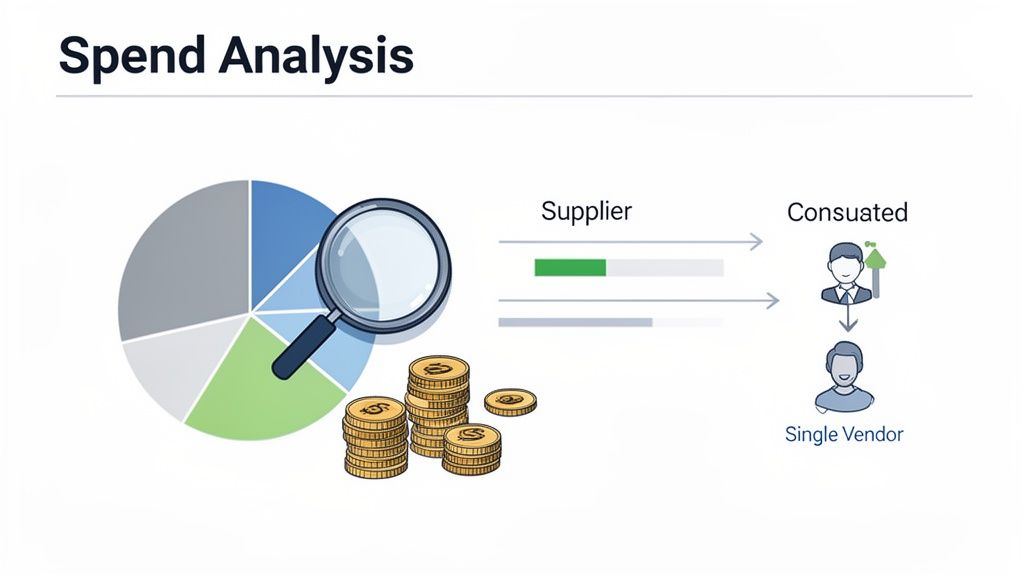
The whole point is to get a crystal-clear picture of where every dollar is going. That means categorizing every purchase and identifying who is buying what, from which suppliers, and under what terms. Only then can you start asking the right questions and turning those insights into a concrete savings strategy.
Uncovering Hidden Spending Patterns
A detailed spend analysis almost always reveals surprising—and costly—patterns that fly under the radar in day-to-day operations. You’re looking for specific red flags that signal immediate opportunities for improvement.
- Maverick Spending: This is the "rogue" purchasing that happens outside of approved contracts and processes. It’s a huge source of value leakage, since these purchases miss out on negotiated discounts. For instance, an analysis might show a professional services firm where individual departments are signing up for five different project management tools, all with separate, unapproved contracts.
- Supplier Proliferation: You might discover you’re paying dozens—or even hundreds—of suppliers for the same category. A logistics company, for example, could find it's using five different vendors for packaging materials at wildly different prices. That’s a clear signal to consolidate and leverage your total spend for better pricing.
- Contract Non-Compliance: Are you actually getting the prices you negotiated? Spend analysis can highlight discrepancies between your contracts and the invoices you’re paying, revealing overcharges and missed rebates that add up fast.
By bringing all purchasing activity into a centralized system, you can eliminate the blind spots that allow maverick spending to thrive. A unified platform for contract execution ensures that every purchase is tied to an approved agreement, automatically enforcing compliance.
From Data to Dollars: Setting Targets and KPIs
Once you have a clear map of your spending, you can set realistic, data-backed targets. This isn't about arbitrary goals like "cut costs by 10%." It's about targeted, measurable objectives based on the opportunities you've just uncovered.
This is where you build the foundation for your entire savings program. Your analysis might lead to specific Key Performance Indicators (KPIs) like:
- Reduce supplier count for office supplies by 40% within six months to consolidate spend and increase negotiating power.
- Decrease maverick spending on software subscriptions by 75% in the next quarter by implementing a centralized approval workflow.
- Increase spend under management to 90% by year-end, ensuring nearly all purchases go through approved channels.
These KPIs give you a clear baseline to measure success against. They also provide the hard data needed to get buy-in from leadership and other departments, demonstrating the tangible value a strategic procurement function can deliver. The insights you gain here will directly inform the supplier consolidation and negotiation tactics we'll explore next.
For more details on building strong frameworks, check out our guide on procurement best practices.
Building Stronger Supplier Relationships That Save Money
Once you’ve mapped out your procurement landscape with spend analysis, the real work begins. It’s time to move beyond haggling over line items and start building strategic supplier relationships. This is where you unlock sustainable, long-term cost savings in procurement—by shifting from a purely transactional mindset to one of partnership.
This means looking past the sticker price and truly understanding the Total Cost of Ownership (TCO). TCO isn't just the purchase price; it’s the sum of all associated costs over the lifetime of a product or service. Think maintenance, training, integration, and even the administrative overhead of managing the relationship. Basing sourcing decisions on TCO prevents you from winning a battle on price but losing the war on overall cost.

From Negotiation to Partnership
Effective negotiation isn't about arm-wrestling your suppliers into submission. It’s about coming to the table prepared with data and a clear vision of what you need. When you're armed with insights from your spend analysis, you can demonstrate the value of your business and leverage volume for better terms.
But the real goal is to build relationships that deliver more than just discounts. The best partners offer innovation, better service levels, and more reliable supply chains—all of which feed directly into your bottom line.
Here are a few practical tactics:
- Supplier Consolidation: One of the most powerful moves you can make is to reduce the number of vendors you work with. A smaller, more strategic supplier pool simplifies administration, cuts transactional costs, and dramatically increases your negotiating power.
- Performance-Based Contracts: Structure agreements that reward suppliers for hitting or exceeding specific KPIs, like on-time delivery or quality metrics. This aligns their goals with yours.
- Collaborative Forecasting: Share your demand forecasts with key suppliers. This simple step helps them plan production and inventory more efficiently, and those savings can often be passed right back to you.
A Real-World Example in Healthcare
Imagine a regional healthcare system. A spend analysis reveals they're using a dozen different suppliers for routine medical supplies—gloves, gowns, sanitizers. Each clinic orders on its own, creating a mess of inconsistent pricing and a massive administrative headache for accounts payable.
By consolidating this spend with a single, preferred supplier, the healthcare system scores several key wins:
- Volume Discounts: They immediately unlock significant savings by leveraging their total purchasing volume.
- Simplified Administration: One vendor means one contract, one ordering process, and one invoicing cycle. This frees up countless hours for the procurement and finance teams.
- Improved Inventory Management: A strategic partner can help them implement a just-in-time inventory system, slashing the costs of holding excess stock.
This is the power of moving from many transactional vendors to a few strategic partners.
The terms you negotiate are only valuable if they are consistently enforced. A centralized contract platform is essential for ensuring that every purchase order and agreement across the organization adheres to the master terms you’ve established with your strategic suppliers.
Locking In Savings with Centralized Contracts
This is where a solution like BoloSign becomes the backbone of your supplier management strategy. Once you've negotiated favorable terms, you need a rock-solid way to execute and manage those agreements. BoloSign lets you create, send, and sign PDFs online almost instantly, turning a handshake deal into a legally binding contract in minutes.
You can build pre-approved templates for Master Service Agreements (MSAs) or Statements of Work (SOWs) that already contain your standard, hard-won terms. When a new project kicks off, your team can grab these templates to ensure compliance and prevent rogue clauses from creeping into new deals.
This isn’t just about speed; it’s about control. With BoloSign's AI-powered contract automation, you create a single source of truth for every supplier agreement. This system ensures every department buys under the correct terms, locking in the cost savings you fought for at the negotiating table. The platform's commitment to compliance standards like ESIGN, eIDAS, and HIPAA provides the security you need for sensitive procurement data.
Streamlining Your Entire Contract Lifecycle
You've just negotiated a great deal with a new supplier. Fantastic. But all that hard-won savings can quickly disappear if your contract management process is a mess of manual tasks, email chains, and physical paperwork.
This is where the hidden costs really start to add up—in administrative overhead, frustrating delays, and serious compliance risks. To truly lock in your procurement wins, you have to transform your contract lifecycle from a bottleneck into a well-oiled machine.
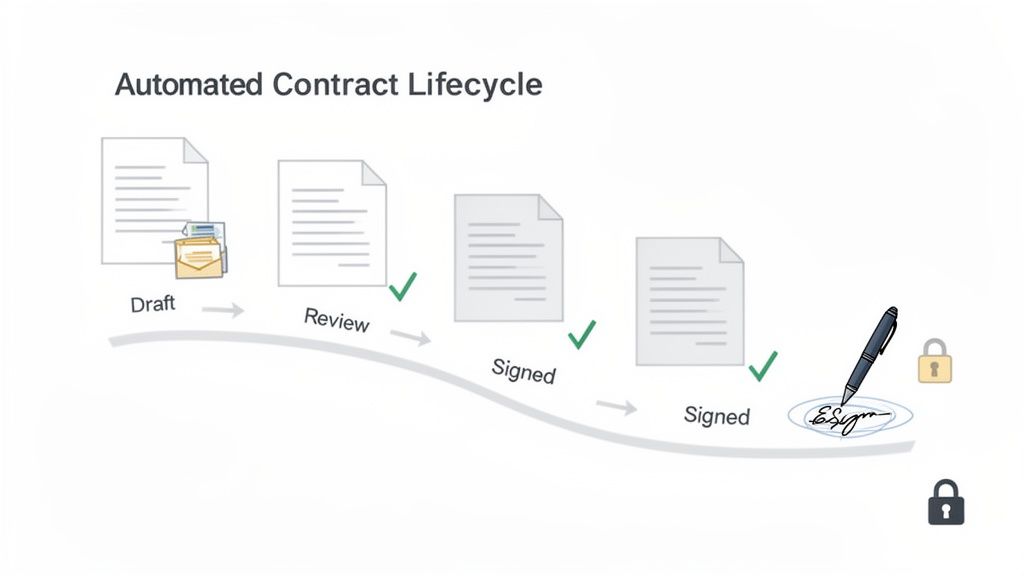
Automating the whole journey—from authoring and redlining to approvals and secure eSignatures—isn't a luxury anymore. It's a core part of any modern, cost-effective procurement team.
From Manual Drudgery to Automated Efficiency
Think about the old way of doing things. A Word doc gets passed around via email, versions get lost in the shuffle, and deciphering the final redlines feels like an archaeological dig. Then comes the final hurdle: chasing down physical signatures. Every one of these steps introduces delays and human error, which are just different words for "costs."
Now, picture this instead. Your team needs a new Master Service Agreement (MSA). They don't start with a blank page. Instead, they pull a pre-approved, legally-vetted template from a central library. Right there, you’ve slashed drafting time and baked compliance in from the start.
The real power of contract automation is its ability to create a secure, repeatable, and auditable process. It eliminates the chaos of email chains and lost documents, giving you a single source of truth for every agreement and locking in the savings you negotiate.
With a platform like BoloSign, your team can create, send, and sign PDFs online in just a few minutes. This isn't just about speed; it's about removing the friction that slows business down, letting you finalize agreements and onboard vendors faster than your competitors.
Real-World Impact Across Industries
This isn't just theory. The benefits are tangible and apply across all sorts of businesses.
- For a Staffing Agency: A recruiter can instantly send a standardized client agreement and a contractor onboarding packet. Both parties can sign PDFs online from any device, and the executed documents are automatically filed and routed. What used to take days of follow-up now gets done in under an hour.
- For a Logistics Company: Onboarding a new carrier means sending out a transportation agreement, proof of insurance forms, and compliance paperwork. An automated workflow handles it all, tracks progress, and sends reminders, making the entire process fast and fully compliant.
- For an Education Institution: Managing hundreds of vendor contracts for everything from catering to IT support is a massive task. Using templates and automated approvals ensures every agreement meets institutional standards without bogging down the legal team for weeks on end.
In every case, contract automation slashes administrative busywork, minimizes legal risk, and speeds up the procurement cycle. These aren't just "nice-to-have" efficiencies—they are measurable cost savings that hit the bottom line.
Centralizing for Control and Compliance
A lack of centralization is a huge liability. When contracts are scattered across different departments, hard drives, and filing cabinets, it’s impossible to manage renewals, track obligations, or ensure compliance. This chaos often leads to getting stuck with auto-renewals on bad terms or missing out on volume discounts.
Even integrating digital solutions like robust UAE e-invoicing systems can dramatically improve your financial operations by cutting down on manual work and errors. Centralization is the name of the game.
The need for this kind of efficiency is especially critical in government procurement. An analysis by Oliver Wyman suggests that governments could see near-term savings of 25% just by reviewing their procurement contracts more effectively. Their findings also show that long-term savings hinge on strategically centralizing the entire procurement function.
This is exactly what a platform like BoloSign is built to do. It gives you a single, secure home for all your agreements, offering total visibility and control. The platform’s AI-powered contract intelligence helps you stay on top of key dates and obligations, while its compliance with global standards like ESIGN, eIDAS, HIPAA, and GDPR gives you confidence. You can dive deeper in our guide on contract lifecycle management best practices.
Best of all, this level of control is finally affordable. BoloSign offers unlimited documents, templates, and team members at one fixed price, making it up to 90% more affordable than alternatives like DocuSign or PandaDoc. It’s a simple, predictable model designed to help you scale your savings without blowing up your budget.
Using AI for Smarter Procurement Decisions
Artificial intelligence isn't some far-off concept anymore; it's the next frontier for driving serious cost saving in procurement. AI-powered tools are fundamentally changing how procurement teams work, shifting them from reactive problem-solvers to predictive, strategic partners in the business. This whole shift is about using data to make smarter, faster, and less risky decisions.
At its core, AI gives you a massive analytical advantage. It can chew through mountains of information—from dense contract clauses to shifting market trends—at a speed no human team could ever hope to match. This opens up entirely new ways to spot savings opportunities, head off risks before they blow up, and simplify complex processes that used to burn through valuable time.
AI Contract Review for Proactive Risk Mitigation
One of the most immediate ways AI makes an impact is in contract analysis. Manually reviewing every single supplier agreement for risky clauses or weird deviations from company policy is a huge undertaking, and it's ripe for human error. This is where AI-powered intelligence, a core feature of BoloSign, really shines.
Think of it like having an AI assistant that automatically scans a new vendor agreement and instantly flags the problem spots.
- Non-standard liability clauses: The AI can spot indemnification clauses that put too much risk on your company and even suggest safer, compliant language.
- Deviation from templates: It can compare a proposed contract against your pre-approved templates and highlight any changes that weren't authorized.
- Missing compliance terms: For regulated industries like healthcare, AI can double-check that agreements contain mandatory clauses related to things like HIPAA.
For example, a real estate firm can use BoloSign's AI contract review to instantly scan dozens of contractor agreements. The system can flag things like non-standard insurance requirements or ambiguous payment terms, preventing future disputes and expensive legal bills. This proactive approach turns contract management from a defensive chore into a real strategic advantage. You can dive deeper into how this works in our guide on artificial intelligence in contract management.
From Reactive to Predictive Procurement
Beyond just analyzing contracts, AI is shaking things up with predictive analytics. Instead of just reacting to supply chain chaos or sudden price hikes, you can start seeing them coming. AI models can analyze historical data, market indicators, and even geopolitical news to forecast demand with much greater accuracy and pinpoint potential weak spots in your supply chain.
This predictive power helps you avoid two of the biggest money pits in procurement:
- Stockouts: By forecasting demand more accurately, you can dodge costly emergency orders and painful production downtime.
- Overspending: By anticipating price swings and supply shortages, you can make smarter buys and lock in favorable terms before the market turns against you.
The impact here is staggering. Companies that adopt AI-driven predictive procurement platforms see an average savings of 18.8% on every $1 million of spend. That's a massive leap from the 6% savings typically seen with old-school methods.
And it’s not just about the money. The data also shows that predictive cycles are accelerated by 60%, and procurement teams gain triple the influence over company spend, giving them far more control and visibility. You can read more about these findings on predictive procurement.
Traditional vs. AI-Powered Procurement
The contrast between yesterday's procurement methods and what's possible with AI today is stark. The table below breaks down the real-world differences in outcomes.
| Metric | Traditional Procurement | AI-Powered Procurement |
|---|---|---|
| Cost Savings | Average 6% on managed spend | Average 18.8% on managed spend |
| Cycle Speed | Reactive, manual processes | 60% faster predictive cycles |
| Risk Management | Manual review, often inconsistent | Proactive, automated risk flagging |
| Team Influence | Limited to transactional tasks | 3x greater influence over spend |
| Decision-Making | Based on historical data & intuition | Data-driven, predictive insights |
As you can see, the move to AI isn't just an incremental improvement—it's a complete change in how procurement creates value for the business.
Making AI-Powered Procurement Accessible
For a long time, these kinds of advanced capabilities were locked away, reserved for huge enterprises with bottomless budgets. But platforms like BoloSign are changing that, making AI-powered digital signing solutions and contract intelligence accessible to everyone. By integrating an eSignature workflow with AI analysis, you get one seamless process—from the initial review to the final, secure execution.
The ability to instantly create, send, and sign PDFs while an AI quietly flags risks in the background is a total game-changer. BoloSign’s straightforward pricing—unlimited documents and users for one flat cost—makes it up to 90% more affordable than alternatives like DocuSign. This empowers teams in professional services, education, and logistics to tap into the power of AI without the enterprise price tag.
Ready to see how AI can transform your procurement decisions? You can experience it firsthand by starting a 7-day free trial of BoloSign.
Your Action Plan for Procurement Savings
Alright, let's pull all these strategies together into a practical game plan. Real cost saving in procurement isn’t about landing one massive discount; it’s the sum of a hundred small, smart decisions driven by a systematic approach. This is your playbook for turning principles into profit.
Think of it as a continuous loop. First, you have to diagnose your spending to get a crystal-clear baseline. What are you actually spending, and where? From there, you can set meaningful targets, consolidate your supplier base to build leverage, and start negotiating with real power.
This is also the perfect moment to plug the leaks in your contract lifecycle. A solid digital signing solution isn't just about speed; it's about control, visibility, and cutting out the administrative drag that slows everything down.
The Path to AI-Driven Savings
To really understand how modern procurement operates, you have to see how data flows from raw analysis to an informed final decision.
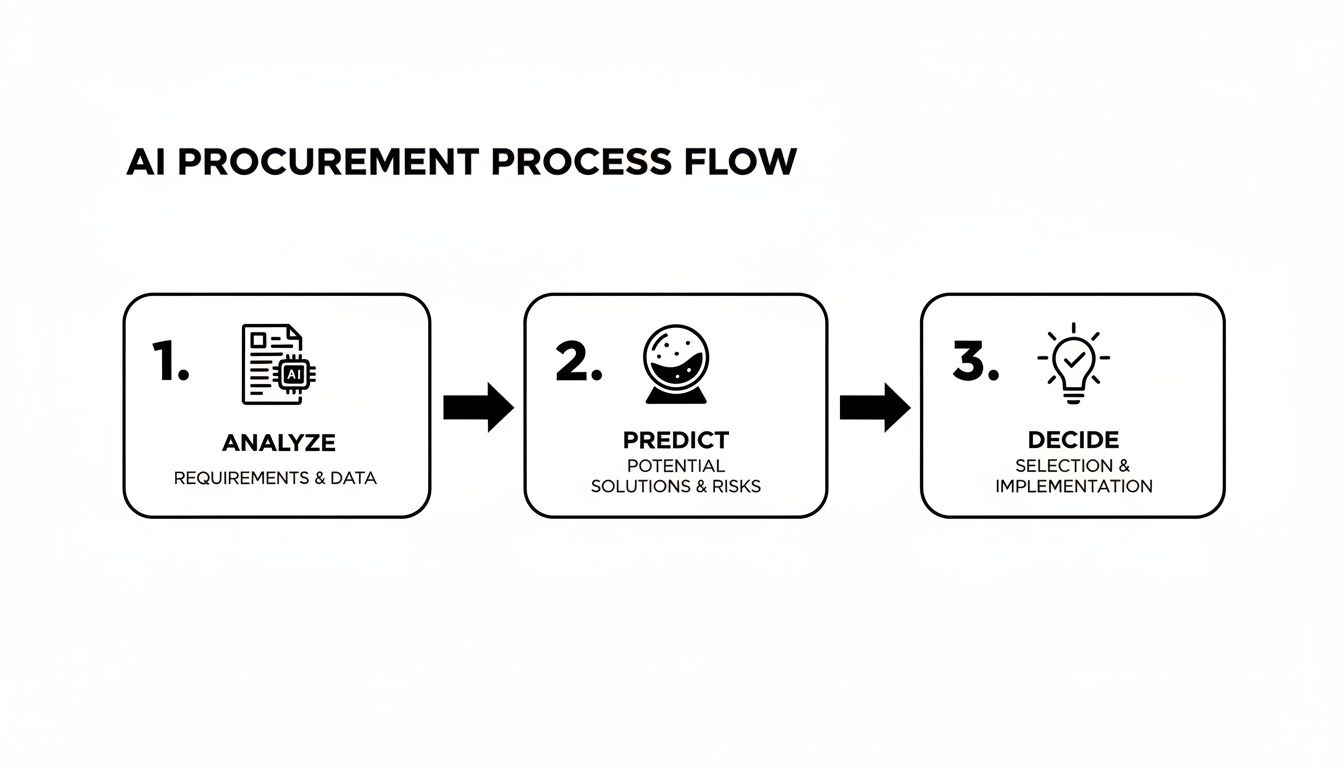
This process isn't just a diagram; it's a new reality. AI gives teams the power to analyze massive datasets, predict outcomes with surprising accuracy, and ultimately make smarter, faster calls.
This cycle—diagnose, negotiate, automate, and measure—is how you build a procurement function that doesn’t just spend money but actively creates value. With a tool like BoloSign, you can instantly create, send, and sign PDFs, accelerating every single agreement from vendor onboarding to master service agreements.
Our transparent pricing—unlimited documents and users for one flat cost—makes powerful contract automation up to 90% more affordable than the other guys. If you want to dig deeper into these strategies, check out our guide on procurement best practices.
Ready to stop talking and start doing? Kick off your 7-day free trial of BoloSign and see for yourself how simple, affordable eSignatures can transform your entire procurement process.
Your Top Questions Answered: Making Procurement Cost Savings a Reality
Getting started with a cost savings strategy can bring up a lot of questions. Here are straightforward answers to some of the most common ones we hear from procurement leaders.
My Team Wants to Cut Costs. Where Do We Even Begin?
The only real starting point is a comprehensive spend analysis. It’s the most critical first step, hands down. You have to get total visibility into where every dollar is going, which suppliers are getting it, and what terms you’ve agreed to.
This isn’t just about making a spreadsheet; it’s about building a data-driven foundation. Once you have that clarity, you can immediately spot opportunities to consolidate suppliers, renegotiate bad contracts, and clamp down on maverick spending.
Without this baseline, any effort to achieve cost saving in procurement is just a shot in the dark. You need a real, actionable strategy, not just a hunt for random discounts.
How Does Contract Automation Actually Save Us Money?
Contract automation delivers savings in a few powerful ways. First, it slashes the administrative hours your team wastes on manual work—think drafting from scratch, routing documents for approval, and chasing down signatures. This frees up your skilled people to focus on strategic negotiations, not paperwork.
Second, it shrinks the entire procurement cycle. A faster process means you onboard vendors and start getting value from them much sooner. For a logistics company, that could mean getting a new carrier on the road in hours instead of weeks.
A centralized, secure platform for eSignatures and contract management also minimizes the risk of expensive errors, compliance slip-ups, and lost documents. These are the hidden costs that automation wipes out.
Should We Focus on Negotiating Lower Prices or Improving Our Processes?
While haggling for lower prices feels like a quick win, the most sustainable cost savings come from fixing your processes. Why? Because better processes—like consolidating your supplier base or implementing a solid digital signing solution—create efficiencies that deliver savings year after year.
These process improvements also cut down on operational risk and help you build stronger relationships with key suppliers. The best strategy is to do both. Use your improved processes to walk into negotiations from a much stronger position.
How Can I Measure the ROI of a Procurement Tool Like BoloSign?
Measuring the Return on Investment (ROI) goes way beyond just comparing subscription prices. You need to track a few key metrics to see the full picture.
- Direct Hard Savings: This is the easy one. Calculate the cost reductions from better-negotiated contracts and the total elimination of paper, printing, and shipping costs for physical documents.
- Soft Savings (Efficiency Gains): Quantify the hours your team gets back by automating manual tasks. Just multiply those hours by the average employee cost to see the value of that reclaimed time.
- Cycle Time Reduction: Track how much you’ve shortened your average contract cycle time. A faster cycle means you realize revenue or operational value that much sooner.
Platforms like BoloSign make this incredibly simple. With fixed, predictable pricing for unlimited documents, the ROI is obvious. Because it’s up to 90% more affordable than the per-envelope models from competitors like DocuSign or PandaDoc, the financial case is compelling from day one.
Ready to see how streamlined eSignatures and AI contract review can truly change your procurement game? BoloSign makes it simple and affordable to create, send, and sign PDFs online, all while staying compliant with ESIGN, HIPAA, and GDPR.
Start your 7-day free trial today and feel the difference for yourself.

Paresh Deshmukh
Co-Founder, BoloForms
24 Jan, 2026
Take a Look at Our Featured Articles
These articles will guide you on how to simplify office work, boost your efficiency, and concentrate on expanding your business.