

8 Contract Negotiation Strategies That Work
Apply eight contract negotiation strategies for faster, safer deals, with practical examples and BoloSign automation for drafting, review, and eSignature.

Tired of nonsense pricing of DocuSign?
Start taking digital signatures with BoloSign and save money.
Negotiation value is rarely lost for lack of a clever phrase. It is lost through scattered drafts, unclear authority, inconsistent redlines, and manual follow-up after the meeting ends. The commercial cost can continue after signature. In a study of water-supply projects in Nyamasheke District, Rwanda, negotiation practices correlated with project performance at r = 0.703, and the model explained 49.4% of observed variance in outcomes. The setting was specific, so the result shouldn't be generalized mechanically, but it shows why negotiation belongs in operational planning, not only legal review. Read the study
Effective contract negotiation strategies combine fallback planning, prioritized trade-offs, disciplined approvals, and clean execution. They also connect negotiated terms to service levels, renewal economics, data protection, payment, and measurable obligations. That's how legal, sales, procurement, and HR teams protect value instead of treating the signed document as the finish line.
This roundup focuses on eight practical moves across the full lifecycle. Teams in the US, Canada, Australia, New Zealand, and the UAE can use BoloSign to create, send, and sign PDFs, templates, and forms instantly, apply AI-powered contract intelligence, and move from redlining to secure eSignature in one workflow. BoloSign supports workflows designed around ESIGN, eIDAS, HIPAA, and GDPR, helping organizations drive efficiency in procurement without forcing counterparties into unfamiliar tools.
1. Know Your BATNA Before You Sit Down
BATNA means Best Alternative to a Negotiated Agreement. It's the option you'll use if the current deal fails. Before discussing rates, liability, exclusivity, or renewal terms, write down that alternative and estimate its value. Then define your reservation value, the least attractive deal you're authorized to accept.
Harvard's Program on Negotiation recommends listing every no-deal option, valuing each one, and selecting the strongest alternative as the BATNA. A staffing agency might compare a prospective master services agreement with another client that's ready to sign. A clinic buying scheduling software might decide that staying with its current vendor remains preferable to accepting weak data or termination terms. Harvard's contract negotiation guidance provides a useful framework for making that comparison explicit.
A logistics company could compare a three-year carrier agreement with spot-market options and a second carrier already in discussion. A real estate developer might know that another buyer can close within 30 days, so it refuses an extended exclusivity clause that creates risk without reciprocal commitment.
Set the boundary before pressure arrives
Record the BATNA, reservation value, assumptions, and approval owner before the first meeting. Revisit the analysis when the other party reveals new information, but keep specific alternatives confidential. You can signal that alternatives exist without disclosing names, rates, or internal deadlines.
BoloSign's AI contract review can compare proposed language with an approved playbook and highlight terms that fall below your internal position. That doesn't replace commercial judgment. It gives legal, procurement, HR, or sales a faster way to identify where a draft needs escalation before someone accepts a clause under deadline pressure.
Practical rule: A walk-away position is useful only when the team knows who can approve movement from it.
For property teams, a clear BATNA supports a stronger guide to leasing office space. For staffing and professional-services teams, it prevents a low-margin agreement from looking attractive merely because it's close to signature.

2. Control the First Draft
The first draft establishes the negotiation's frame. It determines which terms appear normal, which provisions require explanation, and which compromises look like movement. That's why “holding the pen” matters. A well-built template lets your team set the structure for payment, liability, termination, intellectual property, data handling, and implementation responsibilities.
A staffing or HR agency that sends its own master services agreement starts with its preferred placement fees, replacement rules, insurance language, and approval process. A healthcare clinic issuing its own vendor agreement can address protected health information and business associate responsibilities before a supplier's standard paper introduces gaps. A property developer can put inspection and financing deadlines into its purchase agreement rather than negotiating them from scratch after the counterparty has established a different baseline.
Keep templates usable, not aggressive
Maintain preferred, acceptable, and fallback positions for important clauses. Plain language helps the other side review quickly and reduces the chance that every sentence becomes a drafting dispute. Track which provisions are changed most often. Those recurring edits identify where the template needs a clearer business explanation or a stronger fallback.
BoloSign lets teams create reusable templates and send them from PDFs or forms. That matters when a sales representative, recruiter, clinic administrator, or property manager needs to issue the current version immediately. Teams can create, send, and sign PDFs, templates, and forms without rebuilding the workflow for every transaction.
A current template also improves contract automation. Instead of storing a preferred draft in one folder, a fallback in email, and an approval note in a chat thread, the team can keep the working agreement, comments, and signing activity connected. For practical drafting guidance, use this guide to writing a contract.
A training institution might send a standard enrollment or partnership agreement with data protection terms aligned to GDPR for European learners. The institution still needs negotiation flexibility, but it doesn't need to surrender control of the starting position.
3. Anchor the Negotiation with a Justified Opening Offer
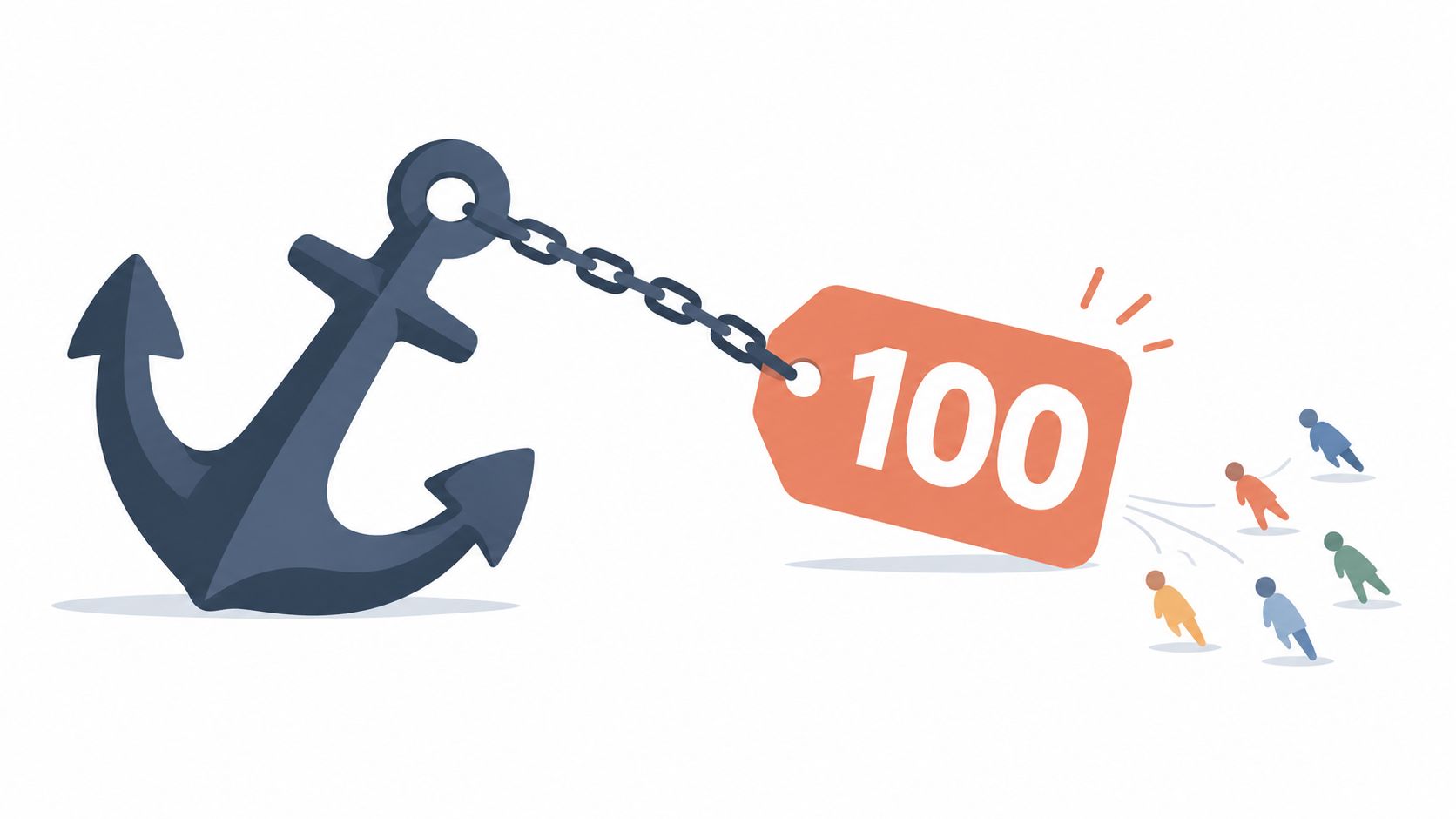
The first serious price, term, rate, or service level often becomes the reference point for the rest of the discussion. That makes anchoring useful, but only when the opening position is credible. An extreme number without a clear rationale can damage trust and invite the other side to disregard the rest of your proposal.
A logistics company might open a three-year freight agreement with a volume-tiered rate card based on its recent shipment history. An education provider could anchor corporate training around per-learner pricing, then explain how the rate changes with multi-year commitment, cohort size, or delivery scope. A real estate agency can support a commission position with comparable transactions in the same area rather than presenting the fee as an arbitrary preference.
Make the anchor explainable
Support the opening position with objective reasons. Those reasons might include expected volume, implementation effort, response-time requirements, payment timing, insurance exposure, or the value of a longer commitment. A range is useful only when both sides understand what causes movement inside it.
Anchoring also applies beyond price. You can establish the initial structure for renewal notice, service credits, implementation dates, support coverage, data-access rights, and change control. The point isn't to force every term through. It's to create a coherent commercial baseline that the other party can evaluate.
BoloSign's contract intelligence can help teams compare pricing and commercial clauses across prior agreements, identify unusual language, and prepare a defensible opening position. AI can surface patterns, but an authorized commercial owner still decides whether the proposal fits current capacity, margin, and risk.
A strong anchor is ambitious enough to create room, but clear enough that the other side can explain why it exists.
Put the opening position in the first draft where possible. Written terms give sales, procurement, finance, and legal a shared reference point, which is more reliable than remembering different numbers from a meeting.
4. Trade Concessions, Never Give Them Away
A concession should change the deal in both directions. If you reduce price, ask for something that protects value. If you add a service, obtain a commitment that makes the added cost worthwhile. This give-get discipline prevents a series of “small” accommodations from subtly shifting the economics of the entire agreement.
For example, a professional-services provider might exchange a reduced setup fee for a minimum term. A healthcare staffing vendor could offer a faster onboarding timeline in return for guaranteed monthly hours. A SaaS sales team might offer a discount for annual prepayment while requesting a longer renewal commitment and permission to use the customer as a reference, provided those conditions fit the customer's procurement rules.
The trade doesn't always need to be financial. Useful exchanges include:
- Term for price protection: A longer commitment can support a better rate, but the buyer should seek renewal limits, service guarantees, or clear exit rights.
- Volume for capacity: A buyer can provide forecast visibility or volume commitments in return for priority capacity and defined response times.
- Flexibility for certainty: A clinic might request scheduling flexibility while giving the staffing partner predictable minimum hours.
- Speed for scope control: A customer can accept a faster approval path if the supplier limits implementation scope and documents change-control charges.
Keep a concession ledger
Before offering movement, write down what you want in return. Group related points into packages instead of negotiating every clause as an isolated exchange. Maintain a concession log in the deal record so another team member doesn't give away the same point later.
This approach matters in volatile markets, where a traditional walk-away option may be weaker. A 2025 corporate-travel survey found that nearly half of respondents said their negotiating position had weakened for airline and lodging contracts, while suppliers increasingly requested evidence of volume and share shifts. The same report said 81% were preparing for another major disruption. The survey coverage supports a practical conclusion: trade transparency, flexibility, or term for protections you can reliably use.
BoloSign's redlining and approval workflows keep each proposed trade visible. Internal reviewers can see the rationale before the counterparty receives it, which is particularly useful when sales, procurement, finance, and legal are working on the same agreement.
5. Prioritize High-Risk Clauses with a Redline Playbook
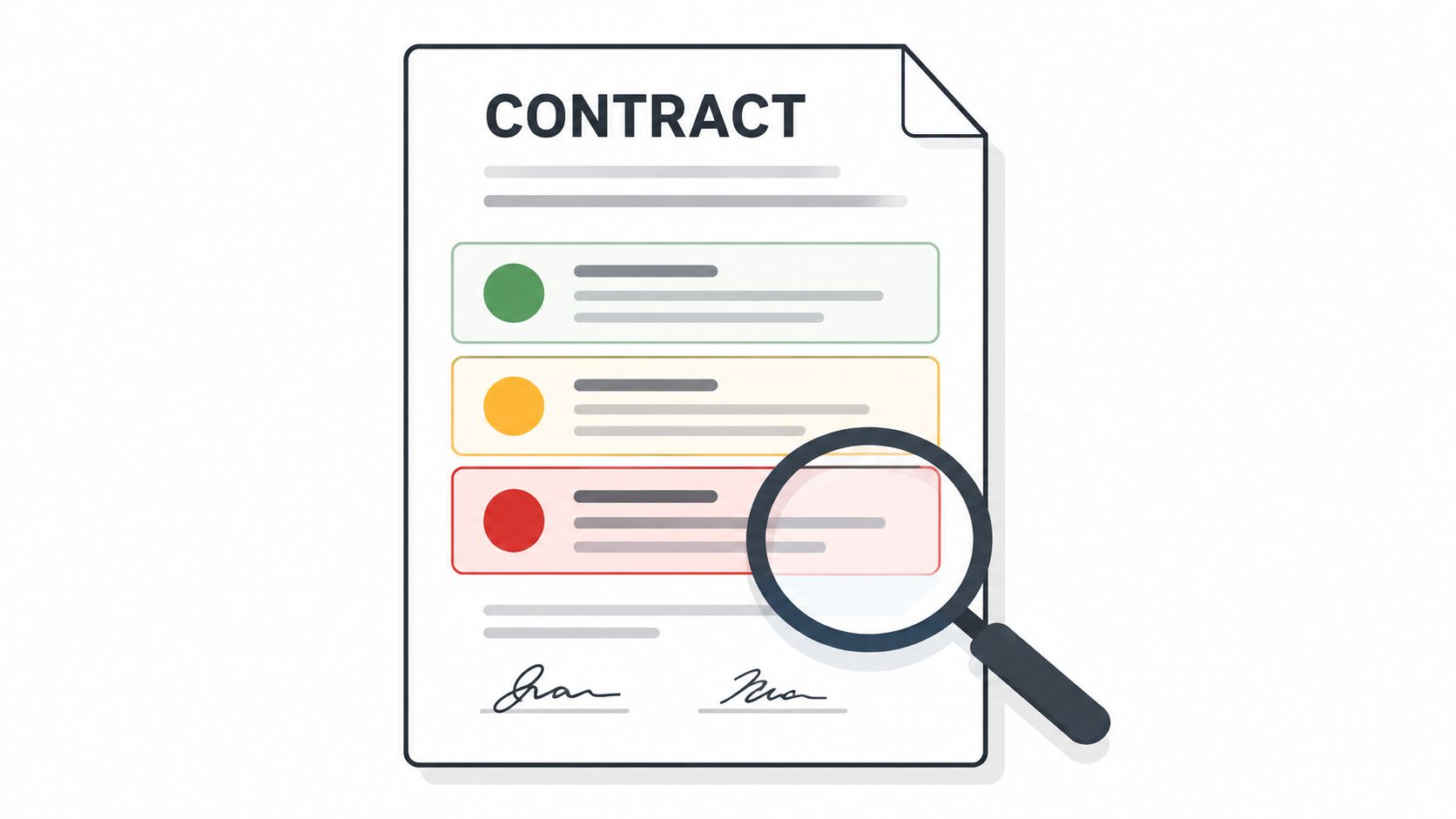
Not every redline deserves equal time. A clause playbook ranks provisions by business impact and tells reviewers what to accept, what to change, and when to escalate. Common high-risk areas include limitation of liability, indemnification, intellectual property, data protection, termination, auto-renewal, payment, governing law, service levels, and audit rights.
A logistics company should pay close attention to cargo damage, insurance, claims procedure, and liability allocation. A healthcare provider needs to resolve protected-health-information handling and the required business associate documentation before sharing patient data. A real estate developer may focus on financing deadlines, earnest-money treatment, inspection rights, title, and termination triggers.
Build the playbook around decisions
For each important clause, define a preferred position, an acceptable fallback, an owner, and an escalation trigger. Separate must-have terms from should-have terms and low-value stylistic preferences. That helps legal teams spend time on material exposure instead of debating wording that has no meaningful effect on the deal.
A practical redline should answer four questions:
- Is it legally workable? Can the language be enforced and interpreted as intended?
- Is it commercially authorized? Does the position fit the budget, margin, timeline, and operating model?
- Is it proportionate? Does the requested protection match the relative bargaining power and risk?
- Will it close? Is the counterparty likely to accept it, or does it need a different structure?
The RedlineBench framework uses these same kinds of priorities across commercial alignment, legal correctness, negotiation quality, acceptance prediction, and deal-closing orientation. Its rubric assigns 33.4% to commercial context, 25.7% to legal correctness, 17.0% to negotiation quality, 13.7% to deal-closing orientation, and 10.2% to acceptance prediction. Review the RedlineBench rubric.
BoloSign's AI contract review can flag risky clauses and suggest alternative language, while human reviewers apply the organization's actual approval rules. For a focused explanation of exposure allocation, see this guide to limitations of liability.
6. Use Calibrated Questions and Strategic Silence
A negotiation can reveal more through a well-timed question than through another paragraph of argument. Ask what the other team needs to approve the clause, what risk its position addresses, and which part of your proposal creates difficulty. Then pause. People often add useful context when they aren't rushed to fill every silence.
A procurement manager might ask a vendor, “What would your legal team need to see in the indemnity clause to approve this?” The answer may reveal an insurance limit, a defense-control concern, or a requirement to preserve a specific exclusion. A property developer can ask which closing condition creates the buyer's timing problem instead of immediately accepting a longer inspection period. A staffing agency can ask whether the client's concern is the replacement guarantee, the fee, or the approval process.
Turn objections into operating information
Prepare three calibrated questions before each important meeting. Use questions to uncover the difference between a true deal-breaker and a preferred position. Labeling the issue plainly can also help: “It sounds like your finance team is concerned about variable charges,” or “It seems the approval problem is the liability cap rather than the service level.”
After presenting a proposal, give the other side room to respond. Don't treat silence as failure. It may indicate that the counterparty is checking authority, processing the trade, or deciding which concern to raise first.
BoloSign supports comments and collaborative review directly around the working document. That creates a written record of questions, answers, and unresolved points rather than leaving important context in disconnected email. Teams can then connect the negotiated position to approval and eSignature without losing the reasoning behind the redlines.
The written record matters for remote negotiation. Email and portals can preserve words while losing tone and relationship signals, so use direct questions and clear comments to reduce avoidable misunderstanding.
7. Set Deadlines and Build Approval Paths Early
A deal can be commercially sound and still fail because nobody knows who must approve it. Set the review window, response dates, escalation route, and signature target before negotiations become urgent. Shared deadlines create momentum without turning the process into an artificial pressure tactic.
A staffing agency might give a new client a five-business-day review window for its master services agreement and automatically route agreements above a defined internal threshold to the CFO. A training institution can establish a decision window before the academic term, with reminders for legal, finance, and program leadership. A transportation company may need insurance and compliance approval before a carrier agreement becomes operational.
Make authority visible
Approval paths should reflect both contract value and risk. A low-value agreement containing sensitive health data may need more scrutiny than a larger routine purchase with standard terms. Define which deviations require legal review, which need finance approval, and which can be accepted by an authorized commercial owner.
BoloSign's automated reminders and approval workflows help keep the sequence visible. Reviewers can work from the current version, record decisions, and avoid the manual chasing that causes teams to send a draft for signature before every material issue is resolved.
Useful workflow measures include first-response time, unresolved redlines per round, percentage of edits with a rationale, and the time between final approval and signature. These measures help leaders identify whether delays come from drafting, negotiation, internal authority, or execution.
Approval principle: The person who negotiates a term shouldn't have to guess whether someone else can authorize it.
For a broader operational framework, see this guide to contract management workflow automation.
8. Lock in Terms with Clean Execution and Obligation Tracking
Agreement on the last redline isn't the end. Teams still need to verify the final document, collect valid signatures, store the executed version, and track what the parties promised to do. Many post-signature disputes begin when the signed PDF differs from the last approved draft or when nobody records renewal, service-level, insurance, or data-review dates.
Before sending the agreement, compare the final PDF with the approved redline. Confirm exhibits, schedules, order forms, addenda, and referenced online terms. Then send the correct record through a signing workflow that captures signer identity, intent, timestamps, authentication details, and a reproducible copy.
Under the US ESIGN Act, an electronic signature can be an electronic sound, symbol, or process attached to or logically associated with a record and adopted with intent to sign. A workflow must do more than place an image on a PDF. It should associate the signature with the record, preserve evidence, and provide required consumer disclosures where applicable. This ESIGN overview explains the evidence a secure process should retain.
Connect signature to performance
A real estate agency can send the final purchase agreement for eSignature, then track the closing date, inspection deadline, and notice obligations. A logistics company can store executed carrier agreements with reminders for insurance certificates and service reviews. An education provider can track renewal and data-processing commitments. A healthcare clinic can connect the signed vendor agreement to compliance review and access controls.
BoloSign lets teams send PDFs and forms for secure eSignature, add a signature to Google Forms, and connect signed records to CRM workflows. It supports instant signing for documents that originate in sales, recruiting, healthcare administration, property operations, procurement, and education. For organizations handling personal data, GDPR Article 33 requires notification to the competent supervisory authority without undue delay and, where feasible, within 72 hours after becoming aware of a qualifying breach. Read the Article 33 requirement. Contract systems should therefore support access control, record preservation, affected-data identification, and rapid incident documentation.
8-Point Contract Negotiation Strategy Comparison
| Strategy | 🔄 Implementation complexity | ⚡ Resource requirements | 📊 Expected outcomes ⭐ | 💡 Ideal use cases | 💡 Key advantages / Quick tip |
|---|---|---|---|---|---|
| Know Your BATNA Before You Sit Down | Moderate, research alternatives and value estimates | Low–Moderate: market intel, stakeholder input | Stronger walk-away position; fewer poor deals ⭐⭐⭐⭐ | High-stakes negotiations, supplier selection, new markets | Prevents accepting bad terms; keep alternatives confidential |
| Control the First Draft | Moderate, template design and legal review | Moderate: legal input, template library, version control | Sets favorable defaults; faster, more consistent negotiations ⭐⭐⭐⭐ | Recurring contracts, master service agreements | Frame the deal; maintain preferred structure and liability limits |
| Anchor the Negotiation with a Justified Opening Offer | Low–Moderate, prepare data-backed anchor | Low: market data, comparable deals, pricing history | Shifts settlement zone toward your position; room to concede ⭐⭐⭐ | Pricing talks, procurement, sales proposals | Use objective justification and record the anchor in the first draft |
| Trade Concessions, Never Give Them Away | Moderate, value mapping and tracking | Moderate: negotiation playbook, logging tools | More mutually beneficial outcomes; concessions feel earned ⭐⭐⭐⭐ | Renewals, bundled deals, multi-term agreements | Link every concession to a specific return; log trades |
| Prioritize High-Risk Clauses with a Redline Playbook | High initially, lower ongoing, build and calibrate playbook | High up-front legal time; then modest to maintain | Focuses legal effort on critical risks; fewer missed exposures ⭐⭐⭐⭐ | Contracts with liability, IP, data protection concerns | Tier clauses, set fallbacks and escalation rules |
| Use Calibrated Questions and Strategic Silence | Low, skill training and practice | Minimal: coaching and rehearsal | Uncovers constraints and approval needs; can improve offers ⭐⭐⭐ | Live negotiations, discovery calls, stakeholder probes | Prepare calibrated questions; pause after offers to elicit responses |
| Set Deadlines and Build Approval Paths Early | Moderate, design workflows and thresholds | Moderate: workflow tools, named approvers, reminders | Shorter cycle times; fewer last-minute surprises ⭐⭐⭐⭐ | Time-sensitive deals, enterprise procurement, deal desks | Share timeline early; automate reminders and routing |
| Lock in Terms with Clean Execution and Obligation Tracking | Moderate, process + tooling for execution and tracking | Moderate: eSignature/CLM tools, admin for obligations | Reduces post-signature disputes; ensures renewals and compliance ⭐⭐⭐⭐ | Regulated industries, long-term contracts, service-level agreements | Confirm final PDF vs last redline; track renewals and obligations |
Turn Better Negotiations into a Repeatable Workflow
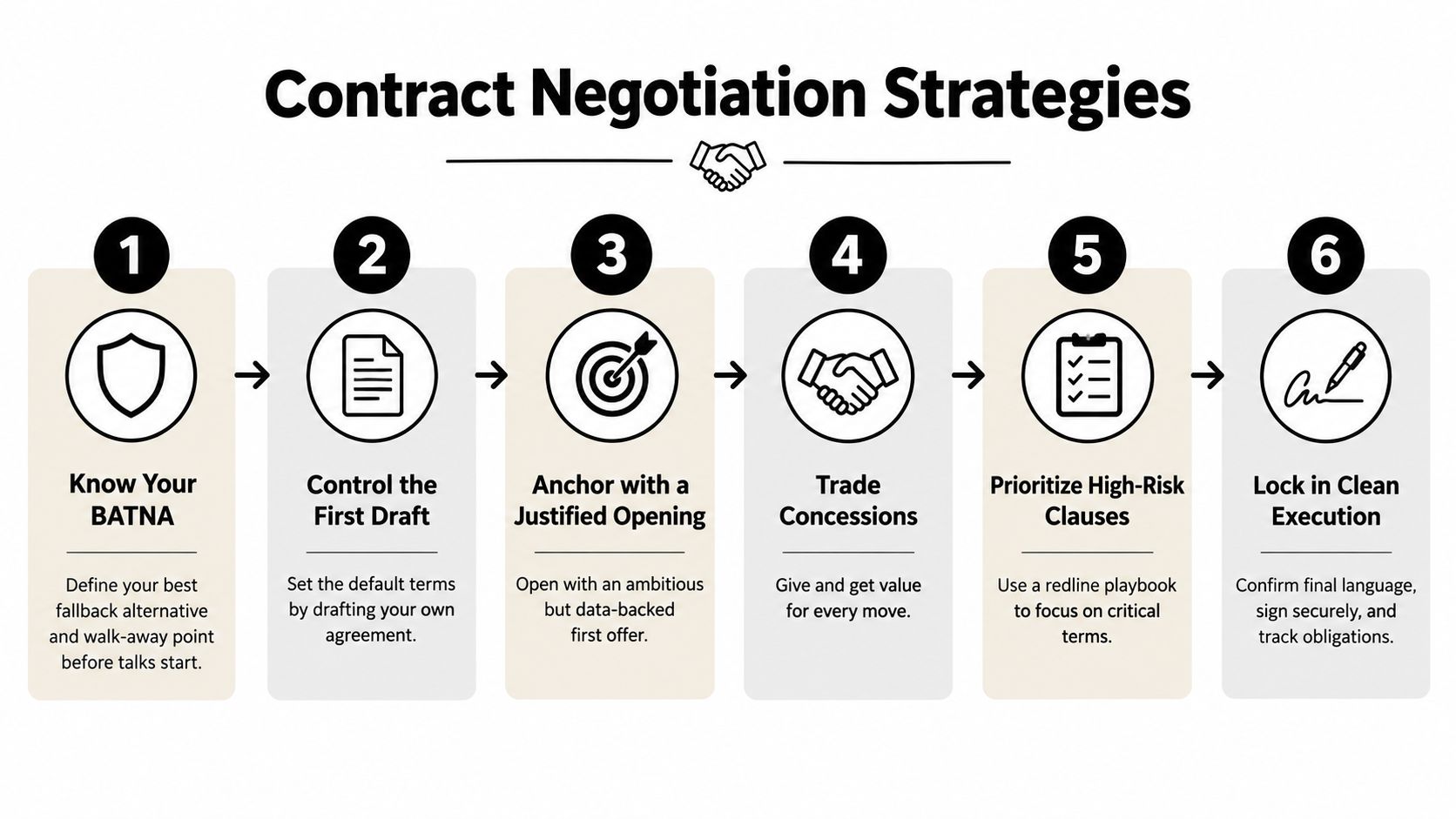
The eight tactics work best as one operating system, not as isolated tricks. Define the BATNA before the meeting. Control the first draft. Justify the anchor. Trade concessions instead of donating them. Prioritize high-risk redlines. Ask questions that reveal approval constraints. Route decisions early. Then execute the exact approved version and track the obligations that give the contract its practical value.
That last point deserves more attention. 90% of CEOs say their companies leave money on the table during contract negotiations, while 82% of CFOs believe negotiations don't produce the value they should, according to the cited negotiation trends report. The same source says nearly 40% of legal-operations leaders now assess contract programs using business metrics such as revenue and cost savings, rather than legal efficiency alone. See the negotiation trends report. Those findings support a practical shift: negotiate terms that finance and operations can measure after signature.
For the next agreement, use a short implementation sequence:
- Choose the right template. Start with a current master services agreement, order form, staffing agreement, vendor contract, lease, consent form, or education document.
- Set the playbook. Mark preferred language, acceptable fallbacks, escalation triggers, and business owners for liability, indemnity, data, payment, termination, renewal, and service levels.
- Assign approvers early. Include legal, finance, security, HR, procurement, or an executive owner according to the agreement's risk and commercial authority.
- Review the PDF with AI contract intelligence. Ask BoloSign to identify non-standard clauses, obligations, missing protections, and language that differs from the approved position. Human reviewers should make the final decision.
- Negotiate in a controlled workspace. Keep redlines, comments, version history, concession logic, and approvals connected to the same deal record.
- Send the approved document for secure eSignature. Create, send, and sign PDFs, templates, and forms instantly, then retain the completed record and audit evidence.
- Track the promise, not only the signature. Record renewal dates, implementation milestones, service levels, insurance evidence, payment conditions, and data-processing reviews.
BoloSign supports this lifecycle through AI-powered automation, contract intelligence, collaboration, approvals, secure eSignature, and compliance-focused workflows. It's designed to help legal, sales, procurement, HR, healthcare, real estate, logistics, education, and professional-services teams move from intake and drafting through negotiation, signing, and obligation tracking.
The commercial model is straightforward for growing teams. BoloSign offers unlimited documents, templates, and team members at one fixed price, with a claim of being up to 90% more affordable than DocuSign or PandaDoc. That makes the platform relevant when a company wants broad adoption without asking every department to ration document sends or user access.
BoloSign also supports workflows involving ESIGN, eIDAS, HIPAA, and GDPR, while teams can create and sign PDFs, templates, and forms instantly. Whether a recruiter is issuing a staffing agreement, a clinic is collecting a consent form, a broker is executing a lease, a carrier is signing a logistics contract, an institution is managing enrollment, or a sales team is closing through a CRM, the objective stays the same: fewer disconnected steps and clearer accountability.
Better negotiation also requires better commercial communication. Teams building that capability can use resources such as sales engineering skills from PreSales Unleashed, then turn those skills into a repeatable contract workflow rather than relying on individual memory.
Start with one contract type, one playbook, and one approval path. Measure how quickly the team reaches a reliable signature, how often material redlines recur, and whether post-signature obligations are visible. That's how contract negotiation strategies become an operating advantage instead of a collection of meeting habits.
BoloSign helps teams review, negotiate, approve, and sign contracts with AI-powered automation, unlimited documents, templates, and team members at one fixed price. Visit BoloSign to start a 7-day free trial and experience a simpler way to move from contract strategy to secure eSignature.

Paresh Deshmukh
Co-Founder, BoloForms
13 Oct, 2026
Take a Look at Our Featured Articles
These articles will guide you on how to simplify office work, boost your efficiency, and concentrate on expanding your business.