

Contract Negotiation Process: A Practical Playbook
Run the contract negotiation process from intake to signature with owners, timelines, clause trades, KPIs, and eSignature controls.

Tired of nonsense pricing of DocuSign?
Start taking digital signatures with BoloSign and save money.
In 2025, 90% of CEOs said their companies were leaving money on the table during contract negotiations, according to Icertis's State of Contracting Report, which analyzed more than 10 million contracts. That's a useful challenge to the usual success measure: getting the signature quickly.
A good contract negotiation process protects the commercial outcome, assigns responsibility, and gives the people delivering the agreement something they can follow. A fast signature can still be a bad deal if nobody can explain the acceptance criteria, control customer-data use, or identify who approves a change.
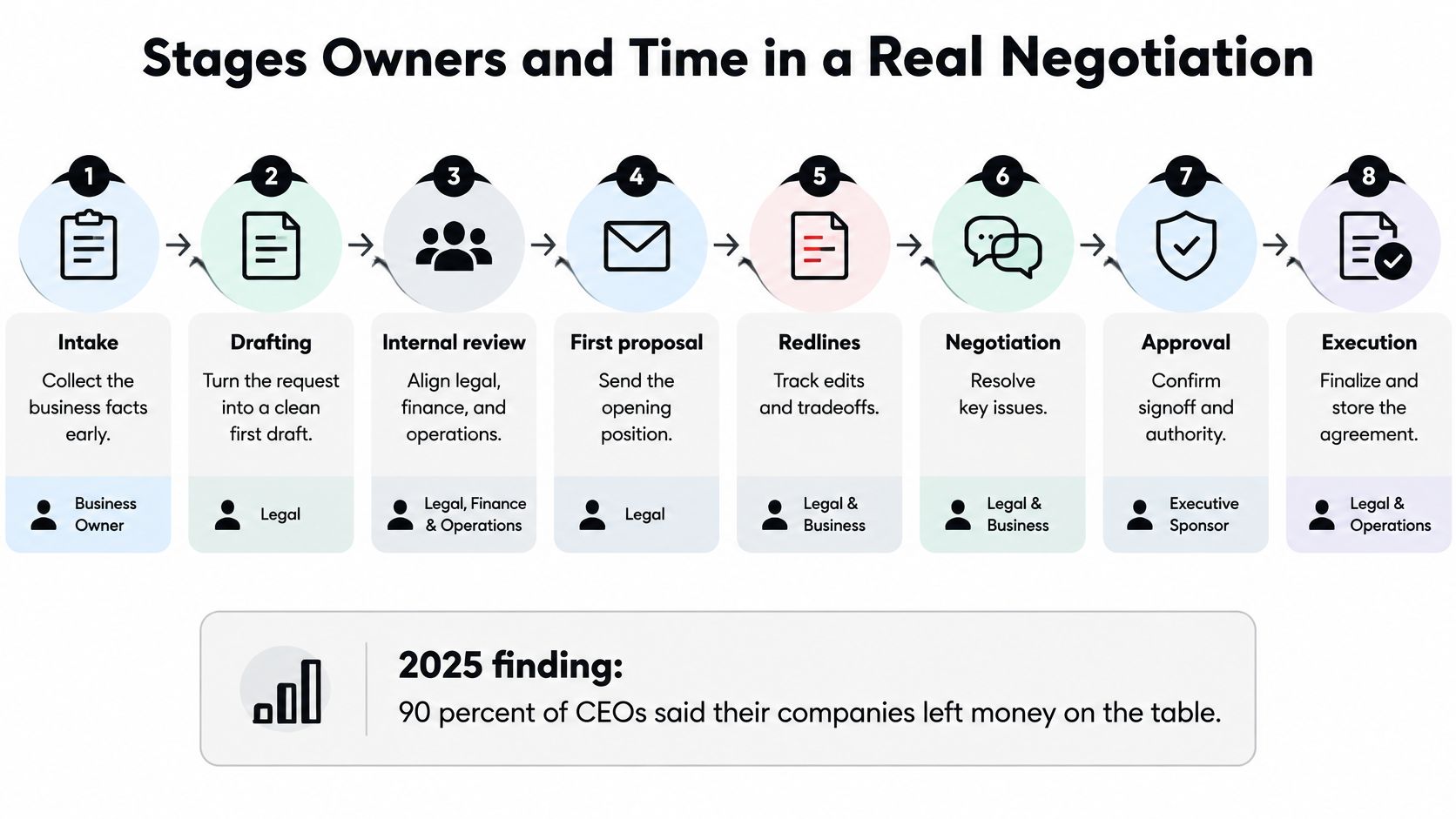
Stages Owners and Time in a Real Negotiation
Negotiation isn't just what happens between opposing lawyers. The business owner defines the requirement, finance checks the economics, security examines data exposure, and operations decides whether the delivery promise is realistic.
A scholarly analysis of global master services agreements reported that, in the organizations examined, approximately 25% of contracting time went to creation, 30% to negotiation, and 45% to review; it estimated 2018 internal review-and-negotiation costs of $6,900 for a standard low-risk procurement or sales contract, $21,300 for a mid-complexity agreement, and $49,000 for high-complexity procurement. The same analysis described typical negotiation sessions with about five participants per side for one hour, internal discussions averaging three hours with five to seven participants, and approximately 25 sessions covering a multi-document contract.
Those figures describe coordination work, not merely typing changes into a document. Assign an owner and an exit test to each stage so the team knows what must happen next.
Contract negotiation stages, owners, and exit tests
| Stage | Usual owner | Time signal | Exit test |
|---|---|---|---|
| Intake and scoping | Business owner with procurement or sales | Creation work | Scope, dates, BATNA, and must-haves written down |
| Drafting initial terms | Legal or sales operations on approved paper | Creation work | First proposal uses current standard terms |
| Redlining and collaborative review | Counsel on both sides | Review work | Every open point sits in a term matrix |
| Approval workflow | Legal, finance, security, then executive by threshold | Inside review time | Each exception is approved in sequence |
| Live negotiation | Cross-functional team with relevant decision-makers | Negotiation time | Concessions are traded, not given alone |
| Risk remediation | Risk owner for the clause | Before signature | Exposure is quantified for named scenarios |
| Execution and eSignature | Authorized signers | After redlines close | Right signer and signature level recorded |
| Post-execution obligations | Contract owner | After signature, ongoing | Obligations, milestones, and amendment rights logged |
The process map makes the handoffs visible, even when review and negotiation loop back on each other.
The same stages, different risk owners
For a staffing master services agreement, the recruiter may own intake, but payroll needs to validate payment timing and HR must check candidate-data responsibilities. A clinic vendor agreement puts privacy and security owners closer to the drafting stage. A logistics services deal needs dispatch or operations to validate delivery windows before sales promises them.
Property agreements need commercial context as well as legal wording. A team assessing a leisure-property transaction can use JRG Property UK Ltd.’s UK leisure property updates to frame market questions, then verify the specific premises, permitted use, and lease obligations during intake.
Deal-desk rule: A document isn't ready for the next stage just because someone has finished editing it. It's ready when the exit test is satisfied.
Before opening the next markup, write down which stage your current deal is in. If the scope is still unresolved, another liability redline won't fix the underlying problem.
How to Run Intake Drafting and the First Proposal
Preparation should produce decisions, not a folder full of background documents. The first proposal needs to express what the business wants, what it can trade, and what would make it walk away.
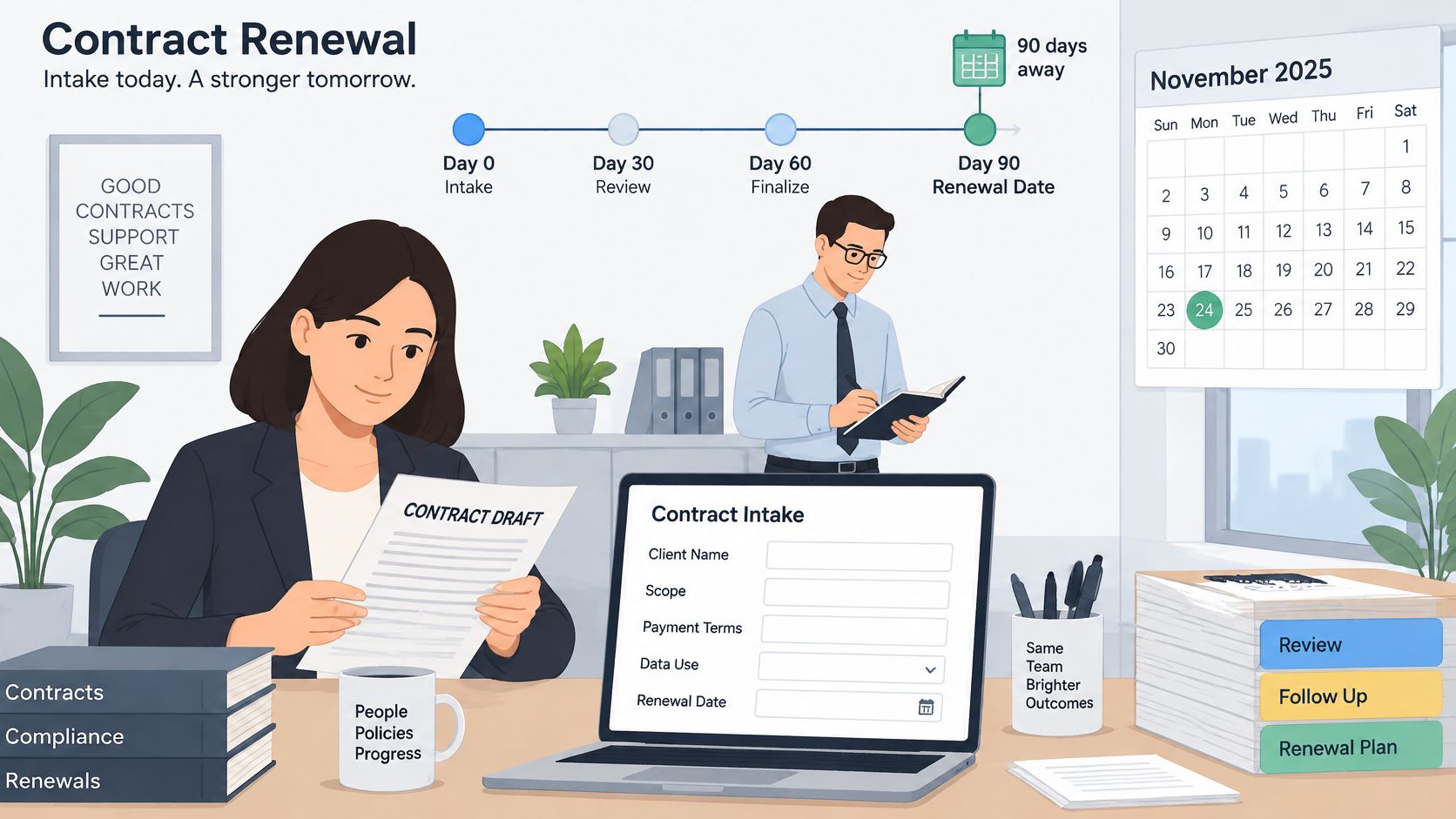
In a survey of 70 banks and credit unions, 70% entered negotiations without adequate market-pricing knowledge and 44% negotiated with fewer than 30 days before expiration or auto-renewal, according to Cornerstone Advisors' contract-negotiation guide, which recommends starting at least 90 days before renewal. Treat that recommendation as a calendar control, not an aspiration.
The working sequence
Open one intake record. Collect the client's legal name, scope, payment terms, data use, renewal date, and notice requirements. For a real-estate lease, record the required move-in date and any fit-out dependencies, not just the proposed commencement date.
Gather spend, utilization, comparable market pricing, service requirements, and liability exposure. Write down the BATNA, your best alternative to a negotiated agreement. A replacement supplier isn't a credible alternative until someone checks availability, transition effort, and operational disruption.
Rank each issue as must-have, tradeable, or acceptable fallback. Name an owner for every material clause. In an education services agreement, the term-start date might be essential, while invoice frequency is tradeable; don't let a negotiator exchange the essential date for a modest discount.
Draft on approved company paper where possible. Auto-fill parties, fees, and term from validated CRM fields, then use AI contract review to flag nonstandard language or missing protections. The reviewer still needs the priorities from intake, because software can identify a deviation without knowing whether the business should accept it.
Send a structured first proposal and a term matrix. Include the clause, opening position, business reason, fallback, owner, and status. The practical mechanics in this guide to how to redline a contract help keep edits understandable rather than burying decisions in scattered comments.
Route exceptions through legal, finance, security, and an executive only when the relevant approval threshold is crossed. Set thresholds by deal size, contract type, and role, and don't advance until the required approval is complete. Otherwise, the team may negotiate a concession that its own approver later rejects.
Trade in pairs and log each revision. If you offer earlier payment, record what you receive in return. Preserve the reason for the trade, not just the final wording, so the next reviewer doesn't accidentally remove the reciprocal benefit.
Sample negotiation timeline before renewal
These milestones illustrate how to implement the preparation window.
| Days before renewal | Milestone | Owner | Exit test |
|---|---|---|---|
| 90 | Open intake and collect client, scope, payment terms, data use, and renewal date | Business owner | Intake form complete |
| 30 | Emergency threshold, anything still open is escalated | Contract owner | Bridge or escalation decided |
A renewal workflow should make the deadline and the current decision visible together.
For a professional-services statement of work coming out of HubSpot, validate the customer entity, deliverables, fees, and acceptance owner before generating the draft. A populated field isn't necessarily an accurate field.
Property buyers can also use REISR's guide to negotiate new apartment prices in Israel as a prompt for questions about negotiation tactics, while keeping transaction-specific legal advice separate. Across these scenarios, send the document to sign PDFs online only after the term matrix is clean and the final draft matches the approved decisions.
Clause Trades and an AI Responsibility Playbook
Price is only one variable. Split the term matrix into economic items and risk items, then negotiate the relationship between them rather than treating each clause as an isolated contest.
Economic items include unit price, volume tiers, payment timing, credits, indexation, and renewal increases. Risk items include warranties, indemnities, liability caps, insurance, confidentiality, data protection, audit rights, service levels, and termination assistance.
Use this distinction to prepare conditional offers.
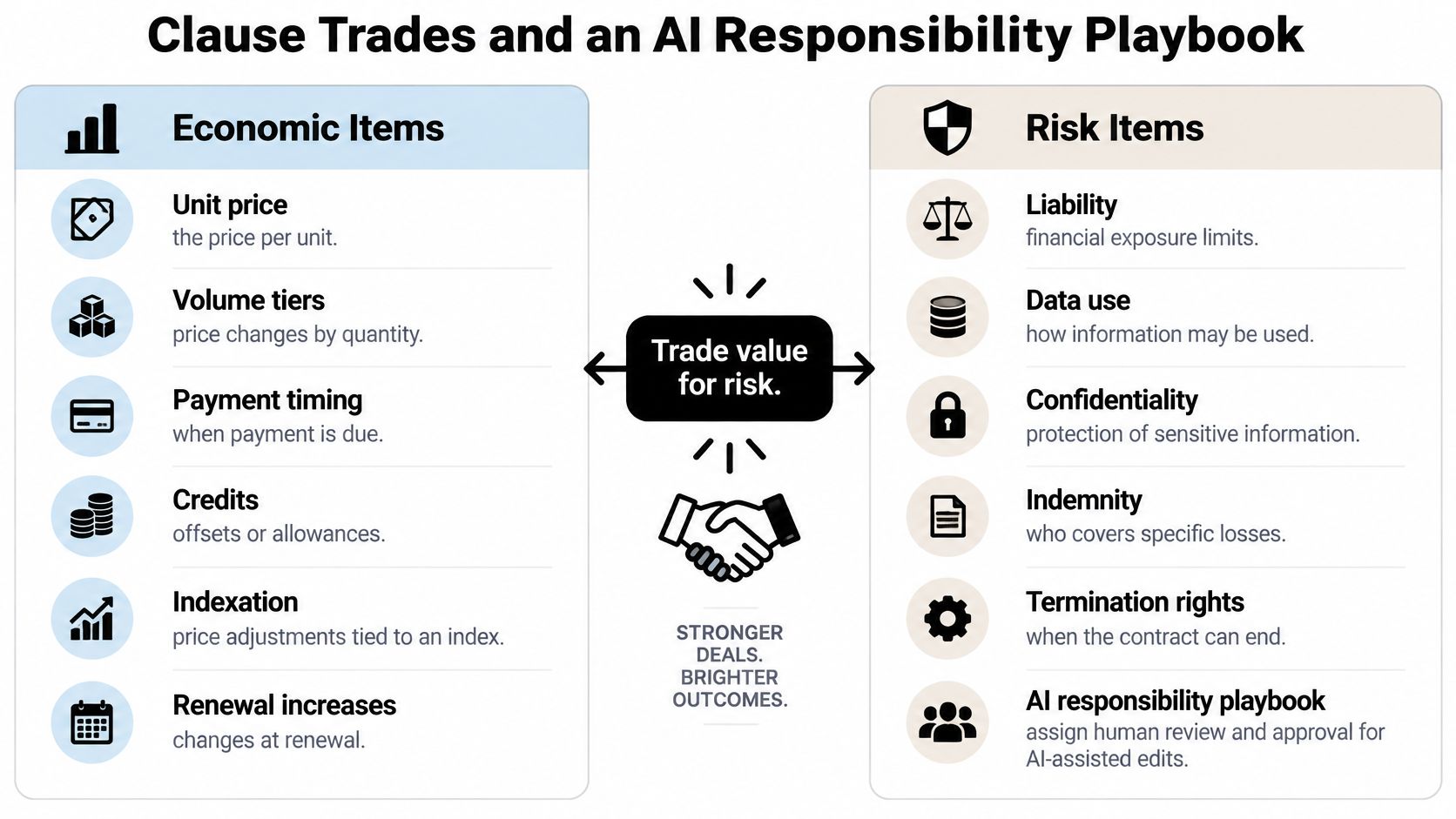
Exchange value rather than surrendering it
- Commitment for rate: Offer a longer commitment only for a lower rate that justifies the reduced flexibility.
- Payment for discount: Offer faster payment in exchange for an explicit discount, after finance checks the cash-flow effect.
- Exposure for narrower rights: Consider a tighter supplier liability cap only alongside narrower permitted-use rights and an exposure assessment. Use a limitations-of-liability review to distinguish the general cap from exceptions that need separate treatment.
For acquisition-related deals, Dealmaker Wealth Society's strategies for merger negotiations provide another context for evaluating linked terms. Don't assume that an attractive economic concession compensates for every operational risk.
The 2024 National Contract Management Association analysis, based on input from more than 600 contracting professionals, reported that buyers and suppliers estimated roughly one-quarter of negotiations experienced significant disagreements or disputes during performance, according to NCMA's Most Negotiated Terms report. Vague operational wording can turn an apparent negotiating win into a delivery dispute.
Build an auditable AI responsibility chain
An accuracy warranty doesn't establish who authorized an automated action. For consequential uses, an auditable chain from input to output to business decision can matter more than a broad promise about model performance.
| AI term | Question to answer before signature |
|---|---|
| Training use | Who may train on customer data? |
| Data location and retention | Where does data sit, and how long is it kept? |
| Model behavior evidence | What evidence must the supplier provide? |
| Human review | Who reviews an automated decision? |
| Suspension trigger | What event pauses the automated process? |
| Exit and deletion | Which exit and deletion rights survive termination? |
A clinic's fallback might prohibit training on patient-related data and require privacy approval for new processing. A staffing agency should preserve human review before candidate rejection. A logistics firm should define which routing changes require dispatcher approval and preserve decision logs.
Adapt this language with counsel:
Supplier may use Customer Data only to deliver the Services and may not train or improve any model on it without Customer's written consent. Supplier will delete Customer Data within [X] days after termination and certify deletion in writing.
Before signature, test service failure, data breach, early termination, volume shortfall, regulatory change, and a disputed invoice. For each scenario, identify the decision-maker, evidence, remedy, and escalation route.
Use the accompanying video alongside the clause matrix, with the approval owner checking any proposed wording.
A Scorecard for Negotiation Quality
| Metric | What to count | Healthy signal | When to act |
|---|---|---|---|
| Cycle time | Days from intake to signature | Standard deals moving through the approved service window | If stalled, check third-party paper and approval rework |
| Standard-term deviation | Clauses off the playbook | Few unapproved departures | Stop extra concessions when fallback language covers the point |
| Concession value | Value given versus value received | Trades are paired | Reject a discount that buys vague remedies |
| Approval rework | Returns to the same approver | No repeat review without a material change | Fix intake fields causing the bounce |
| Obligation performance | Milestones met by counterparty | High compliance after signature | Reopen weak acceptance criteria before renewal |
| Disputes per contract | Material disagreements in performance | Rare, with causes logged | Treat repeats as a potential scoping failure |
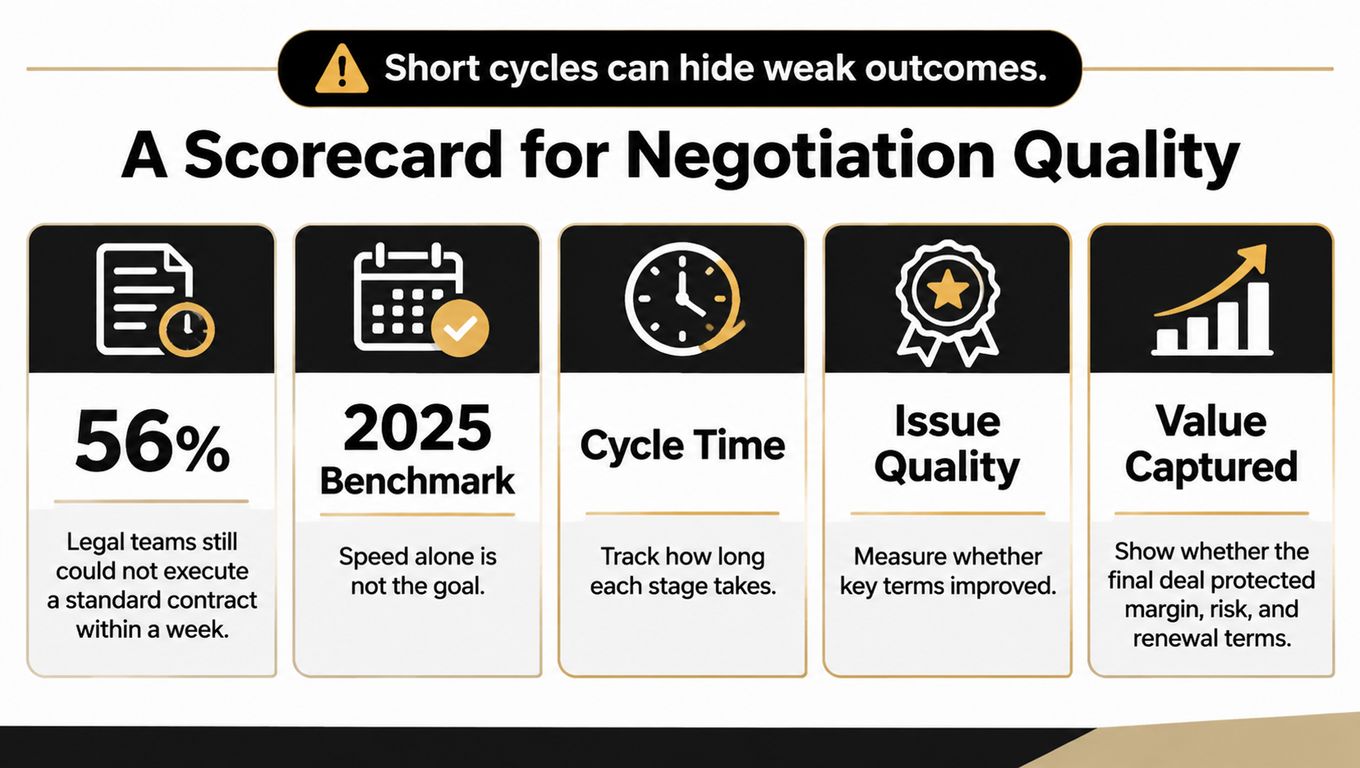
A short cycle isn't enough to declare success. A 2025 benchmark cited by Impact Negotiation Group reported that 56% of legal teams couldn't execute standard contracts within a week; its discussion also reports that contract leaders track third-party paper share (95%), contract value (90%), and obligation performance by counterparty (83%), according to its contract-negotiation problems analysis.
Those measures ask different questions. Cycle time tells you how long the process took, while obligation performance tells you whether the agreement worked after the negotiators stepped away.
The scorecard should keep speed, issue quality, and captured value visible together.
When to stop negotiating
Stop chasing incremental concessions when the remaining language sits inside approved fallbacks, material deviations are resolved, and the obligation plan is measurable. The negotiator's preference for different wording isn't, by itself, a business reason to prolong the deal.
Say a procurement renewal already has acceptable renewal protection, defined service remedies, and a funded exit plan. Continuing to pursue a minor payment concession may create more disruption than value.
The stopping rule isn't exhaustion. It's an approved risk position with obligations that someone can measure.
A CRM-driven sales order may produce a different decision. If the buyer's draft introduces unrestricted data reuse or acceptance criteria that nobody can verify, the team should escalate or walk away even if the revenue target makes an immediate signature attractive.
When customization earns its cost
Customize the process when third-party paper creates material differences, dollar or data exposure crosses an approval threshold, or a regulated signer requires stronger identity checks. A high share of third-party paper can justify a dedicated review path, but it doesn't make every requested edit necessary.
Keep price changes and schedule changes separate on the dashboard. A staffing agreement may preserve its rate while missing the start date that made the service useful; a construction-style delivery obligation can slip without a matching fee amendment.
Review the scorecard at redline close, while the team can still change the agreement. Waiting until quarter end turns a decision tool into a retrospective explanation.
Fixes When Negotiations Stall or Drift
A stalled deal needs a diagnosis, not another indiscriminate round of edits. Assign the recovery action to someone who can make the relevant decision.
Match the fix to the actual blockage
Emergency renewal pressure. Freeze new concessions and ask whether a short, expressly limited bridge is available. If the BATNA field is blank, assign someone to validate an alternative before making a permanent commitment under deadline pressure.
A liability markup turns personal. Return to the term matrix and ask what loss each side is trying to control, then propose a paired risk-and-economic trade. Don't answer an aggressive email by widening your own demand without a commercial reason.
Third-party paper defeats the standard review path. Keep your playbook positions, accept only logged deviations, and return unresolved departures with a clear reason. Rewriting the whole agreement can obscure which changes need approval.
A price win hides a schedule slip. A study of Italian public-works contracts awarded between 2000 and 2007 found price renegotiations exceeding 5% affected 46% of contracts, while time renegotiations exceeding 5% affected 83%, with nearly zero correlation between price and schedule renegotiations. Record each as a separate change-control risk, with its own owner and approval requirement.
An AI add-on arrives at the end. Hold execution until the team resolves data-use permission, human review, incident handling, and exit duties. A generic AI warranty isn't a substitute for deciding who can stop an automated process.
Separate execution convenience from compliance
Healthcare teams shouldn't treat an eSignature click as proof that the surrounding workflow meets HIPAA requirements. Privacy and security owners still need to evaluate access, authentication, auditability, and protection of patient information.
For agreements in the US, Canada, Australia, New Zealand, and UAE, obtain a local determination of signer authority and any document-specific execution requirements. A person's ability to access a signing link doesn't establish that they can bind the organization.
Keep the final draft, approval decisions, and commercial rationale together. If performance later changes, the contract owner should be able to distinguish an authorized amendment from an informal operational accommodation.
Before the next negotiation meeting, ask: Which open point is a must-have, and which is only habit?
Sign Once and Track What You Promised
A verbal agreement is only a checkpoint in the contract negotiation process. Before sending the final file, compare it with the approved matrix, check that every schedule and attachment is included, and confirm the contracting entities are correct.
Choose the signature level before sending. Routine staffing forms and education enrollments may suit a simple eSignature, subject to applicable requirements. A clinic agreement, cross-border lease, or executive employment agreement may call for stronger identity assurance. A fast signature is still a bad outcome if the signer lacks authority or the document uses the wrong execution method.
Choose the execution controls deliberately
Under Article 25 of eIDAS, an electronic signature cannot be denied legal effect or admissibility merely because it is electronic or is not qualified. A qualified electronic signature has the legal effect of a handwritten signature and qualified recognition across EU Member States, as explained in the European Commission's eSignature FAQ. The right method still depends on the document and the applicable requirements.
HIPAA's Security Rule doesn't require electronic or digital signatures, but permits their use as a security measure when a covered entity determines they are reasonable and appropriate, according to the US Department of Health and Human Services. Keep that assessment separate from commercial approval.
For global workflows, include ESIGN, eIDAS, HIPAA, and GDPR in the compliance checklist where applicable. Counsel and compliance owners should verify document eligibility, privacy duties, signer authority, and required safeguards. A platform label alone does not resolve those questions.
Hand the signed agreement to an accountable owner
Prepare the obligation record before celebrating the signature. A contract obligation tracking and management process should identify:
- Accountability: The business owner and each delivery or acceptance owner.
- Dates: Milestones, renewal dates, and opt-out deadlines.
- Change authority: Who can approve amendments and where decisions are retained.
- AI evidence: Required logs, incident notices, review records, and deletion certificates.
Those fields make the handoff useful: the next owner can see what is due, who is responsible, and who can authorize a change. For AI-related terms, record evidence and ownership alongside the obligation, rather than treating accountability as one boilerplate clause. The aim is not to collect extra concessions after fallback language, approval thresholds, and a measurable obligation plan already protect the deal.
BoloSign combines CLM, eSignatures, and AI in one platform. Users define who drafts, reviews, and signs, and the platform routes contracts automatically. Its AI-powered workflows can route and review contracts and suggest edits, while its repository centralizes contracts and enriches metadata with AI.
Keep execution tied to the approved record. Whether a team signs a PDF or uses a template, connect the signing step to the approved document and retain the final agreement and approval decisions together. Contract intelligence should help the next owner understand what was promised, not merely confirm that a file was signed.
Run one live agreement through intake, approval, and signature with BoloSign, then check whether the signed terms and assigned obligations are easy for their owners to track.

Paresh Deshmukh
Co-Founder, BoloForms
5 Nov, 2026
Take a Look at Our Featured Articles
These articles will guide you on how to simplify office work, boost your efficiency, and concentrate on expanding your business.