

Contract Management Workflow Automation: A Practical Guide to Boosting Efficiency & Compliance
Discover how contract management workflow automation transforms your business. Map, build, and integrate automated workflows for faster, compliant agreements.

Tired of nonsense pricing of DocuSign?
Start taking digital signatures with BoloSign and save money.
If you're still chasing contracts through endless email chains and tracking deadlines in spreadsheets, you know the feeling. It's a chaotic mix of wasted time, mounting risk, and pure frustration. This is where contract management workflow automation comes in. It’s not about just getting a fancier tool; it’s about a fundamental shift from manual, disorganized methods to a smart, software-driven process that puts you back in control.
Think of it as the central nervous system for your agreements, handling everything from creation and negotiation to signing and renewal, making sure nothing ever slips through the cracks.
The Problem with Manual Contract Processes
In any fast-moving business, managing contracts by hand isn't just an annoyance—it's a serious bottleneck that slows everything down. Picture a staffing agency trying to manage dozens of new contractor agreements every week. Without a proper system, each contract is its own messy project, tracked across random spreadsheets and buried in email threads. This is a recipe for errors, delays, and compliance headaches.
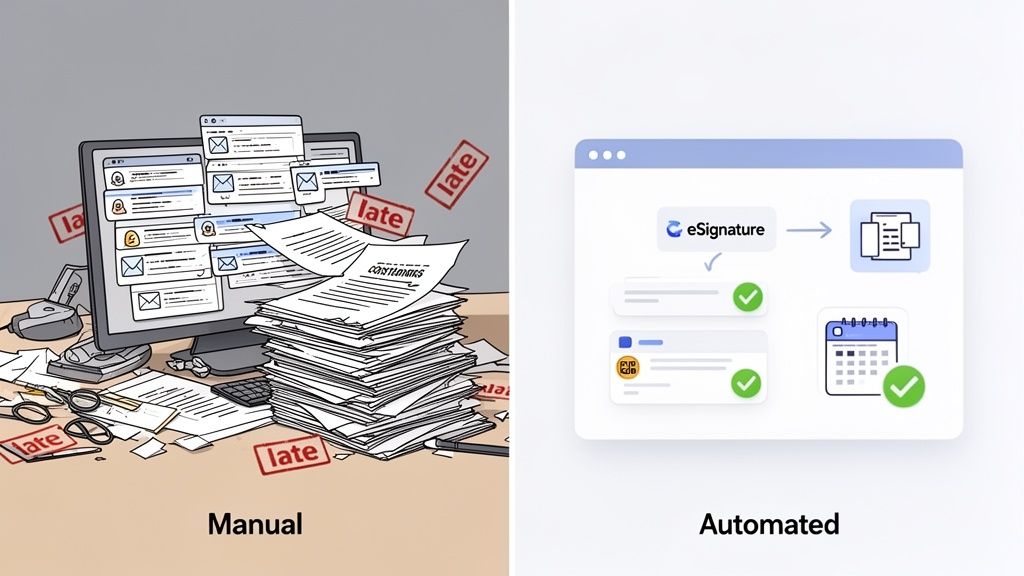
The pain is felt everywhere. Sales teams get stuck waiting for approvals, legal gets buried in low-level admin work, and procurement teams lose their minds trying to figure out which version of a document is the final one. This mess hits the bottom line directly and leaves the company exposed.
Real-World Consequences of Inefficiency
These aren't just hypotheticals. I’ve seen these exact scenarios play out time and again:
- Missed Renewals: A critical vendor agreement for a logistics company auto-renews on terrible terms because the deadline was stuck in someone’s inbox and never flagged.
- Compliance Gaps: A healthcare provider uses an old patient consent form, creating a potential HIPAA violation simply because the latest version was saved on a local drive instead of a central, shared location.
- Version Control Nightmares: A real estate agent sends a client an outdated lease draft, leading to confusion, restarting negotiations, and delaying the whole deal.
Issues like these are precisely why so many businesses are finally moving to dedicated solutions. To really get a handle on the change, it helps to understand what is business process automation and its benefits.
The market reflects this urgency. The global contract management software market hit USD 2.83 billion in 2024 and is projected to nearly double to USD 5.65 billion by 2030. It’s clear that businesses everywhere are getting on board.
Manual vs Automated Contract Workflows at a Glance
To put the difference in perspective, let's look at a side-by-side comparison of the old way versus the BoloSign way. The contrast is stark, showing how automation touches every part of the contract lifecycle.
| Contract Stage | Manual Process (The Old Way) | Automated Workflow (The BoloSign Way) |
|---|---|---|
| Drafting | Copying old docs, finding templates on shared drives. Prone to errors. | Generate contracts from pre-approved, dynamic templates in seconds. |
| Review | Endless email chains, tracking changes in Word, version chaos. | Collaborative redlining in one place. Clear audit trails and version history. |
| Approval | Chasing stakeholders via email or chat for sign-off. Major delays. | Automated, sequential approval workflows notify stakeholders instantly. |
| Signature | Printing, scanning, emailing, or using courier services. Slow and insecure. | Secure, legally binding eSignature with automated reminders. |
| Storage | Scattered across local drives, inboxes, and physical filing cabinets. | A central, searchable, and secure digital repository for all contracts. |
| Renewal | Relying on calendar reminders or spreadsheets, often leading to missed dates. | Automatic alerts for key dates and obligations, ensuring no surprises. |
This table makes it obvious: automation isn't just a minor improvement. It completely overhauls the process, replacing chaos with clarity and control.
The Strategic Shift to Automation
Moving to a platform like BoloSign transforms this entire system from unpredictable to efficient. No more hunting for lost files; you get a single, searchable library for everything. Instead of manually chasing signatures, you can send PDFs for a secure eSignature and let the system handle the follow-ups.
The goal of contract management workflow automation is not just to do the same tasks faster. It's about fundamentally changing how your organization handles agreements to reduce risk, improve visibility, and free up your team for strategic work.
With BoloSign, you can create, send, and sign unlimited documents and templates right away, all for one fixed price. We make powerful AI contract review and automation tech up to 90% more affordable than alternatives like DocuSign, because we believe enterprise-grade tools should be accessible to everyone.
This guide will walk you through exactly how to make this change happen. You'll learn to map your existing processes, build out automated workflows, connect your key systems, and make sure your contracts are always locked down and compliant.
How to Map Your Current Contract Process
Before you can build a powerful automated workflow, you need a clear map of your current journey. Jumping straight into automation without understanding your existing process is like trying to build a house without a blueprint—it’s bound to get messy.
The goal here is to analyze and document your contract lifecycle from the very first request to the final signature. This lets you see exactly where the delays, risks, and frustrations are hiding.
This mapping process isn't about creating complex diagrams. It’s about having honest conversations with the people involved every day. Talk to your sales reps, HR managers, legal counsel, and procurement specialists. Ask them what works, what doesn't, and where they spend most of their time. The insights you gather are the foundation for effective contract management workflow automation.
Identifying Every Touchpoint and Bottleneck
Your first job is to trace the path a contract takes through your organization. Think of it as following a package from shipment to delivery. You need to identify every single stop along the way to get the full picture.
Start by asking these questions:
- Request & Intake: How does a new contract request even begin? Is it a verbal heads-up, a random email, or a formal submission?
- Drafting: Who creates the first draft? Are they using a standard template or winging it from scratch every time?
- Negotiation: How are changes and redlines handled? Is it a chaotic mess of Word documents flying back and forth in endless email chains?
- Approvals: Who needs to sign off on the agreement? Is there a clear sequence, or does it just depend on who’s available?
- Execution: How is the final signature collected? Are you still printing, scanning, and mailing documents in this day and age?
This exercise will quickly reveal your biggest bottlenecks. You might discover that legal approval for a simple non-disclosure agreement takes over a week, or that your sales team is using outdated templates, creating totally unnecessary negotiation cycles.
Turning Your Map into an Actionable Plan
Once you have a visual map of your process, you can start identifying clear triggers for automation. These are the specific events that should kick off an automated action, removing the need for someone to do it manually.
For example, a staffing agency might map its process for onboarding a new contractor. The trigger for automation could be as simple as a new hire’s profile being created in their HR system. That single action could automatically generate a standardized independent contractor agreement from a BoloSign template and send it for an eSignature—no manual steps required.
Similarly, a real estate firm can set a trigger to automatically draft a lease amendment when a tenant's renewal date is 60 days away.
By documenting each step, you're not just creating a flowchart. You're building a business case for change, backed by real-world evidence of where your team is losing time and where your company is exposed to risk.
This is why a staggering 81% of organizations are planning to implement contract automation. The market for solutions that fix these processes is booming, with the contract lifecycle management sector projected to hit USD 3.69 billion by 2032. Businesses in every industry are chasing efficiency, and it all starts with this initial mapping phase. You can read the full research about these contract management trends to see how widespread this shift has become.
Leveraging Templates for Consistency
Your process map will undoubtedly highlight inconsistencies in your documents. This is where a centralized template library becomes a game-changer. With BoloSign, you can create and store unlimited pre-approved templates for all your common agreements, from sales contracts to vendor MSAs.
When you create, send, and sign PDFs online using these standardized templates, you instantly eliminate the risks that come with outdated language or unapproved clauses. Your team can generate a compliant, error-free contract in minutes, knowing it aligns perfectly with your company’s policies.
This simple step turns your process map into a living, breathing workflow that drives consistency and speed across your entire organization. Ready to see it for yourself? Our AI-powered contract review capabilities can take this even further.
Building Your First Automated Workflow
With your process map in hand, it's time to bring that vision to life. This is the exciting part—where you translate your documented steps into a living, breathing automated system. Using a smart platform like BoloSign, you can build a seamless workflow that handles the grunt work, freeing up your team for more strategic tasks.
The great thing about modern contract management workflow automation is you don't need a team of developers. The process is visual and intuitive, centered on setting up simple rules and triggers that mirror your actual business logic. You’re essentially telling the system what to do when something happens, creating a predictable and efficient sequence for every single agreement.
Let's walk through the core components of building a powerful, automated contract workflow from the ground up.
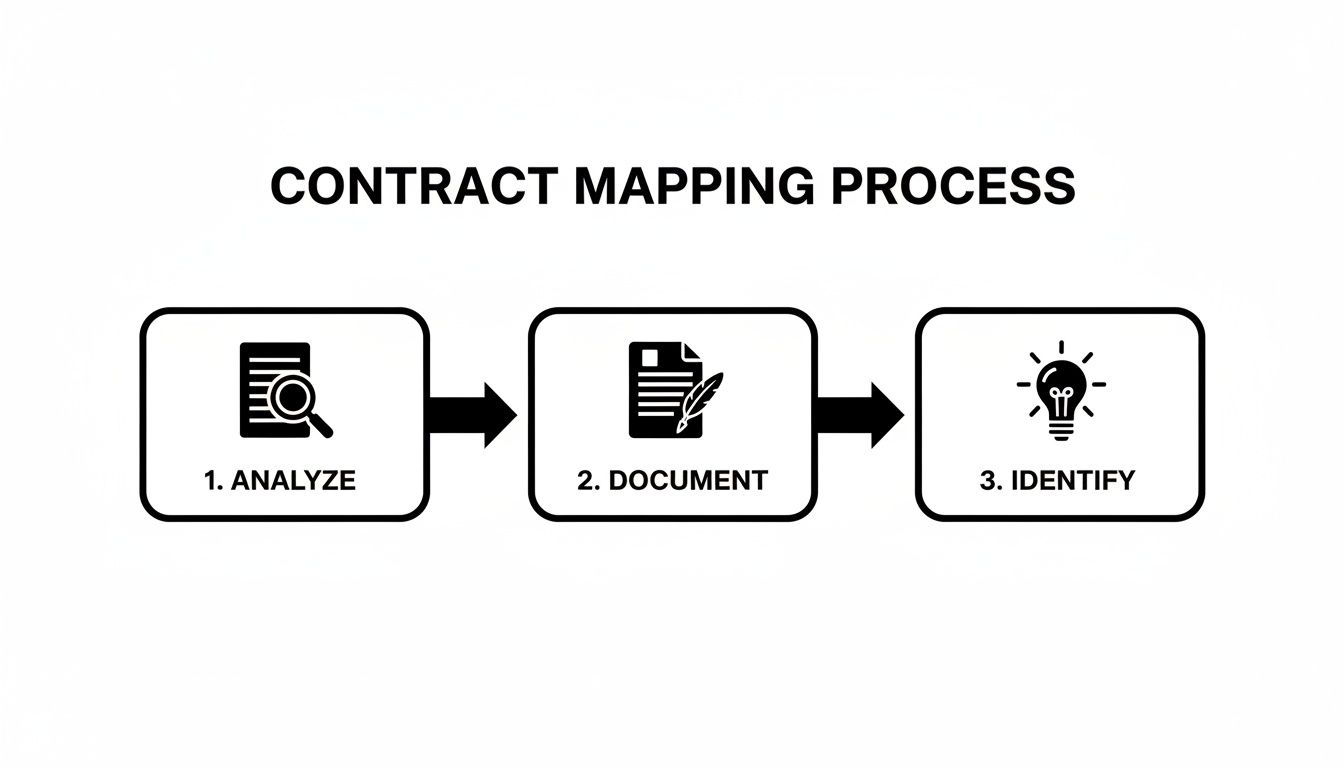
As the diagram shows, a successful system starts with a clear understanding of your current process before you even touch the technology.
Setting Up Dynamic Templates
The foundation of any great automated workflow is a solid library of templates. These aren't just static Word docs; think of them as smart, dynamic documents that can pull data directly from your other business systems, like a CRM or HR platform.
Imagine a consulting firm closes a new deal in their CRM. With an integrated workflow, that single action can automatically tell BoloSign to generate the right Master Service Agreement. The template instantly fills in the client’s name, address, and service details, which eliminates manual data entry and guarantees 100% accuracy.
Setting this up is surprisingly straightforward. Inside BoloSign, you can create and store unlimited templates for all your common agreements. You can even embed a signing field right on your website or add signature to Google Form, creating a truly self-service experience for new clients or employees.
Establishing Rule-Based Approval Chains
Let’s be honest: one of the biggest bottlenecks in any manual process is the approval stage. Chasing down stakeholders for a sign-off is a massive time-waster. Automated, rule-based approval chains solve this problem for good.
You can configure rules that automatically route contracts to the right people based on whatever criteria you set. For instance:
- Financial Thresholds: Any contract with a value over $10,000 gets automatically sent to the legal department for review.
- Contract Type: All sales agreements go directly to the Head of Sales, while new vendor contracts are routed to procurement.
- Geographic Region: Agreements for clients in the UAE are sent to the regional manager for their sign-off.
This ensures every contract follows a compliant, pre-defined path without anyone having to manually forward an email. The system handles all the notifications and reminders, keeping the process moving forward effortlessly. When designing your own systems, it can be a huge help to check out successful workflow automation examples from different industries for inspiration.
Using AI for Smarter Contract Review
Beyond routing and approvals, modern platforms use AI to add another layer of intelligence. BoloSign’s AI contract review feature can automatically scan incoming agreements and flag risky or non-standard clauses.
Think of it as having an extra set of expert eyes on every single contract. The AI can compare a third-party document against your own pre-approved legal playbook and instantly highlight any deviations. For example, if a vendor agreement is missing a critical data privacy clause needed for GDPR compliance, the system will flag it immediately for your legal team’s attention.
By integrating AI-powered automation, you shift from a reactive review process to a proactive risk mitigation strategy. It’s about catching potential issues before they become expensive problems.
This capability is a game-changer for industries handling complex agreements. A university can ensure all faculty contracts include the correct intellectual property clauses, while a logistics company can verify that all shipping agreements meet their insurance requirements.
All of this is accessible through a simple, user-friendly interface. With BoloSign, you get all these advanced features—plus unlimited documents and team members—at a single fixed price, making it up to 90% more affordable than alternatives like PandaDoc.
Integrating Systems for Seamless Data Flow
Real contract management automation doesn't happen in a vacuum. It thrives on connection—tying together the different software you already rely on so that information flows instantly and effortlessly between them. Integrating your contract platform with core business systems like your Customer Relationship Management (CRM), Human Resource Information System (HRIS), or Enterprise Resource Planning (ERP) is an absolute game-changer.
This is how you eliminate the soul-crushing task of manual data entry. Not only is it slow, but it's also a major source of expensive errors. By connecting your systems, you create a single source of truth where data is consistent, accurate, and always up-to-date across your entire tech stack.
From Closed Deal to Signed Contract in Minutes
Let's look at a real-world example that I see all the time. Imagine a sales rep at a professional services firm closes a new deal in their CRM, whether it’s HubSpot or Salesforce. Without integration, that rep has to stop everything, find the right contract template, and then manually copy-paste the client’s name, address, deal value, and service terms. It’s tedious, and a single typo could derail the entire deal.
With an integrated system, the moment that deal is marked "Closed-Won" in the CRM, it kicks off an entire workflow. This single action can automatically:
- Generate the Contract: BoloSign instantly creates the correct service agreement from a pre-approved template.
- Populate Key Details: All client and deal info from the CRM is pulled directly into the contract fields, ensuring 100% accuracy.
- Initiate the Signing Process: The final agreement is automatically sent to the client for a secure eSignature, without the sales rep ever leaving their CRM.
This seamless data flow puts deal cycles on fast-forward, getting you to revenue faster while giving your new client a polished, professional experience right from the start.
Automating the Employee Onboarding Journey
This same principle is just as powerful for human resources. Think about a busy staffing agency that needs to onboard new contractors quickly to meet client demands. The moment a new hire is added to the agency's HRIS, an integrated workflow can take over.
BoloSign can automatically generate and send a complete onboarding packet, including the employment agreement, NDAs, and policy acknowledgments. The new hire can sign PDFs online from any device, and all signed documents are automatically filed back into their employee record. This removes administrative bottlenecks, guarantees compliance from day one, and frees up the HR team to focus on the human side of their work.
The real power of integration lies in making your technology work for you, not the other way around. It connects otherwise separate systems to create one unified, automated process that saves time, cuts down on risk, and gives you total visibility.
Unlocking Your Entire Tech Stack with BoloSign
To make this happen, you need a platform built with robust integration in mind. BoloSign offers powerful tools, including a flexible Document Signing API and embeddable components, that empower businesses to connect their entire tech stack. Maybe you're a logistics company linking your ERP to automate vendor agreements, or perhaps you're a real estate agency connecting your property management software—the possibilities are endless. Effective integration is a core part of building a centralized and secure system. For more on this, check out our guide to effective contract repository management.
With BoloSign, you get these enterprise-grade integration features as part of our straightforward, fixed-price model. Unlike providers like DocuSign or PandaDoc that charge a premium for these critical connections, we include unlimited documents, templates, and team members. This makes powerful automation up to 90% more affordable.
Fortifying Compliance and Security with Automation
A fast, streamlined workflow is fantastic, but if it isn’t secure and compliant, you’re building on a shaky foundation. True contract management workflow automation has to do more than just accelerate your processes; it needs to fortify your business against risk.
This is where a secure, compliant platform becomes your organization's greatest defense.
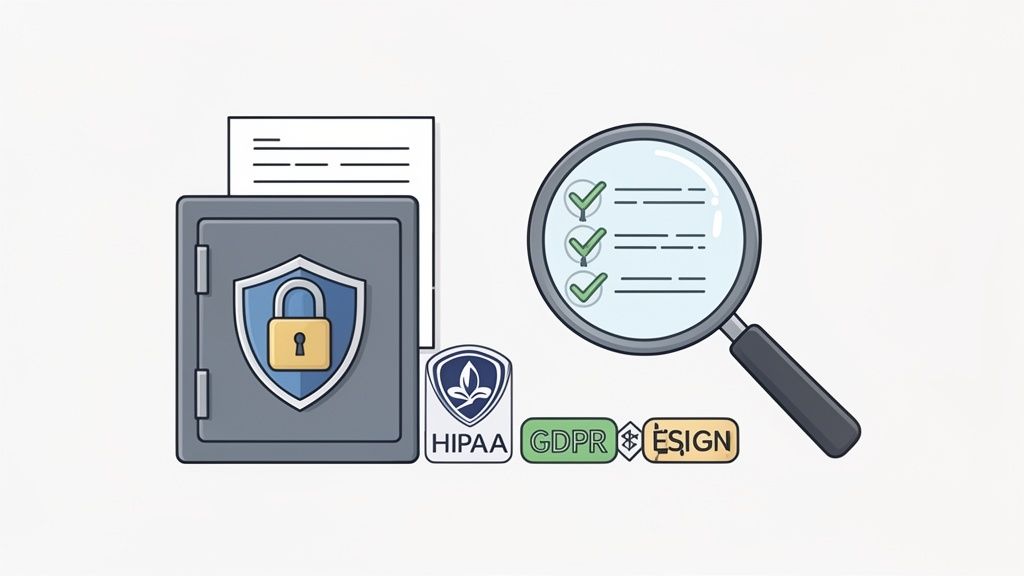
Without automation, compliance is often a manual, hope-for-the-best effort. With a system like BoloSign, it’s built directly into every step of the contract lifecycle. You get the peace of mind that comes with enterprise-grade security and adherence to global standards.
Meeting Strict Regulatory Requirements
Organizations today operate under a complex web of regulations. Whether you're a healthcare provider in the US, a staffing agency in the EU, or a professional services firm in the UAE, staying compliant is non-negotiable. An automated system is designed to help you meet these obligations head-on.
BoloSign is built to support adherence to major global standards, including:
- ESIGN & eIDAS: Ensuring your electronic signatures are legally binding and recognized in the United States and the European Union.
- HIPAA: Providing the necessary security and privacy controls for healthcare providers managing patient consent forms and business associate agreements.
- GDPR: Offering tools to manage data privacy and consent for contracts involving EU citizens.
For instance, a clinic using BoloSign to sign PDFs online for patient intake can operate confidently, knowing the platform’s security protocols are designed to be HIPAA-compliant. This removes the guesswork and risk that come with less secure methods like email.
A centralized, automated system transforms compliance from a daunting manual checklist into an integrated, always-on function. It’s about creating a single source of truth that is both efficient and defensible.
This intense focus on security is driving major market growth. The contract automation software market hit USD 2.332 billion in 2022 and is expanding rapidly as businesses prioritize scalability and security. Large enterprises in North America, handling increasingly complex agreements, are a huge part of this trend.
How Automation Creates an Ironclad Audit Trail
One of the most powerful security features of an automated system is the comprehensive audit trail. Every single action taken on a contract—from the initial draft to the final eSignature—is automatically logged with a timestamp and user details.
This creates an unchangeable record that is crucial for audits and dispute resolution.
Imagine a dispute arises over a vendor agreement. Instead of digging through months of emails to piece together the negotiation history, you can pull up a complete, detailed log in seconds. This trail shows:
- Who viewed the document and when.
- Every change that was made during redlining.
- The exact time and date of each approval and signature.
This level of transparency is nearly impossible to achieve with a manual process and is essential for demonstrating due diligence. You can learn more about how this supports your business by exploring our guide on what is contract compliance.
Proactive Risk Mitigation with AI
Modern platforms go beyond simply tracking actions; they proactively help you mitigate risk before a contract is even signed. BoloSign’s AI contract intelligence acts as a first line of defense, automatically scanning agreements to flag non-standard clauses or missing terms.
If a supplier sends over an agreement that lacks a crucial liability clause from your playbook, the AI will highlight it instantly. This allows your legal team to address potential issues before they become binding obligations, protecting your business from costly errors and future legal battles.
This entire security framework is backed by enterprise-grade certifications like SOC 2 and ISO 27001, giving you ultimate confidence in the integrity of your contracts. At BoloSign, this level of security isn't an expensive add-on; it's a core part of our affordable, fixed-price promise.
Measuring and Optimizing Your Automated Workflow
Alright, so you’ve automated your contract workflow. That’s a huge step, but the work isn’t over. A common mistake is treating this as a “set it and forget it” project. How do you actually know if all that effort is paying off?
This final piece of the puzzle is all about measuring what matters and using that data to keep improving. By tracking the right key performance indicators (KPIs), you can shift from just automating tasks to truly optimizing your entire contract lifecycle. This isn't about getting lost in spreadsheets; it’s about pulling clear, actionable insights straight from your platform to turn a good workflow into a great one.
Defining Your Key Performance Indicators
To actually see your success in numbers, you need to focus on metrics that reflect speed, efficiency, and risk reduction. Your platform’s dashboard should be your single source of truth, giving you a real-time view of these critical numbers.
Here are a few essential KPIs I always recommend teams start with:
- Contract Cycle Time: This is the big one. It’s the total time from the moment a contract is requested to the final eSignature. If this number is steadily shrinking, you're on the right track. It’s the clearest sign that you’re becoming more efficient.
- Approval Turnaround Time: Where are the bottlenecks? This metric tells you exactly how long each stage takes. If you see agreements consistently getting stuck with a specific department—ahem, legal or finance—you know precisely where to focus your efforts.
- Clause Deviation Rates: Keep an eye on how often non-standard language is being added to your contracts. A high rate here could mean your templates aren’t hitting the mark or that your team needs a bit more training on when to stick to the script.
- Renewal Success Rate: Are you catching renewals in time to renegotiate better terms, or are they slipping through the cracks? This metric has a direct and immediate impact on your bottom line.
Turning Insights into Action
Data is worthless if you don’t do anything with it. The analytics inside a platform like BoloSign are designed to help you spot these friction points and sharpen your processes on the fly.
For example, I’ve seen countless teams discover that standard NDAs are consistently held up during legal review. This is a dead-simple fix. The data is practically screaming at you to create a pre-approved, "no-touch" template. This empowers your business teams to generate and sign PDFs online for routine agreements without roping in a lawyer every single time, freeing up your legal counsel for much higher-value work.
Another classic scenario involves sales contracts. If you notice a high rate of redlining around payment terms, it’s a clear signal to update your standard template with clearer, more flexible options. Making a proactive adjustment like this can dramatically shorten your negotiation cycles.
By measuring and optimizing, you create a powerful feedback loop. The data shows you what's working and what isn't, empowering you to make small, continuous improvements that lead to significant gains in speed and compliance over time.
This is how you bring the entire story full circle. You move from chaotic, manual processes to a data-driven system that gets smarter with every contract. You can finally show, with hard numbers, the benefits of speed and efficiency in a way that gets the whole organization on board.
With BoloSign, these powerful analytics are built right in. You get unlimited documents, templates, and team members at one fixed price, making our digital signing solutions up to 90% more affordable than alternatives like DocuSign or PandaDoc.
Make Contract Automation Simple and Affordable
Making the switch to an automated system doesn't have to be complicated or expensive. With the right partner, you can streamline your workflows, ensure compliance, and free up your team to focus on growth—all without breaking the budget. BoloSign was designed to make powerful contract automation and AI-powered intelligence accessible to everyone.
Instead of complex pricing tiers that penalize you for growing, we offer one simple plan: unlimited documents, unlimited templates, and unlimited team members for a single fixed price. This makes BoloSign up to 90% more affordable than platforms like DocuSign or PandaDoc, while delivering the enterprise-grade security and features you need.
You can create, send, and sign PDFs online instantly, integrate with your favorite tools, and leverage AI to review contracts in minutes.
Ready to see how an affordable, unlimited platform can transform your contract management? Start a 7-day free trial of BoloSign and experience the benefits firsthand.

Paresh Deshmukh
Co-Founder, BoloForms
2 Feb, 2026
Take a Look at Our Featured Articles
These articles will guide you on how to simplify office work, boost your efficiency, and concentrate on expanding your business.