

Contract Approval Policy: A Step-by-Step Guide for 2026
Build a contract approval policy with risk tiers, approval workflows, clause checks and e-signature compliance. Steps, sample language and tools included.

Tired of nonsense pricing of DocuSign?
Start taking digital signatures with BoloSign and save money.
A manager asks who signed off on a rate change, a longer notice period, or a vendor's new payment terms, and nobody can answer without searching old emails. That's the true test of a contract approval policy. It isn't a list of senior names. It's a routing system that decides, before anyone signs, which agreements need a quick business check, which need legal and finance, and which can never move without executive approval.
When that routing is clear, low-risk work moves fast and high-risk commitments get proper scrutiny. When it isn't, you get both problems at once, delays on routine paperwork and weak control over the contracts that matter most.
Map Risk Tiers and Who Approves Each
Say a staffing agency sends a temporary placement agreement with a changed rate card. The client signs it, finance invoices at the old rate, and the discrepancy surfaces a month later. The document itself isn't unusual. The failure is simpler, nobody can show who approved the new pricing.
A tiered system prevents that by classifying the agreement before review starts. Capture business owner, counterparty, contract value, term, data access, jurisdiction, non-standard clauses, and renewal obligations at intake. Those fields, not the requester's urgency, set the route.
Approval Tiers by Contract Risk
| Risk tier | Typical agreements | Who approves | Evidence to keep |
|---|---|---|---|
| Low | Standard NDA, approved-template placement or order form, no changes | Business owner | Template ID and approval timestamp |
| Medium | Template deviations on pricing, payment terms, data access or auto-renewal | Business owner, legal and finance | Redline history and reviewer comments |
| High | Unlimited liability, indemnities, healthcare business associate agreements, multi-year or material commitments | Legal, finance and executive or board | Signed approval record and board or delegation reference |
| Amendments and renewals | Change orders, extensions, price increases | Same tier as total contract value after the change | Version log linking each amendment to the original |
Low-tier work should be boring by design. If a real estate team uses an approved lease template without changes, or a trainer issues a standard enrollment form, the business owner checks the commercial facts and it moves. Adding legal to every one of those only teaches staff to work around the process.
Medium tier starts when wording or money changes. A logistics customer asking for extended payment terms, a professional services client changing data access, or that staffing rate card all need a second pair of eyes, because the risk sits in the deviation. If you're also vetting a new supplier or delivery partner at this stage, a practical outsourcing due diligence guide helps you check the counterparty before the approval route is even set.
High tier is for exposure you can't unwind easily, long commitments, broad indemnities, regulated healthcare agreements, anything material to the business. Governing-body review should stay a minority route. The City of Durham contract approval thresholds review found that in Spring 2024, 93 of 419 contracts reviewed, 22%, required City Council approval. That's a useful shape to copy, senior oversight concentrated where the value and risk sit, not spread across every file.
Amendments get re-tiered on total contract value after the change, never on the size of the increment alone. A small extension to a large agreement is still a large agreement.
Start here: List your five most common contract types, assign each a tier and a default approver, and note what pushes it up a tier.
That one page does most of the work. It's also the foundation for wider contract compliance, since you can't audit approvals you never defined.
How to Write the Policy in Six Steps
Write the policy so a new employee can apply it without asking anyone. If a step relies on tribal knowledge, it isn't finished.
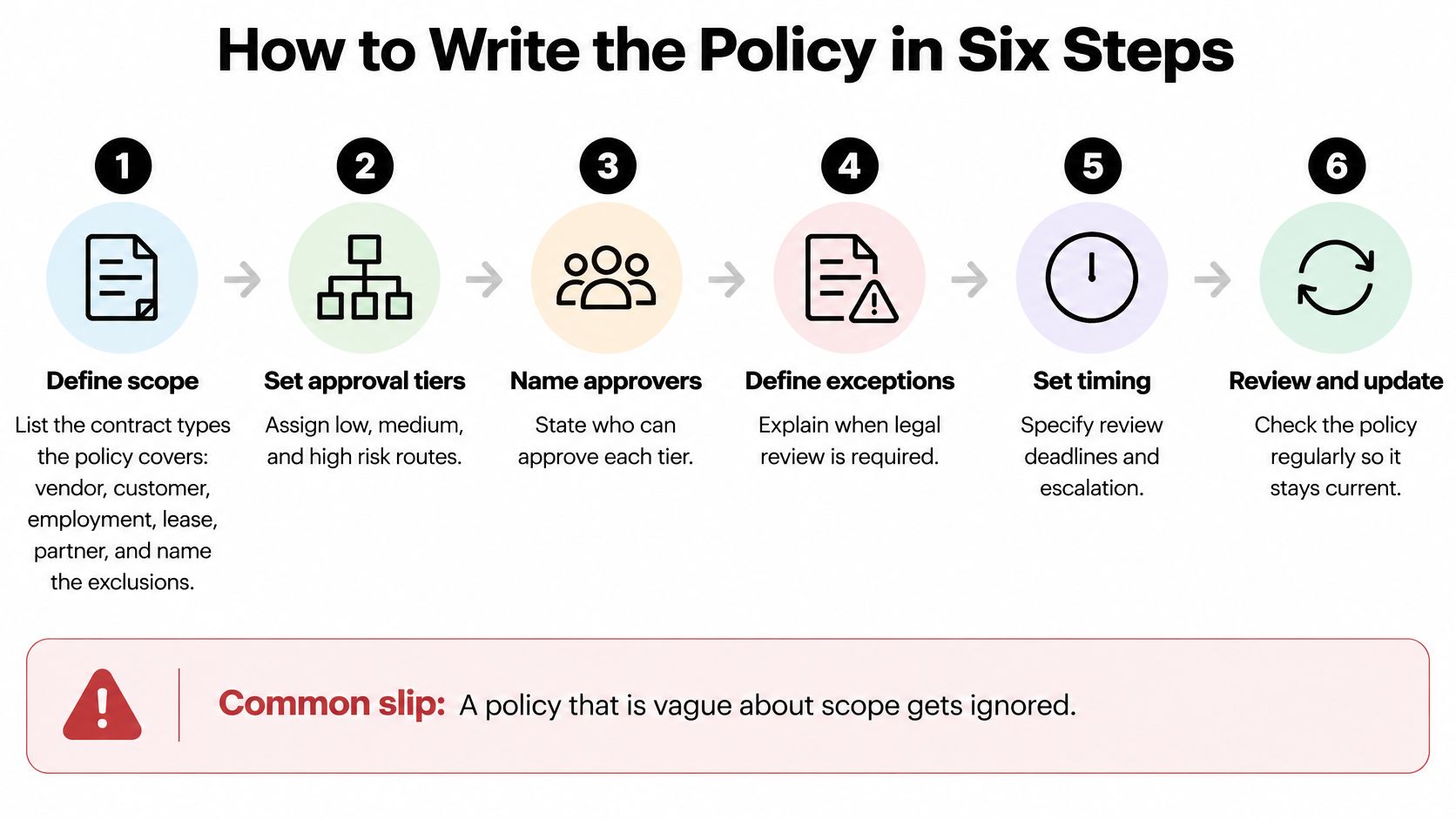
Steps 1 to 3 Scope Roles and Thresholds
Define scope: List what the policy covers, vendor, customer, employment, lease and partner agreements, and name the exclusions. Don't leave out purchase orders and statements of work, because that's where uncontrolled commitments hide. A clinic that covers vendor contracts but not service statements of work has a gap, not a policy.
Assign roles: Name the requester, reviewer, approver and signer for each contract type. No one approves a request they made, and the negotiator doesn't sign off on their own deal. In a small real estate office that separation can be one extra person, but it still has to exist.
Set thresholds: Tie monetary and risk triggers to total contract value, annual spend and renewal value, not just the first-year amount. A three-year logistics agreement priced by year one will always look smaller than it is.
Use public benchmarks as a starting calibration, then adjust to your own spend. A 2025 benchmarking survey of public agencies reported the median thresholds below, with wide dispersion across agencies.
| Threshold level | Median value | Source note |
|---|---|---|
| Small or micro purchase | $7,000 | 2025 public agency benchmark |
| Informal purchase requiring multiple quotes | $25,000 | 2025 public agency benchmark |
| Formal procurement such as RFP or invitation to bid | $50,000 | 2025 public agency benchmark |
| Governing-body approval for commodities | $181,880 | 2025 public agency benchmark |
| Governing-body approval for services | $191,160 | 2025 public agency benchmark |
The reason to tier thresholds is visible in a South Florida Water Management District redesign, where the governing board approved 52% of all contracts, representing 96% of total contract expenditures, and raising the board threshold to $300,000 would have meant the board approved only 13% of contracts while retaining control over 75% of contract expenditures. Fewer files, same grip on the money.
Steps 4 to 6 Workflow Templates and Enforcement
Map the workflow: Set the stage order, a target turnaround per tier, and what happens when a task goes overdue. If you document this once as a clean sop, new approvers follow the same sequence instead of inventing their own.
Set template and clause rules: List approved templates, fallback wording staff may accept without escalation, and red-flag clauses that always trigger legal review. A healthcare team should never have to guess whether a changed data clause is acceptable.
Define enforcement: Write the exception path, the audit evidence each approval must leave, and a review date, for example every six months. Delegated authority drifts as people change roles, so a policy without a review date goes stale.
A finished policy reads in about ten minutes. If yours needs a meeting to interpret, shorten it and move the detail into the tier table.
Build the Approval Workflow and Fix Bottlenecks
The most common symptom is a contract sitting in someone's inbox for two weeks while the customer waits. The fix usually isn't chasing harder. It's removing approvers who never needed to be there and validating the request before it reaches a human.
Sequential routing means the draft goes to each approver in turn and the next step starts only when the current one finishes. That order matters for accountability, but every extra person in the chain adds their own queue. Route by tier, and add only the approvers that tier requires.
Validate First Then Route the Exception
Build a controlled straight-through path for routine, within-policy agreements. Check requester and supplier data, budget, approved vendor status, template use, delegated authority, sanctions and privacy requirements, and whether the contract matches the request. Auto-approve only when every rule passes. If one fails, send that precise exception to the function accountable for it, finance for budget, legal for clauses, and log the result.
The gap between routing and validation is where unauthorized spend slips through. Benchmarking on purchase requisition automation reports that 68% of organizations automate approval routing, but only 52% automate budget or policy checks at the point of request, and that organizations without automated intake have 18-22% of spend bypassing approved intake, compared with about 5% where automated checks evaluate budget and contract alignment. A fast workflow with no checks just moves bad approvals faster.
| Symptom | Likely cause | Fix |
|---|---|---|
| Approvals stall for more than a week | Too many approvers added to every contract | Route by tier and add only the approvers that tier requires |
| Approval exists only as an email reply | No system of record for decisions | Require approval inside the workflow with a timestamp |
| Overdue tasks sit unnoticed | No reminder or escalation rule | Send automatic reminders and escalate after the tier's target turnaround |
Approval has to happen inside the workflow, attributable and time-stamped. An email saying looks good doesn't show which version was approved, and it's close to impossible to audit later. If finance still reconciles spend manually after approval, a simple way to track receipts and payments in Excel can at least tie the approved amount to what was paid while you improve the system.
Set a target turnaround per tier and measure against it. For scale, the City of Toronto procurement metrics report that in 2025 the period from receipt of a procurement recommendation to award through purchase-order issuance averaged 35 working days, including legal agreements and approvals. Your low tier should be nowhere near that, and if it is, the data tells you before staff start bypassing it. Good contract management workflow automation makes those targets visible instead of anecdotal.
Reminders and escalation rules take a day to fix. Re-tiering a contract type takes a quarter, so start with the reminders.
Track median approval time, rework rate, exception frequency and policy-bypass rate. Those four numbers tell you whether you're speeding up safely or just speeding up.
Clause Checks, Aggregation and Exception Rules
Adding more approval layers can increase risk. When escalation routes are unclear, staff get shadow approvals, sign first and reconcile later, or split work into pieces that fit under a limit. Clear clause triggers and aggregation rules do more for control than one more approver.
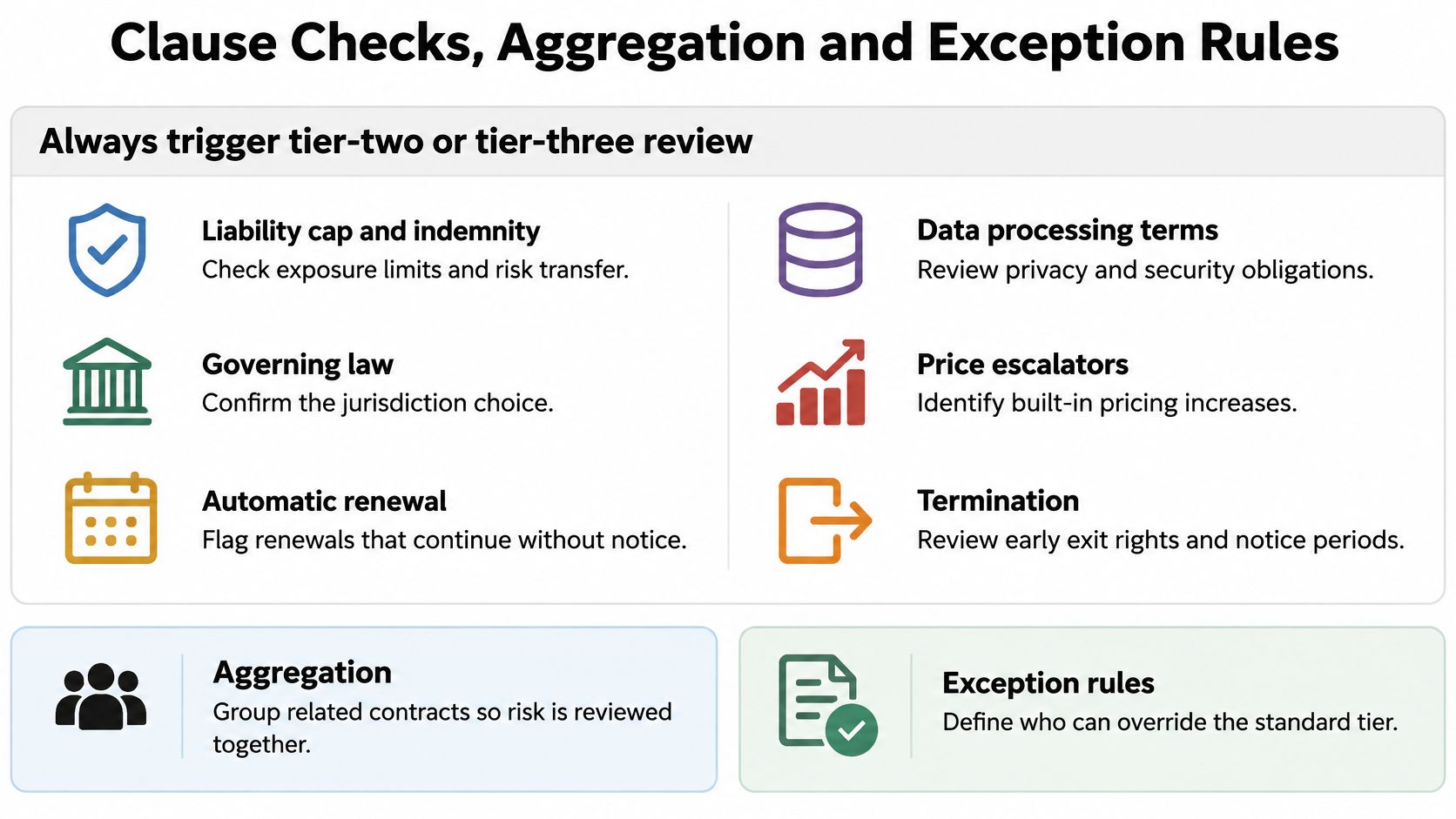
Clauses That Always Escalate
- Liability cap and indemnity: These set your maximum exposure and who pays when something goes wrong.
- Governing law: A foreign jurisdiction changes where and how you'd enforce the agreement.
- Automatic renewal: A quiet renewal clause can extend a vendor commitment for years without a fresh decision.
- Data processing terms: These carry privacy and security obligations your business has to perform.
- Price escalators: Built-in increases change the effective value of the deal over its term.
- Termination for convenience: Weak exit rights lock you into an underperforming supplier.
- Non-solicitation: In staffing and professional services, this can restrict who you're allowed to hire or place.
Any one of these should push the agreement to medium or high tier, regardless of its headline value.
Aggregation and Exceptions
State plainly whether your threshold applies to total contract value, annual spend, renewal value or expected lifetime value, and how related purchase orders, statements of work and amendments are grouped. A logistics company placing many small carrier orders with one provider, a clinic extending a service agreement through repeated amendments, or a staffing firm splitting one placement into smaller agreements can all stay under a threshold on paper while the commitment grows well past it.
Governance guidance on delegation of authority identifies segregation of duties, aggregation rules, written exception paths, and explicit treatment of unauthorized commitments as core controls. That's the part most policies skip, and it's exactly where audits find problems.
For emergencies, name who may approve a deviation, set a fixed window such as 30 days, and require retrospective review with full audit evidence before that window closes. If someone signs without authority, log it, review whether the commitment stands, and fix the delegation or the training that allowed it. Don't back-date an approval, because that converts a process failure into a records problem.
Review the delegation matrix whenever roles change. Authority tied to a person who left six months ago isn't control, it's a delay waiting to happen.
Sample Policy Language and AI Drafting Rules
Short clauses beat long policy prose. Adapt the five below with counsel before use, then change the bracketed parts to match your business.
1. Purpose and scope: This policy applies to all vendor, customer, employment, lease and partner agreements, including purchase orders, statements of work, amendments and renewals.
Change the list to your real contract types, and name anything you deliberately exclude.
2. Approval authority: Each risk tier has named approvers and written delegated limits. No agreement may be signed above the signer's delegated limit.
Attach your tier table to this clause so the limits live in one place.
3. Separation of duties: No person may approve a contract they requested or negotiated, and no person may approve their own request.
In a very small team, name the fallback approver now rather than during a deadline.
4. Exceptions: A deviation may be approved only by the named exception approver, lasts no longer than the stated window, and requires retrospective review with evidence recorded in the contract file.
Set the actual window and review deadline, or exceptions become permanent.
5. AI-assisted drafting: AI tools may format documents, compare clauses and flag risk. Changes to liability, data processing, governing law, healthcare obligations or automatic renewal require human legal or business approval before use.
That last clause needs operating rules behind it, approved data sources, confidentiality limits, version and prompt logging, and a named person accountable for every accepted suggestion. Use the phrase AI contract review for the step where AI-flagged risks get routed to legal, and point it at the same trigger list as your clause checks so the policy keeps one source of truth.
The pressure to move faster is real. The IntelAgree 2026 CLM trends report found 81% identified faster contract cycles as a priority, while 25.9% specifically identified standardized approval workflows as a leading risk-reduction opportunity. Both findings point the same way. AI speeds approvals only when templates and approval paths are already standardized, otherwise it automates inconsistent decisions at greater speed.
Put the five clauses in a shared document and have legal and one business owner each mark the lines they'd change. You'll find the disagreements quickly, and resolving them on paper is cheaper than resolving them on a live contract.
E-Signature Compliance for Approved Contracts
Approval and signature are different controls. Approval records who agreed internally. The eSignature executes the agreement with the counterparty, and your policy should state which signing method each tier requires.
In the United States, the ESIGN Act provides that an electronic signature, contract or record cannot be denied legal effect, validity, or enforceability solely because it is electronic. It doesn't remove other obligations, so your policy still needs to state when electronic delivery is permitted, how consent is captured, and when notarization, acknowledgment or special record retention applies. For staffing agreements, healthcare vendor contracts, leases and logistics documents, though, you can create a PDF or reusable form, send it for electronic signing, and keep the completed record without printing anything.
For cross-border work, the European Commission eSignature guidance explains that a qualified electronic signature has the equivalent legal effect of a handwritten signature throughout the EU, within the eIDAS levels of simple, advanced and qualified. Match the method to risk, standard eSignature with a full audit trail for low-tier templates, stronger authentication for high-value or cross-border agreements.
Healthcare needs its own line in the policy. U.S. Department of Health and Human Services HIPAA guidance states that no HIPAA-specific electronic-signature standards currently exist, and an electronic business associate agreement must create a legally binding contract under applicable state law. So don't just label a workflow HIPAA-compliant. State who may approve a business associate agreement, how the signer is authenticated, where the record is kept, and who can access protected information. Add GDPR where data processing terms apply, and confirm local signing rules for Canada, Australia, New Zealand and the UAE before you reuse a U.S. workflow there.
When you assess any vendor, ask for evidence rather than logos. Our compliance marks include ISO 27001:2022, SOC 2 Type I, SOC 2 Type II, eIDAS, ESIGN Act, UETA, GDPR, CCPA, and HIPAA, which is the kind of list your legal team should verify for any digital signing solution. Align retention periods with those commitments and with your own record schedule, and check your approach against electronic signature best practices before rollout.
Ask legal three questions. Which agreement types need stronger authentication, which need consent records for electronic delivery, and how long must the signed record and audit trail be retained?
Roll Out Your Approval Policy in BoloSign
A policy only works if each contract reaches the right people, in the right order, with a clear route for exceptions. Start by turning each risk tier into a template workflow. Template Workflows can auto-populate key fields in pre-approved templates, while custom approval rules route contracts by deal size, role, or type.
The screenshot below shows how routing looks once your tiers and approvers are set.
Define who drafts, who reviews, and who signs. BoloSign sends the draft to each approver in turn, and the process does not move forward until every step is completed. Each reviewer receives a notification and can comment or request edits. Automated reminders help prevent approvals from becoming bottlenecks.
Use the walkthrough to understand the sequence, then pilot the workflow with three contracts from different tiers, such as a staffing agreement, a healthcare vendor contract, and a logistics or real estate document. Run the pilot in one department, check that each contract reaches the intended approvers, and adjust the routing before expanding. If a contract needs urgent handling, define who can authorize that exception and how the normal approval sequence will resume.
Set up your first tiered template workflow in BoloSign. Route contracts by deal size, role, or type, and use reviewer notifications and automated reminders to keep each approval step visible.

Paresh Deshmukh
Co-Founder, BoloForms
4 Nov, 2026
Take a Look at Our Featured Articles
These articles will guide you on how to simplify office work, boost your efficiency, and concentrate on expanding your business.