

The Ultimate Commercial Real Estate Closing Checklist for a Smooth Transaction
Use the commercial real estate closing checklist to streamline your transaction, stay compliant, and close with confidence.

Tired of nonsense pricing of DocuSign?
Start taking digital signatures with BoloSign and save money.
Closing a commercial real estate deal is a high-stakes process involving dozens of critical documents, strict deadlines, and complex legal requirements. A single overlooked detail can lead to costly delays, legal disputes, or even the collapse of the entire transaction. This is where a comprehensive commercial real estate closing checklist becomes your most valuable asset, guiding you through every step from due diligence to post-closing handovers.
However, managing this intricate process with outdated tools like manual email chains and disconnected spreadsheets introduces unnecessary risk and inefficiency. This guide not only breaks down the essential checklist items but also demonstrates how modern tools can transform this complex workflow. For instance, using an eSignature platform like BoloSign allows real estate firms to create, send, and sign PDFs and closing documents instantly. This accelerates approvals from all parties, from vendor management teams to property developers, and ensures every signature is legally binding and compliant with ESIGN, eIDAS, and other global standards.
Before you start checking items off your list, understanding what is due diligence is crucial to mitigating risks and ensuring a smooth transaction. Our checklist provides a structured framework to navigate this phase with confidence. By leveraging AI-powered automation and a secure digital signing solution, you can streamline document management, accelerate approvals, and ensure every signature is fully compliant. Let’s dive into the eight critical checkpoints that will ensure your next commercial real estate closing is smooth, efficient, and successful.
1. Title Review and Commitment Letter Verification
At the core of any commercial real estate transaction is the absolute certainty of ownership. Title review is the critical due diligence step where the buyer, with their legal counsel, scrutinizes the property's ownership history to ensure the seller can legally transfer a "clear and marketable" title. This process confirms the property is free from undisclosed liens, encumbrances, or other claims that could jeopardize the buyer's rights after closing. The culmination of this investigation is the title commitment, a formal document from a title insurance company outlining the terms under which it will issue a title insurance policy.
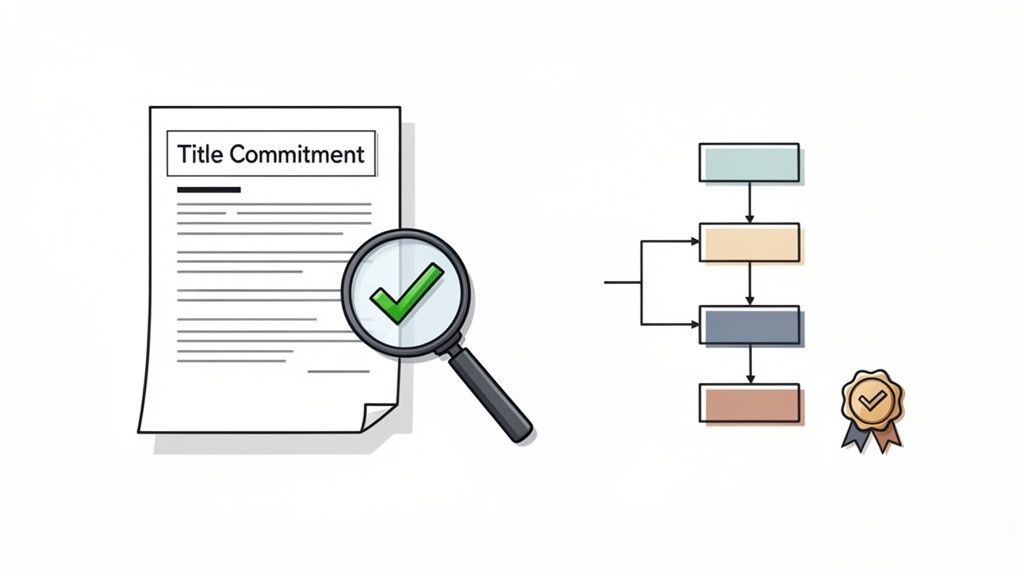
This step is non-negotiable in a commercial real estate closing checklist because it protects your investment from costly future disputes. Failing to identify a title defect before closing can lead to legal battles, diminished property value, or an inability to develop the property as planned. The title commitment letter serves as a roadmap, detailing any "exceptions" or issues that must be resolved before the title policy is issued.
Real-World Scenarios
- Industrial Property: A title search for an industrial warehouse reveals an old environmental lien from a previous owner's contamination incident. This lien must be formally released and cleared before the transaction can proceed, protecting the new owner from liability.
- Retail Shopping Center: During due diligence for a shopping center, the title commitment uncovers a restrictive utility easement cutting directly through an area designated for a future parking lot expansion. The buyer must then negotiate with the utility company to relocate the easement or decide if the limitation is a deal-breaker.
Actionable Tips for a Clean Title Transfer
- Start Early: Request the title commitment at least 30-45 days before the scheduled closing. This buffer is crucial for identifying and resolving complex issues without delaying the transaction.
- Engage Legal Counsel: Never review title exceptions alone. An experienced real estate attorney can interpret complex legal language, identify potential risks, and advise on the best course of action for clearing exceptions.
- Centralize Document Management: A single, secure repository is vital for managing title documents, attorney correspondence, and exception clearance notices. Use a digital signing solution like BoloSign to manage, send, and track all title-related documents for signature. This creates a clear, auditable trail and ensures all stakeholders are working from the same version.
- Clarify Responsibilities in the PSA: The Purchase and Sale Agreement (PSA) should explicitly state which party is responsible for the cost and effort of clearing specific title exceptions. This prevents last-minute disputes over who pays for what.
2. Environmental Assessment and Phase I/II Compliance
Beneath the surface of a commercial property can lie significant environmental risks and liabilities that are invisible to the naked eye. An environmental site assessment (ESA) is a crucial due diligence step to uncover potential contamination from past or present activities, such as hazardous material spills, underground storage tanks, or asbestos. The process typically begins with a Phase I ESA, which involves historical record reviews, site inspections, and interviews to identify any recognized environmental conditions (RECs). If RECs are found, a more invasive Phase II assessment, involving soil and groundwater testing, may be required.
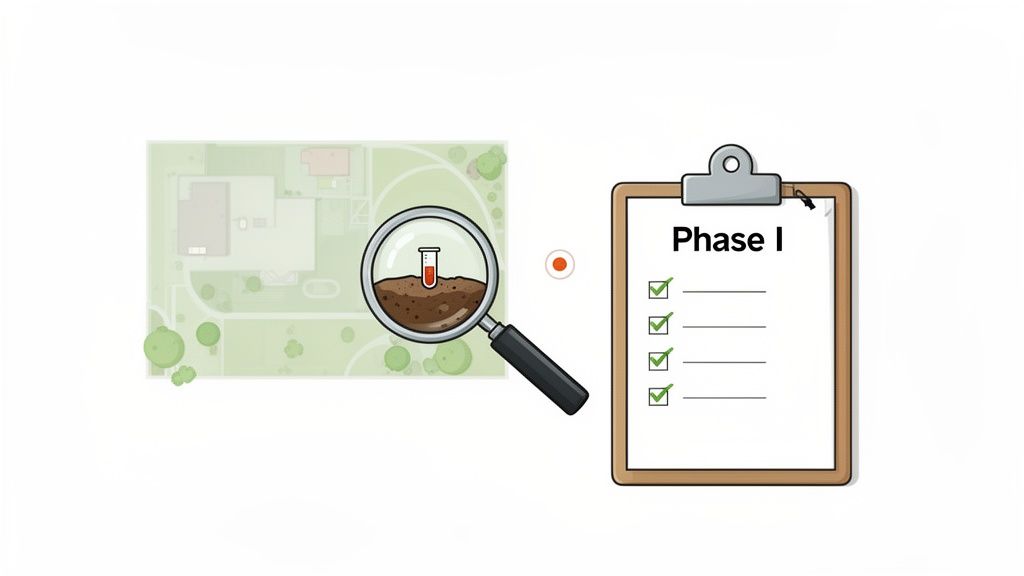
This step is an indispensable part of any commercial real estate closing checklist because it protects the buyer from inheriting costly cleanup responsibilities and potential legal liabilities that can run into millions of dollars. Failing to perform a thorough ESA can lead to regulatory fines, diminished property value, and severe limitations on future development or financing. The Phase I report is your first line of defense, providing a professional opinion on the environmental health of the asset and guiding the decision to proceed, renegotiate, or terminate the deal.
Real-World Scenarios
- Former Gas Station: A Phase I ESA for a property slated for retail development reveals historical records of underground fuel storage tanks. This finding triggers a mandatory Phase II assessment, which confirms soil contamination. The buyer then negotiates a price reduction to cover the remediation costs before closing.
- Manufacturing Facility: During due diligence for an older industrial plant, the Phase I report identifies the historical use of heavy metals and solvents. A subsequent Phase II investigation is required to test soil and groundwater, ensuring the property complies with current environmental standards before the new owner takes possession.
- Flood-Prone Commercial Lot: An assessment for a property in a designated flood zone addresses not just contamination but also the potential for mold and water-related damage. The findings influence the buyer's insurance requirements and long-term property management strategy.
Actionable Tips for Environmental Compliance
- Order the Phase I ESA Early: Initiate the Phase I assessment as soon as you are under contract, ideally within the first 10-15 days of your due diligence period. This provides ample time for a potential Phase II investigation without derailing your closing timeline.
- Engage Qualified Professionals: Only hire a reputable and insured environmental consulting firm with extensive experience in the specific property type and region. Verify their credentials and ask for sample reports.
- Centralize Environmental Reports: Use a secure platform like BoloSign to manage all environmental reports, consultant communications, and regulatory correspondence. Creating a centralized, auditable trail is critical for demonstrating compliance and managing liability. With unlimited documents at a fixed price, you never have to worry about storage limits.
- Define Remediation Responsibility: The Purchase and Sale Agreement (PSA) must clearly define which party is responsible for the costs of any required environmental remediation. This should be negotiated upfront to prevent disputes.
- Budget for Contingencies: Always budget for the possibility of a Phase II assessment and potential cleanup costs. Unforeseen environmental issues are a common hurdle, and financial preparedness is key. For more details on what to include, check out this comprehensive real estate due diligence checklist.
3. Survey and Property Boundary Verification
A property's physical boundaries are just as critical as its legal title. An updated property survey, conducted by a licensed professional, provides a definitive representation of the asset's physical limits. It identifies encroachments, easements, building locations, and compliance with zoning setbacks. This step moves beyond legal descriptions on paper to a tangible map of what you are actually buying, ensuring there are no costly physical surprises after the deal is done. The result is an official survey map and report, often an ALTA/NSPS Land Title Survey, that provides comprehensive details required by lenders and title insurers.

Including a current survey in your commercial real estate closing checklist is essential for mitigating physical and financial risks. An outdated or non-existent survey can hide significant problems, such as a neighboring structure encroaching on your land or an unrecorded utility easement that prevents future development. Verifying these details before closing allows you to address issues with the seller or relevant third parties, preventing future litigation, construction delays, and unforeseen expenses.
Real-World Scenarios
- Retail Property: A survey for a retail strip mall reveals a neighbor's newly installed fence encroaches two feet onto the property, impacting a key delivery access route. This discovery forces the seller to negotiate a formal boundary line agreement or remove the fence before closing.
- Industrial Warehouse: An ALTA survey for a warehouse slated for expansion identifies a major underground gas line easement running directly through the proposed new wing's footprint. The buyer must then work with the utility provider to assess relocation feasibility and costs or terminate the deal.
- Office Building: The survey confirms that the building and its associated parking lot fully comply with local zoning setback requirements. This verification is crucial for the lender to approve financing and for the buyer to avoid future municipal fines or forced modifications.
Actionable Tips for Accurate Boundary Verification
- Order the Survey Early: A detailed ALTA survey can take several weeks to complete. Order it as soon as the property is under contract, ideally 30-45 days before the closing date, to allow ample time for review and resolution of any findings.
- Specify ALTA/NSPS Standards: For most commercial transactions, request an ALTA/NSPS Land Title Survey. It is the most comprehensive standard and is required by nearly all lenders and title companies as it provides specific details about boundaries, improvements, easements, and potential encroachments.
- Coordinate with Legal and Title Teams: Share the survey immediately with your attorney and the title company. Your counsel can interpret its legal implications, while the title company will use it to remove the standard "survey exception" from your final title insurance policy.
- Digitize and Centralize Survey Documents: Surveys, legal reviews, and related correspondence can accumulate quickly. Use a secure document management platform to store and share these critical files. With BoloSign, you can manage the survey alongside the PSA and other closing documents, ensuring all stakeholders have access to the latest versions.
4. Mechanical, Structural, and Systems Inspection Report
Beyond the property lines and legal ownership, the physical condition of the building itself is paramount to its value and operational viability. A comprehensive inspection of the mechanical, structural, and building systems provides a crucial X-ray view of the asset's health. This due diligence step involves hiring certified professionals to meticulously evaluate the core components like HVAC, electrical panels, plumbing, roof integrity, and structural soundness. The resulting report documents existing deficiencies, required maintenance, potential safety hazards, and the remaining useful life of key systems.
This detailed physical assessment is a non-negotiable part of any commercial real estate closing checklist because it directly impacts both immediate repair costs and long-term capital expenditure budgets. Uncovering a failing HVAC system or an insufficient electrical capacity before closing gives the buyer significant leverage to negotiate repair credits, price reductions, or even walk away from a problematic investment. Ignoring this step is a gamble that can lead to unexpected, six-figure repair bills shortly after taking ownership.
Real-World Scenarios
- Healthcare Clinic Property: An inspection of a medical facility reveals the existing HVAC system lacks the specialized medical-grade air filtration required by health regulations. The report’s findings force the seller to fund a costly system upgrade as a condition of the sale. This is a critical check for HIPAA-compliant facilities.
- Logistics Warehouse: During due diligence for a distribution center, an electrical inspection identifies that the building's power capacity is insufficient to support the buyer's planned automated conveyor systems and EV charging stations, prompting a negotiation for the seller to cover the cost of a new transformer.
- Office Building: A thorough roof inspection determines the membrane has only three years of effective life remaining. This allows the buyer to accurately forecast this major capital expense and negotiate a lower purchase price to account for the impending replacement cost.
Actionable Tips for a Thorough Inspection
- Hire Commercial Specialists: Ensure your inspector has specific, verifiable experience with the type of commercial property you are buying. An inspector for a high-rise office has a different skill set than one for an industrial warehouse or a medical clinic.
- Request Granular Reports: Demand a detailed written report complete with high-resolution photographs, clear descriptions of defects, and estimated costs for repairs or replacements. Vague summaries are not sufficient for negotiations.
- Centralize Documentation: The inspection report is a critical closing document. Use a digital signing solution like BoloSign to manage and store the report alongside the PSA, amendments, and contractor bids. This ensures all stakeholders have access to the same verified information, simplifying negotiations for repair credits.
- Negotiate from a Position of Strength: Use the inspection findings to create a formal repair request or amendment to the Purchase and Sale Agreement. Clearly outline whether you are asking for the seller to complete repairs before closing or to provide a credit to cover the costs.
5. Lease Abstract and Tenant Documentation Review
For any income-producing commercial property, the tenants are the engine of its value. This crucial step in the commercial real estate closing checklist involves a deep dive into all existing lease agreements to verify the property's cash flow and operational stability. Buyers must scrutinize lease abstracts, which summarize key terms like rent, renewal options, and landlord obligations, and then reconcile them against the full lease documents. The process culminates in obtaining tenant estoppel certificates, signed statements from each tenant confirming their lease terms are accurate and that no defaults exist.
This review is indispensable because it validates the financial underwriting of the deal. A discrepancy between the rent roll and the actual lease terms, or the discovery of a tenant in default, can drastically alter the property's net operating income and, therefore, its market value. Failing to complete this step can lead to inheriting unforeseen landlord liabilities, problematic tenants, or a significant revenue shortfall immediately after closing.
Real-World Scenarios
- Shopping Center: A buyer reviewing lease abstracts for a shopping center discovers that the anchor tenant's lease expires in just six months with no contractual renewal option. This finding significantly increases the property's risk profile and gives the buyer leverage to renegotiate the purchase price.
- Office Building: During due diligence, the buyer's request for estoppel certificates reveals that three tenants are in default on their rent payments, a fact not disclosed on the initial rent roll. This information allows the buyer to demand the seller cure the defaults or provide a credit at closing.
- Industrial Complex: A detailed lease review shows that a key tenant has exclusive use rights and a first right of refusal on adjacent space, which limits the new owner's flexibility for future leasing and development plans.
Actionable Tips for a Flawless Lease Review
- Start the Estoppel Process Early: Request tenant estoppel certificates at least 45-60 days before the scheduled closing. This provides a necessary buffer to contact non-responsive tenants and resolve any disclosed issues.
- Standardize Your Forms: Create a standardized estoppel certificate form to send to all tenants. This ensures you receive consistent, comparable information and confirms critical details like security deposits, commencement dates, and any lease amendments.
- Reconcile All Documents: Do not rely solely on lease abstracts provided by the seller. Your legal team must compare each abstract to the full lease agreement, including any modifications or side letters, to identify any inconsistencies. Learn more about how to negotiate commercial lease terms to protect your interests.
- Digitize the Process: Managing estoppel requests from multiple tenants is a logistical challenge. Use BoloSign to create, send, and sign estoppel certificates instantly. Our platform creates a secure, auditable trail, simplifies follow-up with non-responsive tenants with automated reminders, and accelerates the entire verification process.
6. Zoning Compliance and Land Use Verification
Beyond ownership, the value of a commercial property is fundamentally tied to its permitted use. Zoning and land use verification is the critical due diligence step where the buyer confirms that the property's current and intended future uses are legally compliant with local municipal ordinances. This process involves obtaining an official Zoning Verification Letter from the local planning department, which details the property's classification, permitted activities, and physical restrictions like setbacks, height limits, and parking requirements.
This step is an essential part of any commercial real estate closing checklist because it protects you from purchasing a property you cannot legally operate or develop as planned. Discovering a non-conforming use or a restrictive ordinance after closing can derail your business model, trigger costly fines, or require a lengthy and expensive variance application process with no guarantee of success. The Zoning Verification Letter provides a definitive statement from the governing authority, preemptively addressing these risks.
Real-World Scenarios
- Logistics Warehouse: A buyer intends to expand a warehouse for a transportation hub. The zoning letter confirms that logistics is a permitted use but reveals that strict setback requirements on the property's north side will prevent the planned expansion, forcing a revision of the development strategy.
- Healthcare Clinic: An investor verifies that a property is zoned for "Medical Office." The zoning letter also confirms that the existing number of parking spaces meets the city's stringent requirements for a facility of that size, avoiding the unexpected and significant cost of constructing additional parking.
- Retail Property: The title search reveals a retail property operates under a historical "non-conforming use" variance granted years ago. The zoning letter documents this status and clarifies that any future expansion or significant alteration to the building would void the variance, reverting the property to a more restrictive use.
Actionable Tips for Smooth Zoning Verification
- Request the Zoning Letter Early: Submit your request for a Zoning Verification Letter to the local municipality at least 30-45 days before the scheduled closing. Government agencies often have long processing times.
- Consult a Land Use Attorney: If your intended use requires a variance or special permit, engage a specialized land use attorney. They can navigate the complex application process and represent your interests before planning commissions.
- Verify Parking and Setbacks: Don't just confirm the "use" is permitted. Meticulously check that the property complies with all physical requirements, especially parking ratios and building setbacks, as these are common sources of non-compliance.
- Track Municipal Communications: Managing correspondence with government offices is critical. Use a digital signing solution to centralize and track all requests, responses, and official letters related to zoning verification. This creates a secure, organized, and auditable record for all stakeholders.
7. Insurance Requirements and Policy Verification
Protecting a significant capital asset from unforeseen events is a fundamental aspect of commercial real estate ownership. Insurance verification is the due diligence step where the buyer secures adequate coverage for the property, ensuring it is protected against casualty, liability, and other specified risks from the moment the transaction closes. This process involves obtaining an insurance binder, which is a temporary agreement from an insurer to provide coverage, and verifying that the final policy meets all contractual and lender requirements.
This step is an indispensable part of any commercial real estate closing checklist because a lapse or inadequacy in coverage can expose the new owner to catastrophic financial loss. Before closing, the lender will refuse to fund the loan, and the buyer assumes all risk for events like fires, floods, or liability claims. Verifying the policy ensures the asset is protected, the lender’s collateral is secure, and all parties are compliant with the purchase agreement.
Real-World Scenarios
- Coastal Retail Property: A buyer purchasing a strip mall in a designated flood zone must obtain a separate National Flood Insurance Program (NFIP) or private flood policy. Failure to secure this specific coverage would violate lender requirements and leave the multi-million dollar asset uninsured against a primary regional risk.
- Industrial Facility: An inspection report for an industrial warehouse reveals deferred maintenance on the roof and electrical systems. The buyer’s preferred insurance carrier refuses to issue a policy until these high-risk items are repaired, forcing the buyer to negotiate a seller credit or a pre-closing repair to secure coverage and close the deal.
Actionable Tips for Securing and Verifying Insurance
- Obtain the Binder Early: Start shopping for insurance quotes at least 20-30 days before closing and aim to have a firm insurance binder in hand 10-15 days prior to the closing date. This provides ample time to address any underwriting issues or lender requests.
- Confirm Lender Requirements in Writing: Request the lender’s formal insurance requirements and forward them directly to your insurance agent. Pay close attention to required coverage limits, deductible maximums, and specific endorsements like the “Lender’s Loss Payable” clause, which must name the lender precisely.
- Scrutinize the Declarations Page: Once you receive the binder or declarations page, review it carefully with your attorney. Ensure it clearly lists all required coverages, the correct property address, the named insured, and the policy effective date, which should be the closing date.
- Digitize and Organize All Documents: Use a secure document management system to store insurance quotes, binders, lender requirements, and correspondence. A digital signing solution like BoloSign provides a centralized, auditable platform to manage and track these critical pre-closing documents, ensuring nothing is overlooked.
8. Closing Disclosure and Final Walkthrough Verification
The final hours before a commercial real estate closing are a culmination of meticulous due diligence, where two critical verifications occur: the final walkthrough and the Closing Disclosure review. This two-part step ensures the property's physical condition is exactly as agreed upon and that all financial figures are accurate and transparent. The final walkthrough is the buyer’s last chance to inspect the asset, confirming no new damage has occurred and all contracted repairs are complete. Simultaneously, reviewing the Closing Disclosure (or a similar settlement statement like an ALTA statement) provides a detailed, itemized breakdown of all costs, credits, and loan terms, preventing any last-minute financial surprises.
This dual verification is an indispensable part of any commercial real estate closing checklist because it provides a final safeguard against both physical and financial discrepancies. Skipping or rushing the walkthrough could mean inheriting costly new damages, while failing to scrutinize the settlement statement can lead to overpaying on fees or accepting incorrect loan terms. This final checkup protects your investment and ensures the transaction concludes smoothly and fairly, matching the terms negotiated in the Purchase and Sale Agreement.
Real-World Scenarios
- Office Building: During the final walkthrough of a multi-tenant office building, the buyer discovers the seller has removed high-end light fixtures and custom lobby furniture that were understood to be included in the sale. The closing is temporarily halted until the items are returned or a financial credit is negotiated and reflected on the final closing statement.
- Retail Strip Mall: A buyer reviews the Closing Disclosure and notices that the property tax proration was calculated using last year's figures, despite a recent reassessment that significantly increased the tax liability. This prompts an immediate correction, saving the buyer thousands of dollars in unexpected costs post-closing.
- Warehouse Property: The final walkthrough reveals a large, fresh crack in the concrete slab of a warehouse, likely caused by heavy machinery during the seller's move-out. The buyer documents the damage with photos, and the closing is made contingent on the seller placing funds in escrow to cover the repair.
Actionable Tips for a Flawless Closing
- Time it Right: Schedule the final walkthrough no more than 24 hours before the scheduled closing. This minimizes the window for any new issues to arise. Review your final settlement statement or Closing Disclosure at least three business days prior to closing, as required by law for many loan types, to allow time for corrections.
- Document Everything: Bring a copy of the inspection report and repair addendum to the walkthrough. Use your phone to take photos and videos of any new defects or incomplete repairs. This evidence is crucial for negotiating immediate resolutions.
- Verify All Systems: Don't just look around; test everything. Confirm that HVAC systems, plumbing, and electrical outlets are all in working order as specified in the contract.
- Use Digital Tools for Documentation: If issues are found, document them in a formal notice. Using a platform that supports electronic signatures for real estate documents allows you to quickly create and sign an addendum or a formal record of the walkthrough findings, ensuring all parties acknowledge the new terms before proceeding.
- Confirm Insurance Coverage: Ensure your new property insurance policy is active and effective on the closing date. Performing an Insurance Gap Analysis beforehand is a crucial step to identify and close any potential missing coverages before the deal is finalized.
Commercial Real Estate Closing: 8-Point Checklist Comparison
| Item | 🔄 Implementation Complexity | ⚡ Resource Requirements | 📊 Expected Outcomes | 💡 Ideal Use Cases | ⭐ Key Advantages |
|---|---|---|---|---|---|
| Title Review and Commitment Letter Verification | Moderate — coordinated title search, exception review, legal analysis | Title company, title search fees, attorney review, title insurance costs | Clear chain of title, title commitment with documented exceptions | All commercial acquisitions, lender-financed deals | Protects buyer from ownership claims; facilitates financing |
| Environmental Assessment and Phase I/II Compliance | High — phased investigation, possible invasive testing and regulatory coordination | Environmental consultants, laboratory testing, potential remediation budgets (can be large) | Identification of contamination/RECs, remediation plan or clearance | Industrial sites, former gas stations, properties with industrial history | Prevents transfer of environmental liability; supports lender/insurance due diligence |
| Survey and Property Boundary Verification | Moderate–High — field survey, mapping, easement/encroachment identification | Licensed surveyor, field crew, 2–3 weeks typical, cost varies by size/complexity | Accurate boundaries, easement/encroachment map, lender-ready survey (ALTA if needed) | Development, expansion planning, lender-required transactions | Prevents boundary disputes; confirms development constraints |
| Mechanical, Structural, and Systems Inspection Report | Moderate–High — multi-discipline inspections and reporting | Building inspectors, HVAC/electrical/plumbing specialists, photo documentation, possible contractor estimates | Condition assessment, repair list, remaining useful life estimates | Older buildings, healthcare facilities, logistics/industrial properties | Identifies deferred maintenance and safety issues; informs repair negotiations |
| Lease Abstract and Tenant Documentation Review | Moderate — lease abstraction, estoppel collection, lease clause analysis | Legal review, property management coordination, time to obtain estoppels | Verified rent roll, estoppels, known lease obligations and expirations | Multi-tenant properties, shopping centers, office buildings | Confirms cash flow risks and tenant obligations; aids valuation and underwriting |
| Zoning Compliance and Land Use Verification | Moderate — municipal research, zoning letter procurement, possible variance work | Land use attorney/planner, municipal processing time (1–2+ weeks), potential variance fees | Confirmation of permitted uses, setbacks, parking and any non-conforming status | Change-of-use projects, development, properties with uncertain permitted use | Avoids post-closing zoning violations; informs development feasibility |
| Insurance Requirements and Policy Verification | Low–Moderate — policy review, binder placement, endorsement confirmation | Insurance broker/carrier, premium payment, specialized endorsements (flood, enviro) | Insurance binder/declarations meeting lender requirements and coverage gaps identified | Lender-financed deals, properties in hazard zones, construction projects | Provides financial protection for casualty/liability; satisfies lender conditions |
| Closing Disclosure and Final Walkthrough Verification | Low — final document reconciliation and on-site condition check within closing window | Closing agent, lender, attorney, buyer/seller time for walkthrough and review | Reconciled closing costs, verified property condition, documentation of outstanding items | All property closings, especially TRID/CFPB-governed loans | Prevents last-minute surprises; documents condition and final financial obligations |
Streamline Your Next Closing with AI-Powered Contract Automation
Navigating the intricate landscape of a commercial real estate transaction requires more than just a list; it demands a system. As we've detailed, a comprehensive commercial real estate closing checklist is the bedrock of a successful deal, guiding you from the initial title review and environmental assessments to the final walkthrough and post-closing asset handover. Each item, whether it's verifying zoning compliance, abstracting tenant leases, or confirming insurance policies, represents a critical checkpoint where value is either preserved or lost. A single overlooked detail can introduce significant risk, delay closing, or create costly legal liabilities down the road.
The core challenge lies not just in knowing what to check, but in efficiently managing the immense volume of documentation, communication, and approvals involved. This is where traditional, manual processes falter, creating bottlenecks and increasing the likelihood of human error. The true value of a robust checklist is unlocked when it’s integrated into a streamlined, technology-driven workflow.
From Manual Checklist to Automated Workflow
Imagine transforming this static checklist into a dynamic, automated process. Instead of manually tracking versions of a purchase agreement or chasing physical signatures for estoppel certificates, you can digitize the entire lifecycle. This transition from a paper-based or fragmented digital approach to a unified platform is the key to accelerating closings while enhancing accuracy and security.
Modern contract automation platforms provide the infrastructure to execute every step on your checklist with greater efficiency. For example, when you receive the Title Commitment Letter, instead of simply checking a box, you can upload it to an AI-powered system that flags non-standard exceptions or restrictive covenants. When it's time to gather tenant estoppel certificates, you can deploy a standardized template to all tenants simultaneously and track their responses in real-time, eliminating endless email follow-ups. This is the new standard for high-performing real estate teams.
The BoloSign Advantage: Unifying Your Closing Process
This is precisely where BoloSign transforms your commercial real estate closing checklist from a guide into a powerful, actionable engine. Our platform is designed to manage the high-stakes, document-intensive workflows unique to real estate professionals, property developers, and legal teams. You can securely sign PDFs online, turning cumbersome paperwork like lease amendments, purchase agreements, and closing disclosures into instantly shareable and executable digital documents.
Our industry-leading AI contract review empowers you to analyze third-party documents, such as vendor agreements or complex lease clauses, identifying potential risks before they become problems. Furthermore, our integrated contract automation capabilities allow you to build workflows that automatically route documents for approval, send reminders for critical deadlines, and ensure every step of your checklist is completed in the correct sequence. This level of organization and oversight minimizes risk and ensures full compliance with standards like ESIGN and eIDAS.
What truly sets BoloSign apart is our commitment to affordability and scalability. Unlike platforms that penalize growth with per-user or per-envelope fees, we offer unlimited documents, templates, and team members for one predictable, fixed price. This model makes our platform up to 90% more affordable than alternatives like DocuSign or PandaDoc, enabling your entire organization, from brokers to paralegals, to collaborate seamlessly without worrying about cost overruns. By mastering your closing process with a tool built for efficiency and security, you can close more deals, faster, and with unparalleled confidence.
Ready to transform your closing process and eliminate the friction of manual document management? With BoloSign, you can implement your commercial real estate closing checklist on a unified platform that offers secure eSignatures, AI-powered review, and unlimited usage for one flat fee. Start your 7-day free trial today to experience a smarter, faster way to close deals.

Paresh Deshmukh
Co-Founder, BoloForms
12 Feb, 2026
Take a Look at Our Featured Articles
These articles will guide you on how to simplify office work, boost your efficiency, and concentrate on expanding your business.