

Click Wrap Agreement: A Guide to Enforceable Online Contracts
What is a click wrap agreement? This guide explains how to create legally binding online contracts that improve user experience and ensure compliance.

Tired of nonsense pricing of DocuSign?
Start taking digital signatures with BoloSign and save money.
Think of a clickwrap agreement as the digital equivalent of a handshake. It’s that familiar moment when you click “I Agree” on a website or app, turning a simple click into a legally binding contract. This is a fundamental tool for protecting your business anytime a user signs up for a service, buys something, or accepts your terms.
What Is a Clickwrap Agreement?
A clickwrap agreement is how businesses get clear, legally binding consent from users for their online terms. Unlike more passive methods, it requires a direct, affirmative action—like checking a box or clicking a button clearly labeled “I Agree”—to show acceptance. It's this explicit consent that makes it such a powerful and enforceable type of digital contract.
This simple mechanism is the backbone of most online services and e-commerce. It creates a clear contractual relationship between you and your users before they move forward, which isn't just a formality but a critical layer of legal protection.
Why It Matters Across Industries
You see these agreements everywhere because documented consent is essential for daily operations in almost every field:
- Staffing: A recruitment agency uses one to get candidates to accept the terms of their application process before they can even upload a resume.
- Healthcare: A patient portal requires users to click “I Accept” on its HIPAA privacy notice before accessing medical records, which is a key step for compliance.
- Logistics: A shipping company has drivers agree to liability terms through a clickwrap on their mobile app before starting a delivery route.
- Education: An online course provider makes sure students agree to the academic integrity policy and payment terms before they can officially enroll.
The real power of a clickwrap agreement is its ability to create an undeniable record of consent. By forcing a user to take a specific, deliberate action, it cuts through the ambiguity that can plague online interactions, making the agreement highly defensible if challenged.
Making Clickwrap Agreements Simple and Secure
Trying to manage these agreements manually is a recipe for inefficiency and risk. You really need a modern solution to streamline the process, ensuring every agreement is secure, compliant, and easy to track. A great way to see how this works in the real world is to look at examples like Scalelist's Terms of Use.
This is where a platform like BoloSign comes in. It lets you create, send, and manage your agreements without the usual hassle. You can turn your existing PDFs into reusable templates or even add a signature to a Google Form to capture consent right where your users are.
With BoloSign, you’re not just getting a signature. You get a complete, secure workflow that’s compliant with major standards like ESIGN and GDPR. The best part? It’s 90% more affordable than the big-name tools, giving you unlimited documents, templates, and team members for one flat price.
Ready to see how simple and secure your agreements can be? Start your 7-day free trial today and discover a smarter way to handle your contracts.
The Legal Power Behind Your Click
Ever stop to wonder why that simple click on an "I Agree" button holds so much legal weight? It’s something we do every day, but the strength behind that action wasn't just invented overnight. Its roots go back to the "shrink-wrap" licenses you used to find on physical software boxes back in the 90s. Today, that concept is the digital gold standard, and it’s backed by some serious legal muscle.
This shift from a physical box to a digital checkbox is largely thanks to a few landmark laws. In the United States, the Electronic Signatures in Global and National Commerce Act (ESIGN Act) and the Uniform Electronic Transactions Act (UETA) were game-changers. They essentially gave electronic signatures and contracts the same legal standing as their old-school paper-and-ink cousins. Over in the European Union, the eIDAS regulation does something similar, creating a consistent legal framework across all member states.
These laws all agree on one thing: an affirmative, clear action—like ticking a box or clicking a button—is a perfectly valid way to show you consent to a contract. To really get it, you have to understand the foundational principles of e-signature technology, which is the engine that makes all of this legally possible.
The Problem With "Implied" Consent
So, why is an active click so important? It all boils down to proof. You’ve probably heard of other types of online agreements, like browsewrap or sign-in-wrap. Each one handles consent differently, and that difference is everything when it comes to enforceability.
To make this crystal clear, let's break down the three main types of online agreements.
Clickwrap vs Browsewrap vs Sign-In-Wrap: A Comparison of Enforceability
| Attribute | Clickwrap Agreement | Browsewrap Agreement | Sign-In-Wrap Agreement |
|---|---|---|---|
| User Action | User must take an explicit, affirmative action (e.g., check a box, click "I Agree"). | No action required. Consent is implied simply by using the website or service. | User accepts terms by clicking a button to sign in, register, or proceed. |
| Evidence of Consent | Strong. Creates a clear, direct record of the user's acceptance. | Weak. Difficult to prove the user ever saw or acknowledged the terms. | Moderate. Stronger than browsewrap, but can be challenged if terms are not conspicuous. |
| Typical Enforceability | Very high. The gold standard for online agreements. | Very low. Frequently challenged and thrown out by courts. | Mixed. Success depends heavily on the design and presentation of the terms. |
As you can see, a clickwrap agreement creates an undeniable record that a user saw the terms and actively agreed to them. That active consent is what makes it so powerful.
Why Active Consent Wins in Court
This isn't just theory; the legal track record speaks for itself. Historical data shows a massive gap in court outcomes. One analysis revealed a 70% success rate for clickwrap agreements when challenged, a stark contrast to the dismal 14% success rate for browsewrap. That massive difference comes directly from that explicit user action—it’s the kind of clear proof that holds up under scrutiny.
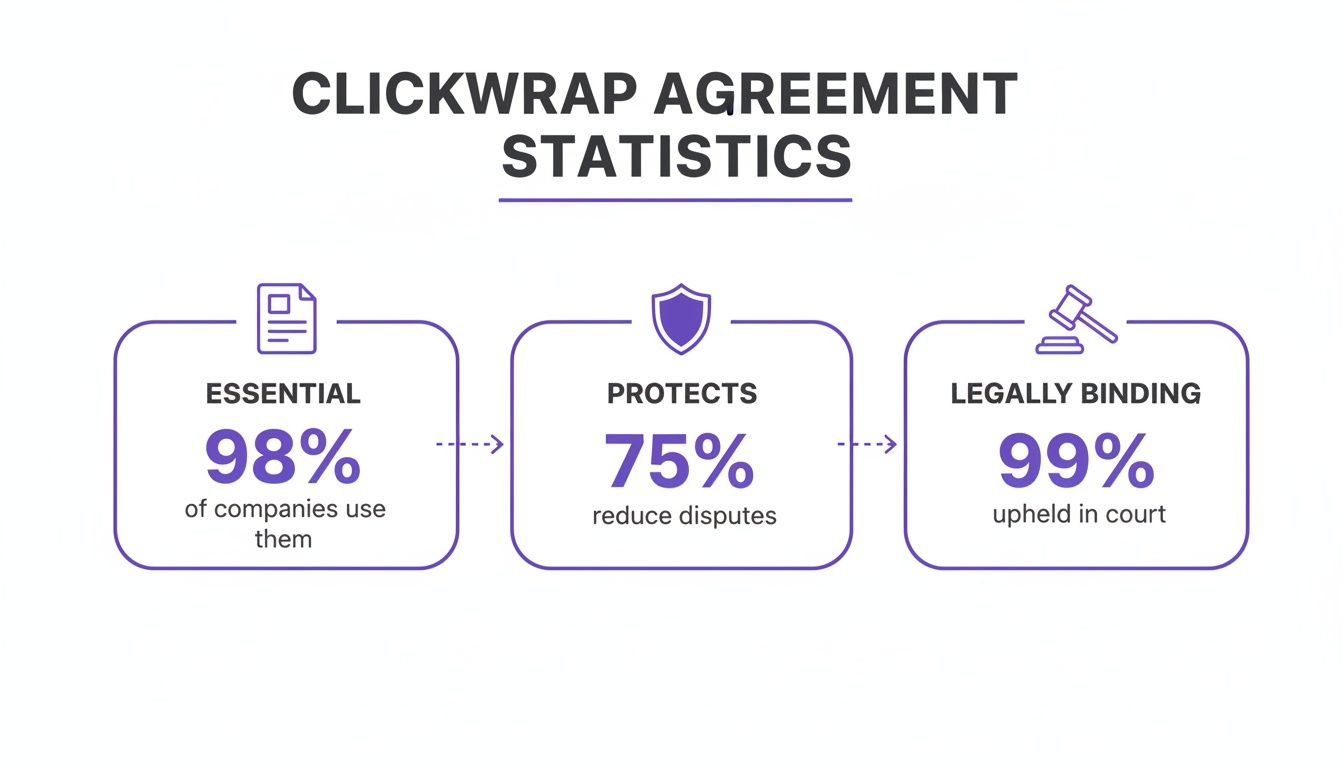
The data is clear: these agreements aren't just a formality. They're a fundamental part of a smart legal and operational strategy.
Your Digital Evidence Locker
For any business, but especially those in regulated fields like healthcare or professional services, proving consent isn't just a good idea—it's non-negotiable. This is where having a rock-solid digital signing solution is so critical.
A clickwrap agreement is only as strong as the evidence you have to back it up. If you can’t prove who clicked, when they clicked, and exactly what they agreed to, your agreement is on shaky ground.
That’s where BoloSign comes in. Our AI-powered platform is built to capture a detailed, unchangeable audit trail for every single agreement. This isn't just a simple log; it records every single interaction with the document, including:
- Who viewed the document
- When they signed it
- Their IP address and location
- A precise timestamp for every action
This comprehensive record is the hard evidence you need to prove consent and make sure your agreements are defensible. It’s built-in compliance for your business, securing sensitive data and meeting the tough standards of ESIGN and HIPAA. With BoloSign, every clickwrap agreement you generate is both convenient and legally ironclad.
Crafting an Enforceable Click Wrap Agreement
An enforceable clickwrap agreement is so much more than just slapping an "I Agree" button at the bottom of a page. If you want it to actually stand up in court, it has to be designed with real intention and clarity. It needs to prove your user knew exactly what they were consenting to.
Think of it less like a checkbox and more like a carefully constructed digital handshake—every single element matters.
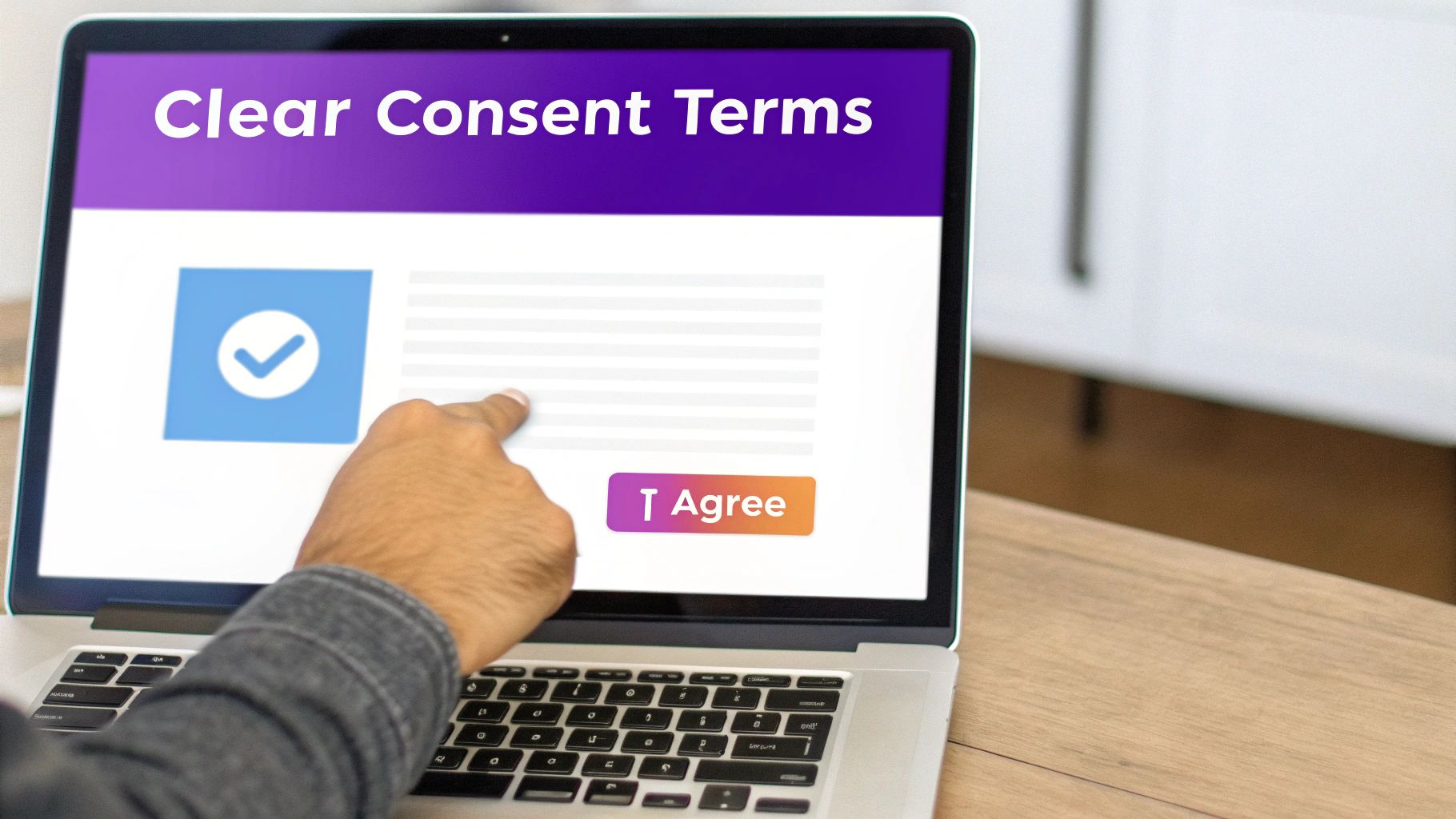
The one principle that courts come back to again and again is reasonable notice. In plain English: did the user have a fair chance to see and understand what they were agreeing to?
Landmark cases like Feldman v. Google have shown that when a user has to take a clear, affirmative action—like clicking a button that explicitly says "Yes, I agree to the above terms and conditions"—the agreement will almost certainly be upheld. On the flip side, cases like Specht v. Netscape prove that if the terms are buried or the consent action is vague, the whole thing falls apart.
The takeaway? Your design and wording aren't just details. They're the very foundation of your contract's legal strength.
The Non-Negotiables of Enforceability
To make sure your clickwrap agreement is built on solid ground, you have to nail a few essential elements. These aren't just "best practices"; they are the criteria a judge will use to decide if your agreement is valid. Getting them right is non-negotiable, whether you’re a logistics company confirming delivery terms or a school managing student enrollment.
Here’s a practical checklist to follow:
Provide Conspicuous Notice: You have to tell the user they're entering a contract. No hiding it in the fine print. A bolded statement like, "By clicking 'Create Account,' you agree to our Terms of Service and Privacy Policy," placed right above the button, is a must.
Ensure Easy Access to Terms: The full terms and conditions must be immediately and easily accessible. The standard way is to hyperlink directly to the documents from the notice text. A user should never have to go hunting for them.
Use Unambiguous Consent Language: The button’s text should leave zero room for doubt. Vague words like "Continue" or "Download" have been shot down in court. You need explicit language like "I Agree," "I Accept," or "Yes, I consent to the terms."
Require Affirmative Assent: The user must take an active step. Pre-checked boxes are a huge red flag and are often invalidated by courts. They have to physically check the box or click the button themselves. This demonstrates their intent to be bound by the terms.
A key takeaway from decades of digital contract law is that clarity trumps everything. If a reasonable person wouldn't understand they were agreeing to a contract, then no contract was formed. The burden of proof is on the business to show they made it obvious.
Automating Best Practices for Maximum Protection
Trying to manually ensure every one of these elements is perfect across all your customer touchpoints is a massive headache, especially as your business grows. One poorly designed form or a single broken link can put your entire agreement at risk.
This is where a dedicated digital signing solution becomes a necessity, not a luxury.
BoloSign is designed to take the guesswork out of compliance. Our platform helps you build enforceable agreements by automating these critical best practices. When you create a template for a new client contract or a vendor agreement, you can be confident the consent language is standardized and legally sound every single time.
For example, a real estate agency can use BoloSign to set up a template for an exclusive listing agreement. That template can be structured to present the terms clearly, require a specific click-to-sign action, and automatically generate a detailed audit trail that logs every step. This gives you concrete proof that the client had reasonable notice and gave their affirmative consent.
With BoloSign, you can create, send, and manage your agreements with total confidence. The platform ensures every document adheres to compliance standards like ESIGN and GDPR, giving you an ironclad record of consent. And because we offer unlimited documents, templates, and team members for one fixed price, you get enterprise-grade protection that’s 90% more affordable than other tools.
Stop worrying about legal loopholes and start building agreements you can trust. Start a 7-day free trial to see how BoloSign can secure your business.
Designing for High Acceptance Rates
Let’s be honest: a legally perfect click wrap agreement is completely useless if nobody signs it. When users get frustrated or confused by the process, they simply walk away. While getting the legal language right is obviously critical, it’s the design and user experience that actually seals the deal. A clunky, intimidating signing process is a major roadblock that can lose you customers or new hires right at the finish line.
The real goal here is to make saying "yes" feel as natural and easy as possible, without ever compromising your legal standing. It’s all about looking at the process from the user's point of view and removing any friction. For sales teams, a smooth signing experience means closing deals faster. For HR, it sets a professional, welcoming tone from day one.
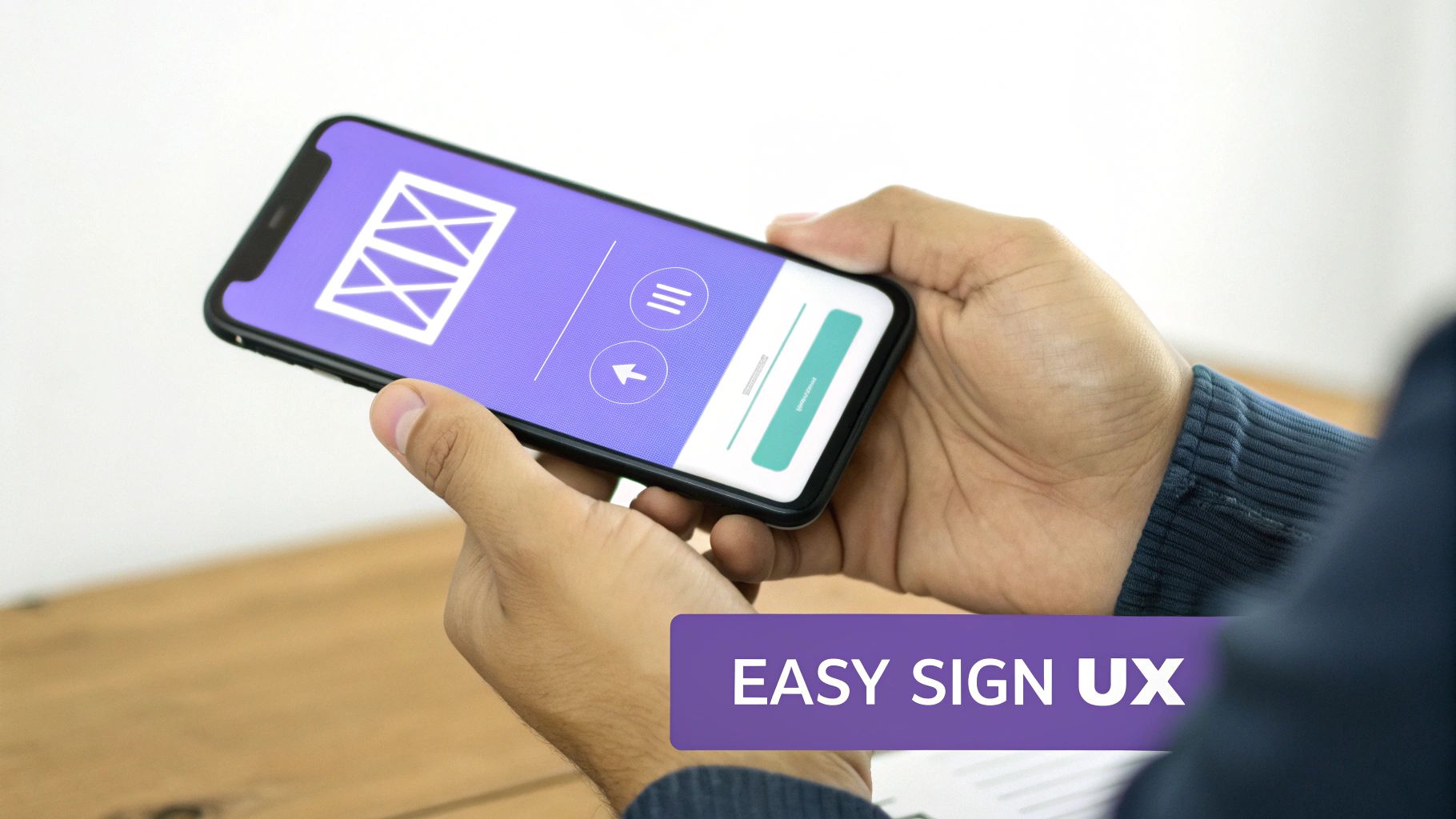
Balancing User Experience with Legal Rigor
Getting high acceptance rates is a classic balancing act. You have to present your terms clearly and get unambiguous consent, but you also need to avoid scaring users off with a wall of dense legal text. The trick is to design an interface that builds trust and gently guides them toward completion.
Clickwrap agreements already have a great track record, often hitting acceptance rates between 85% and 95% under the right conditions. But in the real world, things like confusing layouts or overly long terms can easily push those numbers down to 70-80%. A few thoughtful tweaks—like providing clear summaries and ensuring it works on a phone—can boost completion by 20-30%. That’s a lot of abandoned deals turned into signed agreements.
Core Principles for a High-Converting Design
To build a frictionless acceptance process, focus on these fundamental design principles. Each one is aimed at making the user’s job easier and increasing clarity, so they can agree with confidence.
Mobile-First Responsiveness: A huge portion of agreements are now signed on phones. Your clickwrap design absolutely must be responsive, with readable text and easy-to-tap buttons on any screen. Think about a delivery driver confirming a shipment or a new hire finishing paperwork on their commute—the experience has to be seamless.
Concise Term Summaries: While the full legal terms must be available, presenting a short, plain-language summary upfront can do wonders for user anxiety. Just a few bullet points highlighting the most important clauses on payments, data privacy, or cancellations make the whole thing feel far less intimidating.
Clear, Action-Oriented Calls-to-Action (CTAs): The words on the button matter. Ditch generic terms like "Submit" and use direct, unambiguous language like "I Agree to the Terms" or "Accept and Continue." This reinforces that the user is making a conscious choice to give their consent.
The best clickwrap designs don't just ask for a signature; they guide the user through a process that feels clear and transparent. When you prioritize ease of use, you’re not just improving acceptance rates—you’re building trust from the very first interaction.
Turning Design into Action with the Right Tools
Trying to implement these design principles consistently across every single agreement can be a real headache. This is where a modern contract automation platform becomes a game-changer. Instead of hoping for the best, you can use a tool to standardize a professional and frictionless signing experience for every user.
BoloSign is built specifically to create these kinds of intuitive workflows. Our platform lets you design professional, mobile-friendly signing experiences that look great on any device. With our reusable templates, you can ensure every contract—from a sales agreement for a consulting firm to a patient intake form at a clinic—follows best practices for high acceptance.
The platform comes packed with powerful eSignature features designed to make the whole process smoother. By combining a user-friendly interface with smart automation, BoloSign helps you lock in agreements faster, turning potential drop-off points into completed contracts. Better yet, it does all this at a fixed price that’s 90% more affordable than the big-name tools.
Making It Happen: Implementing Clickwrap Agreements with BoloSign
Knowing the legal theory behind a clickwrap agreement is one thing. Actually putting a secure, enforceable one in place for your business? That's what really matters. The goal is to get from a legal concept to a live contract with as little friction as possible. This is exactly where a dedicated platform can turn a complex legal task into a simple, automated workflow.
With BoloSign, you can build and launch a compliant clickwrap process in just a few steps. The entire system is designed to be fast and intuitive, letting you focus on your business while we handle the technical and compliance heavy lifting.
From PDF to Deployed Agreement in Minutes
You don't need to start from scratch or hire a developer. Your journey begins with the documents you already have.
- Upload Your PDF: Just take your standard PDF contract, terms of service, or any other agreement and upload it straight into the BoloSign platform.
- Create a Reusable Template: In a few clicks, that static PDF becomes a smart, reusable template. You can easily add fields for names, dates, and—most importantly—a legally binding signature block.
- Deploy and Send: Send the agreement out to one person or a whole list of recipients with a customized email. They'll get a professional, easy-to-use link to review and sign the document on any device.
- Track Everything: From your dashboard, you can monitor the entire process in real-time. See exactly who has opened, viewed, and signed your agreement, giving you complete visibility into your contract pipeline.
This simple workflow is a game-changer for businesses that need to move fast. Imagine a professional services firm sending a standard agreement to a new client and getting it signed and returned in less than an hour. That's how you shorten a sales cycle.
Supercharge Your Workflows with Automation
Real efficiency kicks in when your tools start talking to each other. BoloSign’s AI-powered automation and powerful integrations create a seamless flow of information, which means no more manual data entry and a much lower risk of human error. This is how you scale your operations without scaling your admin team.
A perfect example is our integration with Google Forms. A staffing agency can add a signature to a Google Form they use for candidate applications. This lets them collect all the necessary info and get a legally binding agreement to their terms in one single step. No more chasing down separate documents or juggling fragmented processes.
On top of that, you can connect BoloSign to the tools you already use every day:
- Zapier, Make, and Pabbly: Trigger automated actions in thousands of other apps the moment an agreement is signed.
- Google Drive: Automatically save completed contracts to a specific folder, keeping everything secure and organized.
- CRMs (HubSpot, Salesforce): Instantly update a contact record in your CRM as soon as a deal is signed, so your sales team is always in the loop.
This isn't just about speed; it's about building an intelligent, secure, and automated document workflow.
Unlocking Affordable and Compliant Growth
The move to digital agreements is happening fast. The eSignature market, a key piece of clickwrap technology, was valued at $1.53 billion and is expected to explode to $13.4 billion by 2030. This incredible growth shows just how urgently businesses need paperless, secure solutions, especially in regulated fields. For small businesses, finding a tool that is both compliant and affordable is critical to staying competitive. You can see more stats on this rapidly expanding market at ExplodingTopics.com.
This is where BoloSign really shines. Many eSignature tools use a per-user or per-envelope pricing model that basically penalizes you for growing. We think cost should never be a barrier to security and efficiency.
BoloSign offers a simple, fixed-price model that includes unlimited documents, unlimited templates, and unlimited team members. This makes our platform up to 90% more affordable than traditional tools, giving you predictable costs and limitless potential to scale.
Whether you're onboarding new employees, closing sales deals, or getting client approvals, you get enterprise-grade compliance with standards like ESIGN, eIDAS, HIPAA, and GDPR—all without the enterprise price tag.
Ready to see how a faster, more secure, and cost-effective digital signing solution can change your business? Start your 7-day free trial and see the power of streamlined agreements for yourself.
Keeping Your Agreements Secure and Compliant Around the World
For any business today, compliance isn't just about checking a box—it's the very foundation of trust. This is especially true if you operate in sensitive industries or have customers across the globe. A solid clickwrap agreement process, backed by a secure platform, is your first line of defense in meeting the world's toughest legal standards. It’s how you prove consent and protect data, whether you're serving your local community or an international one.
When your customers are scattered across different regions like the US, Canada, Australia, or the UAE, you're juggling more than one set of rules. A single transaction might need to satisfy multiple legal frameworks at the same time. This is where a compliant digital signing solution is no longer a "nice-to-have"—it's an absolute necessity that turns legal headaches into a smooth, automated process.
A Plain-English Guide to Key Global Regulations
Navigating the alphabet soup of compliance standards can feel overwhelming. But at their core, they all share a common goal: protecting consumer data and ensuring consent is crystal clear. A well-designed clickwrap process helps you nail the core requirements of these critical laws.
- ESIGN and UETA (United States): These two acts are the bedrock of electronic contracting in the U.S. They give electronic signatures the same legal force as a wet-ink signature, as long as you can prove the signer’s intent and keep a secure record of the transaction.
- eIDAS (European Union): Think of this as the EU's rulebook for electronic trust services. It creates a predictable legal framework for eSignatures across all member states, ensuring a contract signed digitally in Spain is just as valid in Germany.
- GDPR (European Union): The General Data Protection Regulation is all about data privacy. It demands explicit, unambiguous consent before you process someone's data. A clickwrap agreement provides the clear, affirmative "I agree" action needed to prove you have that consent.
- HIPAA (United States): For anyone in healthcare, the Health Insurance Portability and Accountability Act is non-negotiable. It requires ironclad safeguards for protected health information (PHI). Any digital signing solution used must have powerful security controls and detailed audit trails to stay compliant.
Imagine a U.S.-based telehealth provider treating a patient living in France. They have to navigate both HIPAA and GDPR. The patient intake form, signed with a clickwrap agreement, needs to get consent for medical treatment under U.S. law while also getting explicit permission for data processing under GDPR. This juggling act is only possible with a platform built for cross-border compliance.
Enterprise-Grade Security for Every Business
Meeting these standards isn't just about having the right legal text. It’s about the technology underneath. You need a platform built on a rock-solid security foundation to protect both your business and your customers.
BoloSign delivers this peace of mind with enterprise-grade security features and certifications that are recognized globally, including:
- SOC 2: This certification verifies that our systems have strict controls in place to protect customer data across five key areas: security, availability, processing integrity, confidentiality, and privacy.
- ISO 27001: This is the international gold standard for information security management. It confirms we take a systematic and secure approach to managing sensitive company and customer information.
Combined with our AI-powered contract automation, these security measures ensure every agreement is locked into a secure, compliant workflow. Our comprehensive audit trail captures every single interaction with a document—from the moment it's viewed to the final signature—creating an unchangeable record that stands up in any court. This gives you the confidence that every agreement is secure and compliant, no matter how simple or complex.
With BoloSign, you get this top-tier security and compliance without the enterprise price tag. Our platform is 90% more affordable than traditional tools, giving you unlimited documents, team members, and templates for one fixed price.
Ready to secure your agreements and meet global compliance standards without the hassle? Start a 7-day free trial to experience a smarter, safer way to manage your contracts.
Common Questions About Clickwrap Agreements
You've got questions, and we've got answers. Let's tackle some of the most common queries about clickwrap agreements.
Why Do So Many Companies Rely on Clickwrap Agreements?
Simple: they work. A clickwrap agreement gets the user to physically click “I Agree,” which creates a clear, undeniable record of their consent. In the world of online contracts, that's as good as gold.
Explicit consent is the gold standard for creating enforceable online contracts, and clickwrap delivers just that.
Are Clickwrap Agreements Legally Binding Globally?
Yes, for the most part. The world has largely standardized around the idea that active consent is what makes an electronic agreement valid. Major laws like the ESIGN Act in the US, eIDAS in the EU, Canada’s PIPEDA, and Australia’s Electronic Transactions Act all recognize this principle.
This is where a robust platform comes in handy. Tools like BoloSign don't just get a click; they capture a detailed audit trail—complete with timestamps, IP addresses, and how the signer was authenticated—to build a rock-solid case for consent, no matter where your user is.
What Is the Main Difference Between Clickwrap and Browsewrap?
It all boils down to explicit versus implied consent. Think of it like this:
- Clickwrap is like actively signing a document. The user performs a clear action ("I Agree") that is impossible to miss.
- Browsewrap is more like a sign on the wall at a swimming pool. The rules are posted, and by choosing to swim, you're implying you agree to them.
As you can imagine, one of these is much easier to prove in court. A detailed audit log from a clickwrap action will always beat the flimsy "they should have known" argument of browsewrap, which often fails because the notice wasn't obvious enough.
How Can I Make My Clickwrap Agreement More Enforceable?
Making your clickwrap agreement bulletproof isn't hard if you follow a few best practices. Here’s what you need to do:
- Give Clear Notice: Don't hide the link to your terms. Make it visible and place it right next to the consent action.
- Use Unambiguous Language: The button shouldn't say "Continue" or "Let's Go." Use clear, direct text like “I Accept the Terms” or “I Agree.”
- Ensure Readability: Your terms need to be easy to read on any device, from a giant monitor to a tiny smartphone screen. No one should have to pinch and zoom to read the fine print.
- Keep Meticulous Records: This is where a contract automation tool becomes your best friend. It can embed signature fields and, more importantly, track every version of your agreement so you know exactly what terms a user agreed to and when.
For example, you can easily add a signature to a Google Form to capture consent or check out our full suite of eSignature features to build custom templates. You can even use our contract automation guide to connect with tools like Zapier and cut down on manual work.
Following these steps locks in clear consent every single time. And platforms like BoloSign are designed to handle all of this for you automatically. Ready to experience the platform firsthand? Start your 7-day free trial to see how BoloSign makes eSignatures simple, affordable, and secure.

Paresh Deshmukh
Co-Founder, BoloForms
17 Apr, 2026
Take a Look at Our Featured Articles
These articles will guide you on how to simplify office work, boost your efficiency, and concentrate on expanding your business.